Neglecting battery care triggers a cascade of operational failures: a battery rated for 70 km suddenly delivers just 35 km, forcing mid-day charging breaks that eat into delivery windows. Overheating warnings flash during peak hours. Capacity fade accelerates until the scooter becomes unusable for commercial work—often within 6–12 months for high-frequency riders.
This guide covers why battery maintenance is non-negotiable for gig workers, the four types of maintenance that apply to electric scooters, warning signs that predict failure, and a practical schedule aligned with delivery workloads. For riders who want reliable range without the maintenance burden, we'll show how fleet-managed rentals eliminate battery ownership entirely.
Key Takeaways
- Lithium-ion batteries deliver 300–1,000 charge cycles; good habits can push lifespan from 2 years to 4+
- Follow the 20/80 rule (charge between 20%–80%), avoid extreme heat, use OEM chargers only, and never store in deeply discharged state
- Four maintenance tiers exist — routine, corrective, predictive, and major overhaul — with replacements costing ₹45,000–₹1,20,000
- Watch for reduced range, overheating, power drops, or swelling — early detection prevents total battery failure
- Gig workers face 5–6x faster battery wear than casual riders, making swappable-battery rentals a cost-effective alternative
Why Electric Scooter Battery Maintenance Matters
A lithium-ion battery degrades with every charge cycle. The rate of degradation depends almost entirely on how you treat it. Poor maintenance doesn't just reduce performance; it inflates total cost of ownership through premature replacements and lost delivery income during downtime.
Performance Impact: Capacity Fade Equals Range Loss
When battery capacity drops to 80%, your range drops proportionally to 80% of original. A scooter rated for 70 km now delivers just 56 km—forcing more frequent charging stops that disrupt delivery schedules.
The degradation timeline varies significantly by usage pattern:
| Depth of Discharge | NMC Cycles to 70% Capacity | LFP Cycles to 70% Capacity |
|---|---|---|
| 100% DoD (full drain) | ~300 | ~600 |
| 80% DoD | ~400 | ~900 |
| 60% DoD | ~600 | ~1,500 |
| 40% DoD | ~1,000 | ~3,000 |
| 20% DoD | ~2,000 | ~9,000 |
Source: Battery University BU-808
Most Indian scooters use NMC cells. If you routinely drain to 0% and charge to 100%, you could hit the 70% capacity threshold in just 300 cycles. For a gig worker completing 3–5 full cycles daily, that's 60–100 days of work, or roughly four months at most.
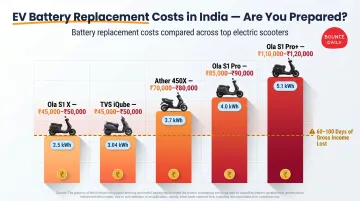
Financial Stakes: Replacement Costs Range From ₹45,000 to ₹1,20,000
Battery replacement represents a five- to six-figure expense that many delivery partners don't budget for:
| Model | Battery Capacity | Replacement Cost (₹) |
|---|---|---|
| Ola S1 X (Gen 3) | 2 kWh | 45,000–50,000 |
| TVS iQube | 2.2 kWh | 45,000–50,000 |
| Ather 450X | 3.7 kWh | 70,000–80,000 |
| Ola S1 Pro (Gen 3) | 4 kWh | 85,000–90,000 |
| Ola S1 Pro+ (Gen 3) | 5.2 kWh | 1,10,000–1,20,000 |
The average cost per kWh is ₹15,000–₹22,000. For a delivery partner earning ₹600–₹1,000 per day, a ₹60,000 battery replacement wipes out 60–100 days of gross income.
The pressure compounds for gig workers specifically. Commercial delivery scooters travel 5–6 times more daily than personal ones and operate 15–20 hours per day, according to Bolt.Earth's 2026 analysis. What takes a casual rider 12 months to experience hits a delivery partner in 8–10 weeks.
Types of Electric Scooter Battery Maintenance
Battery maintenance isn't a single task—it spans four categories, each triggered by different conditions and carrying different costs. Understanding which applies when prevents both neglect and unnecessary spending.
Routine / Preventive Maintenance
Preventive maintenance consists of daily habits that cost nothing but deliver the highest return on effort:
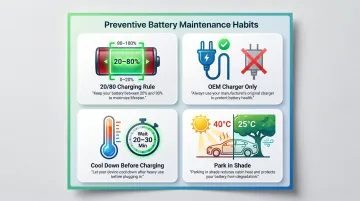
- Charge between 20%–80% (the "20/80 rule")—cycling within this range can deliver 3,000 cycles at 90% capacity retention, versus just 300 cycles with full discharge (Battery University)
- Use only the manufacturer-approved charger—generic chargers lack proper voltage regulation and cell balancing
- Wait 20–30 minutes before charging after long rides—charging a hot battery accelerates degradation
- Park in shade—direct sun exposure in Bengaluru's summer heat (35°C+) accelerates capacity loss dramatically
Temperature Is the Silent Battery Killer
Storing a fully charged battery at 40°C retains only 65% capacity after one year, versus 96% at 25°C and 40% state of charge. EBL Official research confirms that exposure to 40°C causes up to 35% capacity loss in one year.
Preventive maintenance requires no technical skill. Done consistently, these habits extend battery lifespan more than any repair ever will.
Corrective / Reactive Maintenance
Corrective maintenance addresses visible failures after they occur:
Triggers:
- Visible swelling of battery casing (safety hazard requiring immediate professional attention)
- Sudden range loss (e.g., 70 km rated range drops to 35 km)
- BMS error codes on display
- Battery refuses to charge past a low percentage
The risk of relying entirely on reactive maintenance: by the time symptoms appear, internal cell damage has already occurred and may be irreversible. Corrective repair or partial cell replacement costs far more than preventive care ever would.
Predictive / Condition-Based Maintenance
Modern scooters with Battery Management Systems (BMS) enable data-driven maintenance before failure occurs. Ather Energy's BMS monitors 46+ onboard sensors in real-time, tracking:
- Cell-level voltage and temperature
- State of charge with high-accuracy real-time estimation
- Charge cycle count
- Capacity trends over time
Individual owners can act on this data without any technical background:
- Track how range changes week-to-week
- Schedule professional battery health checks annually (every 6 months for heavy users)
- Monitor BMS readings via companion apps when available
At fleet scale, this becomes even more powerful—a fleet manager can catch degradation patterns across dozens of vehicles before any single one fails.
Major / Overhaul Maintenance
Major battery maintenance involves full battery pack replacement, individual cell replacement by certified technicians, or BMS recalibration—typically required when capacity drops below 70–80% of original.
When Required:
- After 500–1,000 full charge cycles
- When corrective measures no longer restore performance
For gig workers completing 3–5 full cycles daily, this threshold arrives within 6–12 months of ownership—making battery overhaul a significant recurring cost for owners but not for those on managed fleet rentals.
Signs Your Electric Scooter Battery Needs Maintenance
Catching these indicators early prevents minor issues from becoming ₹50,000 replacements.
Performance-Based Warning Signs
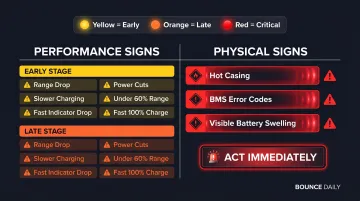
Early Stage:
- Range drops noticeably on full charge (e.g., from 70 km to 45–50 km)
- Charging takes longer than before
- Battery indicator drops faster than expected in the first 10–15 minutes of riding
Late Stage:
- Power cuts during acceleration
- Scooter covers less than 60% of original rated range
- Battery reaches 100% charge unusually fast (indicates reduced cell capacity)
Physical & Behavioral Warning Signs
Immediate Attention Required:
- Battery casing feels warm or hot to the touch even when not charging
- BMS error codes display on screen
- Visible bulging or deformation of the battery pack—this indicates thermal runaway risk and requires immediate professional inspection
Battery University's safety research identifies additional critical warning signs: hissing or popping sounds, electrolyte leakage, or smoke. During thermal runaway, internal temperatures can reach 500°C.
India-Specific Safety Context
These physical signs carry real stakes in the Indian EV market. A DRDO investigation of 12+ electric scooter explosions in India found cell defects in nearly all fire incidents across five manufacturers. Lower-grade materials and faulty battery pack design were the root causes — not rider negligence.
For gig workers logging 8–10 hours daily, this is where rental models change the equation. With Bounce Daily, battery maintenance, quality checks, and swap infrastructure are handled centrally — so you're never the one responsible for catching a failing cell mid-shift.
Electric Scooter Battery Maintenance Schedule
Maintenance frequency depends on how hard you ride. This schedule is built around moderate-to-heavy daily use — the kind typical for gig workers and delivery partners.
Maintenance Frequency Table
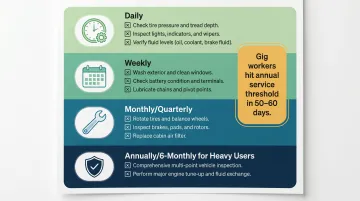
Daily / Per-Use:
- Check charge level before and after each ride
- Avoid charging immediately after long rides
- Confirm no error alerts on display
Weekly:
- Inspect battery casing for swelling or cracks
- Wipe down connectors and charging port with dry cloth
- Verify charging behaviour (time to full charge should be consistent)
Monthly / Quarterly:
- Track range performance against earlier benchmarks to detect capacity fade
- Ensure battery terminals are secure and corrosion-free
- Check BMS readings if app-connected
Annually (or Every 6 Months for Heavy Users):
- Professional battery health evaluation: voltage measurement, cycle count review, capacity retention test
- Consider replacement if capacity has dropped below 75–80% of original
These intervals look manageable on paper — until you do the math on a full-time delivery schedule.
How Fast Gig Workers Hit Service Intervals
Ather Energy recommends professional service every 5,000 km. For a delivery partner riding 80–100 km daily, that interval arrives every 50–60 days, meaning a service visit roughly every two months. Casual commuters covering 15–20 km a day won't hit that same threshold for 8–10 months.
Conclusion
Electric scooter battery maintenance is non-negotiable for daily riders and gig workers. Neglecting it leads to faster degradation, unreliable performance during peak delivery hours, and steep replacement costs that can exceed ₹60,000. A structured maintenance approach—preventive first, predictive where possible—protects both the asset and the income stream it supports.
For riders who'd rather skip all of that—no charge cycle tracking, no capacity monitoring, no ₹50,000 replacement budgets—fleet-managed EV rentals remove battery ownership from the picture entirely.
The Bounce Daily Alternative
Bounce Daily handles maintenance and battery upkeep across its entire fleet. Delivery partners focus on completing deliveries, not worrying about charge cycles or degraded cells. The service offers two variants tailored for gig work:
High Speed Variant:
- 55 km/h top speed, 70 km range
- Chargeable and swappable battery
- Requires driving licence
Low Speed Variant:
- 25 km/h top speed, 85 km range
- Swappable battery only
- driving licence assistance (available for a nominal ₹200-₹230 fee) available at our hub
The fleet has collectively driven 30M+ kilometres and avoided 10,000+ tons of CO2 emissions.
Zero Battery Hassle, Maximum Uptime
For riders ready to skip the hassle, Bounce Daily's rental model offers a straightforward way to ride electric in Bengaluru—no maintenance overhead, no surprise battery costs, and uptime handled entirely by the fleet operator.
Frequently Asked Questions
What is the 20/80 rule in battery?
The 20/80 rule recommends keeping a lithium-ion battery charged between 20% and 80% at all times, avoiding both full discharges and 100% charges. Operating outside this range puts additional stress on battery cells and accelerates long-term capacity loss, reducing overall lifespan.
How often should an electric scooter battery be replaced?
Lithium-ion batteries typically last 500–1,000 charge cycles, translating to roughly 2–4 years for casual riders. For gig workers completing multiple full charge cycles daily, replacement may be needed in under a year once capacity drops below 75–80% of the original.
What happens if I leave my electric scooter battery uncharged for a long time?
Leaving a lithium-ion battery in a deeply discharged state for weeks causes permanent internal damage that reduces capacity. For storage periods beyond 2–4 weeks, maintain around 50% charge and recharge periodically to prevent irreversible damage.
Does heat affect electric scooter battery life in Indian conditions?
High ambient temperatures common in Indian cities—especially during summer months—accelerate lithium-ion battery degradation by increasing the rate of chemical breakdown inside cells. Storing and charging in shaded, ventilated spaces is critical in tropical climates where temperatures regularly exceed 35°C.
What is the difference between a swappable and a chargeable electric scooter battery?
A chargeable battery is charged while installed in the scooter, requiring downtime during charging. A swappable battery can be exchanged at a swap station for a fully charged unit in 2–5 minutes, eliminating charging wait time—a significant advantage for delivery partners maximizing ride time.
Do riders who rent electric scooters need to manage battery maintenance themselves?
With a fleet-managed rental service like Bounce Daily, Bounce Daily handles battery maintenance, health monitoring, and replacement directly. Renters simply ride and return the scooter, with no responsibility for charge cycle tracking, cell degradation monitoring, or replacement costs.