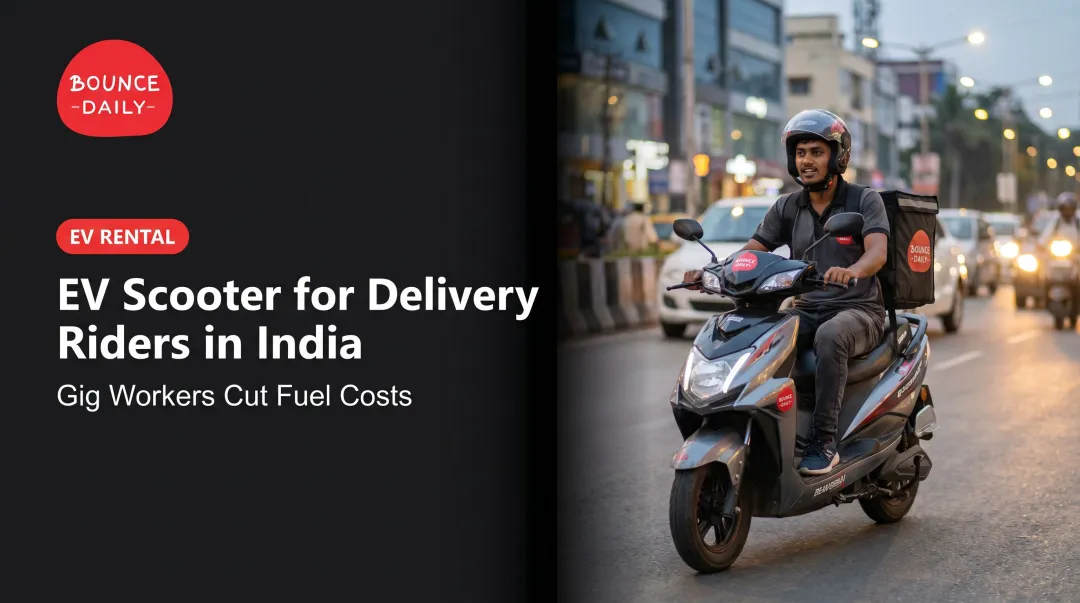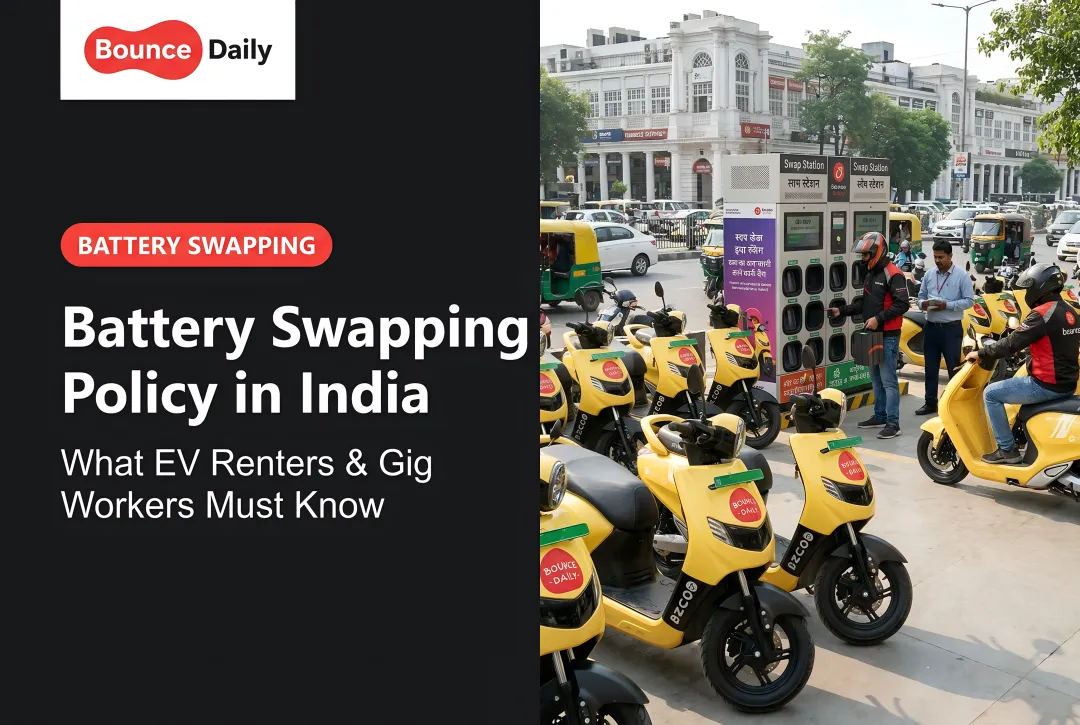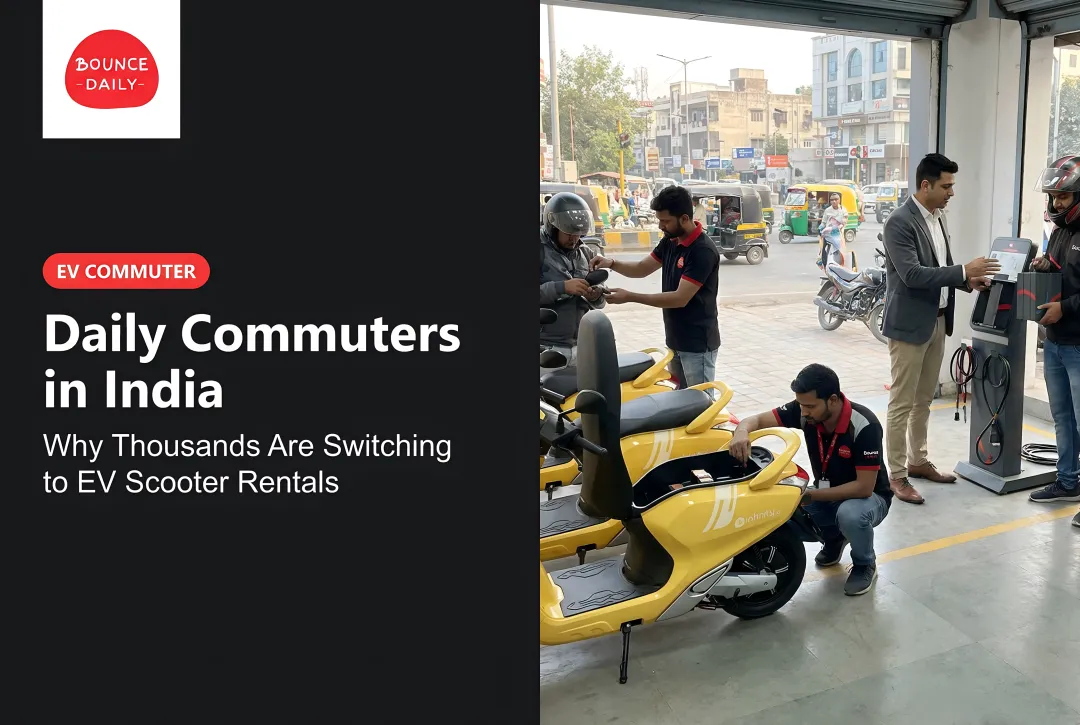
India's gig economy has exploded to an estimated 14.7 million platform-based workers as of 2024, with food delivery alone employing approximately 1.37 million workers. Yet the primary tool these workers depend on—the petrol two-wheeler—is quietly eroding their income through fuel costs, maintenance bills, and EMIs. This blog explores why a growing number of delivery partners are abandoning ownership altogether and switching to electric scooter rentals, and whether the switch delivers real financial and operational benefits.
Key Takeaways
- Fuel and maintenance costs claim up to 37.5% of delivery workers' monthly income
- EV rentals remove the ownership burden: no down payment, no EMI, and no unexpected repair costs
- Daily rental pricing scales with actual working days, protecting earnings during slow periods
- Electric motors deliver consistent efficiency in stop-and-go traffic where petrol bikes struggle most
- Switching to EV rentals lowers running costs and keeps ₹3,000–₹5,000 more in riders' pockets each month
The Real Cost of Urban Commuting for Gig Workers
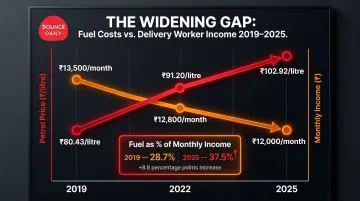
Delivery workers using personal petrol bikes face a compounding financial trap. Monthly income is variable—dependent on order volume, platform policies, and weather—yet vehicle costs remain fixed. An NCAER survey of 924 food delivery workers across 28 Indian cities revealed that fuel costs rose from 28.7% of income in 2019 to 37.5% in 2022, while real monthly earnings dropped from ₹13,500 to ₹12,000. That translates to ₹3,870-4,500 spent monthly just on petrol.
The Hidden Time Tax
Every hour at a mechanic's shop is an hour without earnings. For riders covering 80-120 km daily (2,400-3,600 km monthly), service intervals manufacturers recommend every 5,000-6,000 km come around monthly, not quarterly. At this intensity of use, costs stack up fast:
- Service visits: ₹450–1,200 each
- Oil changes: ₹300–550 per change
- Tyre replacements: ₹1,000–3,000 per tyre
- Total monthly maintenance: ₹800–2,000+
And that's before an unexpected breakdown pulls a rider off the road mid-shift.
Stop-and-Go Traffic: The Efficiency Killer
Urban delivery routes are the worst-case scenario for petrol scooters. Autocar India tested the Honda Activa 110 in Mumbai traffic and recorded 54.4 km/litre in real-world city conditions—below the advertised figure, and likely even lower for delivery riders carrying loads through dense congestion.
ICE engines waste up to 70% of fuel energy as heat. They also keep burning fuel while idling at signals, where delivery riders spend a substantial portion of every shift.
The Petrol Price Volatility Trap
Petrol prices in India climbed approximately 30% between 2020 and 2025, from ₹80.43/litre to ₹105.01/litre. As of May 2026, Bengaluru petrol sits at ₹102.92/litre. That kind of swing makes it nearly impossible to forecast monthly expenses or set aside savings.
When platforms control per-delivery payouts, workers have zero say over revenue. Cutting costs is the only lever they can pull — which makes fuel spend the most urgent number on the page.
Why Gig Workers Are Switching to EV Rentals
No Ownership Burden, No Capital Risk
Purchasing even a second-hand 100-125cc scooter requires ₹18,000-55,000 upfront or a loan with monthly EMIs, a risky commitment for workers whose income fluctuates week to week. EV rentals require no down payment and no long-term lock-in. Bounce Daily's rental model, for instance, converts fixed capital costs into manageable daily expenses that scale with actual working days, protecting riders during slow periods or when orders dry up.
Electric Works Better for Delivery Routes
Electric scooters are mechanically superior for urban delivery work. They deliver:
- Instant torque for quick acceleration at every signal
- No gear changes—one less thing to manage in heavy traffic
- Consistent performance regardless of traffic conditions
Electric motors operate at 85-90% energy efficiency, compared to petrol engines' 20-30%. ICE engines waste energy idling at signals; electric motors consume zero power when stationary. Regenerative braking recovers energy during frequent stops—exactly the conditions delivery riders face all day. The result: EV scooters cost approximately ₹2.5 per km to run, versus ₹4.5 per km for petrol bikes.
Zero Maintenance Responsibility
Lower running costs are only part of the picture. In a rental model, servicing, tyre replacements, battery health, and repairs are handled by the operator, not the rider. This eliminates both the cost and the mental burden of upkeep.
For gig workers whose income stops the moment their bike enters a workshop, having a reliable, maintained vehicle available every morning is direct income protection.
"I've never faced issues with the battery. The premium quality makes it way more cost-effective than petrol bikes." — Karanbir Das, delivery partner, Bounce Daily user for over a year
Petrol Bike vs. EV Rental: The Honest Numbers
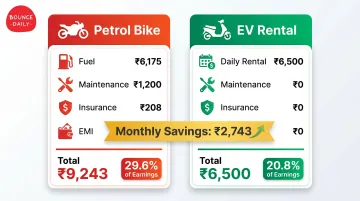
Here's a monthly cost breakdown for a delivery rider covering 90 km/day (2,700 km/month):
Petrol Bike Costs:
- Fuel: 2,700 km ÷ 45 kpl (realistic city mileage) = 60 litres × ₹102.92 = ₹6,175
- Maintenance (servicing, oil changes, wear items): ₹1,200/month (amortized)
- Insurance: ₹2,500/year ÷ 12 = ₹208/month
- EMI or depreciation (₹50,000 scooter, 3-year loan at 12%): ₹1,660/month
- Total monthly cost: ₹9,243
EV Rental (Bounce Daily):
- Daily rental: ₹250/day × 26 working days = ₹6,500/month
- Maintenance: ₹0
- Insurance: ₹0 (included)
- Down payment/EMI: ₹0
- Total monthly cost: ₹6,500
Monthly savings: ₹2,743. That's roughly a week's groceries, a loan repayment installment, or simply more cash staying in your pocket.
That gap looks even sharper when measured against what riders actually take home.
Earnings Retention
If a typical delivery rider earns ₹1,200/day gross (₹31,200/month), vehicle costs represent:
- Petrol bike: 29.6% of gross earnings
- EV rental: 20.8% of gross earnings
The EV rental model allows riders to keep nearly 9% more of what they earn.
Battery & Charging Reality
Range isn't a concern riders need to manage on their own. The High Speed variant (55 km/h, 70 km range) supports both chargeable and swappable batteries, while the Low Speed variant (25 km/h, 85 km range) uses swappable batteries. Either way, riders swap out a depleted battery at a Bounce hub in minutes and get back on the road.
Champalal, a delivery partner, puts it simply: "The rental process is quick and simple. The scooter saves battery and runs efficiently throughout the day."
How EV Scooter Rentals Work for Delivery Partners
Getting started takes minutes — here's how the process works:
Digital Sign-Up
- Download the Bounce Daily app
- Upload your Aadhar card and driving license (required for the High Speed variant)
- Get verified instantly — no paperwork, no waiting
Choose Your Variant
- High Speed (55 km/h, 70 km range): Requires a driving license — best for longer routes and faster urban roads
- Low Speed (25 km/h, 85 km range) — opening up EV access for workers (driving licence assistance (available for a nominal ₹200-₹230 fee) at our hub — visit us or check our app to know more)
Pick Up and Start Earning
Once verified, head to any of Bounce Daily's 6 Bengaluru hubs and ride out the same day. The current fleet covers:
- Locations: Banaswadi, Hoodi, Yelahanka, HSR Layout, JP Nagar, RR Nagar
- Fleet size: 2,300 scooters deployed across hubs
- Included with every rental: tamper-proof batteries, GPS tracking, and insurance
Fleet maintenance is handled centrally, so riders always get a road-ready scooter without dealing with upkeep.### What Riders Are Saying
- Goutam Behera (Delivery Partner): "It's reliable for daily use and operates smoothly."
- Karanbir Das (Delivery Partner): "I've used Bounce scooters for over a year. They're way more cost-effective than petrol bikes and have premium quality."
Beyond Cost: The Bigger Picture
Two-wheelers account for 72% of registered vehicles in India and generate approximately 61% of vehicular carbon monoxide emissions in cities like Delhi. A full transition to zero-emission delivery vehicles could prevent 8,000 tonnes of PM2.5 and 176,000 tonnes of NOx emissions every year.
Bounce Infinity has already avoided over 10,000 tonnes of CO2 through 30 million+ kilometres driven on zero-emission vehicles.
Noise Pollution
Noise pollution in Indian cities currently exceeds safe levels by up to 300%, according to CPCB. Electric scooters run almost silently, cutting the constant noise that gig workers — and everyone around them — deal with every day.
Policy Momentum
Early adopters are getting ahead of mandates that are already locked in:
- Delhi's Motor Vehicle Aggregator scheme requires 100% electrification of two-wheeler delivery fleets by October 2027
- Karnataka's Clean Mobility Policy offers 25% capital subsidies for battery swapping infrastructure (capped at ₹3 lakh for two-wheelers)
- Zomato completed 87 million EV-based deliveries in 2025 with 37,000 EV partners, targeting 100% electric by 2030
The transition is no longer a question of if — the regulations and platform commitments are already in place.
Frequently Asked Questions
What is the urban commute?
The urban commute is the regular daily journey people make within a city between home, work, or service destinations. For gig workers, it's rarely one trip — delivery partners spend most of the day running dozens of short routes across congested city roads.
What are the 5 modes of urban transport?
The five common modes are private vehicles (cars), public transit (buses and metro), two-wheelers (motorcycles and scooters), non-motorised transport (cycling and walking), and shared mobility (rentals and ride-hailing services). Two-wheelers dominate in Indian cities due to affordability and traffic flexibility.
What are the main challenges in urban mobility?
Key challenges include traffic congestion, rising fuel costs, air and noise pollution, inadequate public transport for last-mile connectivity, and the financial burden on daily commuters. These challenges hit gig workers hardest, as they spend many hours daily navigating congested roads.
Is an EV rental worth it for delivery work?
For delivery workers covering high daily distances, EV rentals cut out fuel costs, maintenance expenses, and ownership risk entirely. No petrol bills, no EMI, no repair surprises — which translates directly to higher take-home pay each month.
Do I need a driving license to rent an electric scooter for delivery?
Requirements vary by scooter type. High-speed variants (above 25 km/h) require a valid driving license. Low-speed electric scooters (under 25 km/h) have driving licence assistance (available for a nominal ₹200-₹230 fee) at our hub - visit us or check our app to know more.
How much can gig workers save by switching to an EV rental?
Riders covering 90 km/day can save approximately ₹2,700+ monthly by switching from a petrol bike to an EV rental. Actual savings vary based on daily distance, current petrol prices, and rental plan — but cutting fuel, maintenance, and EMI costs adds up fast.
Thousands of gig workers across Indian cities are already making the switch to EV rentals — lower costs, zero fuel dependency, and a simpler daily routine. If you're running deliveries on a petrol bike, the numbers make a compelling case for trying an EV rental on your next shift.