Introduction
Indians spend over 10 days a year stuck in traffic — second only to South Africa globally. For delivery riders and daily commuters, that's not just frustrating — it's expensive. Rising fuel costs now sit above ₹100 per litre in cities like Bengaluru and Mumbai. The return-to-office wave has pushed average commute times to 59 minutes one-way, up from 51 minutes pre-pandemic.
Those fuel and time costs hit gig workers hardest — delivery riders covering 80–100 km a day on a petrol bike can spend ₹4,000–₹6,000 a month on fuel alone. That's where EV scooter rentals are changing the math. This article breaks down exactly why thousands of Indian commuters and delivery partners are making the switch — and how much they're saving.
Key Takeaways
- EV scooter rentals eliminate upfront costs — no EMI, insurance, or maintenance bills
- Running costs are 85–90% lower than petrol scooters, directly boosting take-home income
- Quick digital onboarding gets riders on the road in minutes, not weeks
- Zero tailpipe emissions cut respiratory exposure for riders stuck in city traffic daily
- Covers 10–30 km daily commutes, the sweet spot for most Indian city workers
What Is an EV Scooter Rental (and Why It's Different from Buying)
EV scooter rental is a pay-per-use or subscription model where commuters access an electric scooter without purchasing it — keeping capital free while getting reliable daily transport. Unlike ownership, riders avoid the ₹70,000–1,20,000 upfront cost, EMI commitments, and the paperwork of RTO registration.
These rentals target urban commutes of 10–30 km per day, matching India's average one-way commute distance of 20 km. For delivery riders covering 60–80 km daily, swappable battery technology extends range without downtime.
The rental model provides consistent, affordable mobility without the burden of ownership. Bounce Daily offers two variants to match different commuter needs:
- Low-speed (25 km/h, 85 km range) — swappable battery (driving licence assistance (available for a nominal ₹200-₹230 fee) at our hub — visit us or check our app to know more)
- High-speed (55 km/h, 70 km range) — license required, chargeable and swappable battery
Both variants include instant digital verification via Aadhaar and DL upload, plus centrally managed fleet maintenance.
Key Advantages of EV Scooter Rentals for Daily Commuters
Significant Cost Savings Over Petrol Alternatives
Cost drives the shift to EV scooter rentals more than any other factor. For gig workers whose earnings depend on minimizing transport expenses, every rupee saved on fuel adds directly to net income.
- No fuel costs: Electricity per km costs ₹0.15–0.35, vs. ₹2.00–2.50/km for petrol scooters (at 45–50 km/L efficiency and ₹102.92/L petrol)
- No EMI payments: Riders avoid ₹3,000–5,000 monthly installments on vehicle loans
- No maintenance bills: Engine oil changes, spark plugs, clutch belts, and air filters cost petrol riders ₹4,000–6,000 annually
- No insurance premiums: Annual two-wheeler insurance runs ₹2,000–4,000, absorbed by the rental operator
Real-world impact for delivery riders:
Field research with delivery workers shows they spend approximately ₹5,100 monthly on fuel, plus ₹800 on maintenance. At 70 km/day coverage, this consumes roughly 32% of gross earnings. Riders using EVs earn approximately 20% more than those on petrol bikes because operating expenses are significantly lower.
Calculation example:
For a delivery rider covering 70 km daily:
- Petrol scooter: 70 km ÷ 45 km/L = 1.55 L × ₹103 = ₹160/day = ₹4,800/month
- EV scooter rental: 70 km × ₹0.25 = ₹17.50/day = ₹525/month (charging cost only)
The savings add up fast. A delivery partner switching from petrol to EV rental saves ₹4,000–4,500 monthly on fuel alone — 15–20% of typical monthly earnings, back in their pocket every single month.
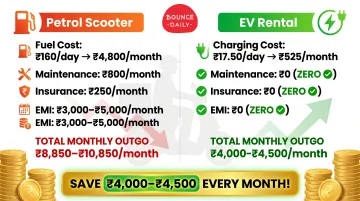
For daily commuters covering 40–100 km/day, particularly delivery workers on e-commerce and food platforms, this cost gap is the single biggest reason to switch.
Zero Ownership Stress and Maximum Operational Flexibility
Beyond cost, EV scooter rentals eliminate the burden of vehicle ownership : no RTO paperwork, no hunting for service centres, no breakdown panic mid-delivery.
- Fleet maintenance, servicing, and uptime handled end-to-end by the operator
- Instant digital onboarding via Aadhar and driving license upload (minutes, not weeks)
- Low-speed EVs under 25 km/h come with driving licence assistance (available for a nominal ₹200-₹230 fee) at our hub — visit us or check our app to know more
- Swappable batteries mean no waiting for a charge: swap and go in minutes
For gig workers whose income depends on uptime, a breakdown isn't just inconvenient — it means lost earnings. Bengaluru's congestion alone caused 7.07 lakh lost productive hours in 2018, translating to ₹7 billion in economic losses.
Flexibility for different rider profiles:
Bounce Daily's two variants address different needs:
- Low-speed (25 km/h, 85 km range): swappable battery only, ideal for shorter urban routes (driving licence assistance (available for a nominal ₹200-₹230 fee) at our hub — visit us or check our app to know more)
- High-speed (55 km/h, 70 km range): Requires license, chargeable and swappable battery, suited for longer daily distances
— a direct health benefit for riders who spend hours daily in traffic, not just an environmental talking point.
Emissions reduction at scale:
| Metric | Figure |
|---|---|
| CO2 prevented per scooter/year | ~1 tonne |
| EV lifetime emissions vs. petrol | 30–40% lower (grid-adjusted) |
| Transport emission drop if 20% of Delhi two-wheelers go electric | 11% |
| Equivalent petrol vehicles removed | 5 lakh |
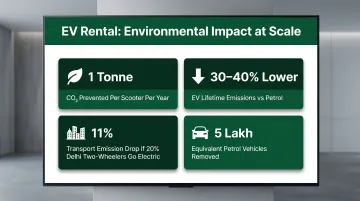
In dense metro corridors like Bengaluru, Delhi, and Mumbai — where two-wheelers make up 60–70% of vehicles — the collective reduction is substantial. For the individual rider, the immediate benefit is simpler: fewer hours breathing exhaust every workday.
What Happens When Commuters Stick to the Old Way
Daily commuters relying on petrol scooters or shared autos face a predictable cycle: rising fuel bills every month, unpredictable maintenance costs, and the anxiety of breakdowns during peak delivery hours.
Without a structured mobility solution, gig workers end up in a trap where transport costs steadily eat into earnings. At ₹5,100 monthly for fuel plus ₹800 for maintenance, a delivery partner loses nearly a third of gross income to vehicle expenses. That leaves little room to save, let alone grow earnings over time.
The broader consequences:
- Increased vehicle emissions in already congested cities (Bengaluru ranks 2nd most congested globally)
- Rising stress from unreliable transport
- Lost productivity from long, expensive commutes
These pressures don't ease on their own. As Indian cities grow denser and fuel prices stay volatile, commuters who don't change course will find the cost and friction of daily travel only getting worse.
How to Get the Most from Your EV Scooter Rental
EV scooter rentals deliver maximum value when treated as a reliable daily mobility tool rather than an occasional fallback — that's where monthly cost savings compound.
Pick the Right Variant for Your Route
- Low-speed (25 km/h, 85 km range): Ideal for urban commutes under 30 km/day (driving licence assistance (available for a nominal ₹200-₹230 fee) at our hub — visit us or check our app to know more)
- High-speed (55 km/h, 70 km range): Built for longer daily distances of 40–80 km, license required
Don't default to the most powerful option. Choose what actually fits your route.
Use Platform Features from Day One
Bounce Daily is built for fast, friction-free onboarding:
- Instant digital verification via Aadhaar and DL upload
- Swappable batteries to eliminate charging downtime
- High-speed variant supports both chargeable and swappable battery options
- Centrally managed maintenance — no servicing hassle for riders
Make It Your Default, Not a Backup
The more consistently you ride, the more you save. Riders who switch fully to EV rentals — rather than falling back on petrol bikes — typically see the sharpest cost difference within the first three months.
Conclusion
For daily commuters and gig workers across India, EV scooter rentals are a direct financial response to rising fuel costs, congested cities, and the hidden burden of vehicle ownership.
The benefits build steadily the longer you stay with it:
- Monthly savings of ₹4,000–5,000 compared to petrol running costs
- Zero ownership stress — no EMIs, no maintenance bills, no insurance renewals
- Cleaner commutes with measurable impact on income, health, and daily reliability
If you're still weighing the switch, treat EV rental as your primary commuting option — not a fallback. Services like Bounce Daily are built for exactly that: daily riders who need a scooter that shows up, runs clean, and doesn't drain earnings before the workday starts.
Frequently Asked Questions
What is the average commute time for workers in India?
Indians spend approximately 59 minutes commuting one-way in urban areas, totalling roughly 2 hours daily. This amounts to over 10 days per year stuck in traffic — the second highest commute time globally after South Africa.
What is the average distance traveled per day in India?
The average home-to-office distance in India is approximately 20 km one-way. Delivery and gig workers often cover 60-100 km per day across multiple trips, with individual delivery distances averaging 3-3.5 km per order.
What are the main modes of urban transport in India?
Two-wheelers (petrol and increasingly electric) dominate short-to-mid distance urban commutes, accounting for 60-70% of traffic in metro cities. Other key modes include walking, bicycles, buses, and trains.
What percentage of people use public transport in India?
Public transport (buses, metro, suburban rail) accounts for approximately 30% modal share in Indian cities with populations above 5 million. Buses lead in Tamil Nadu and trains in West Bengal, but most urban commuters still depend on personal two-wheelers for last-mile travel.
Which city has the longest commute time in India?
NCR (Delhi region) leads at 64 minutes one-way. Bengaluru ranks 2nd most congested city globally, with drivers losing 168 hours annually in rush-hour traffic and an average commute of 54 minutes.
What is considered a normal commuting distance in India?
A typical daily commute for urban Indian workers is 10-20 km one-way, with the national average at 20 km as of 2023. This is the distance range where EV scooter rentals — with 70-85 km of range per charge — cover a full day's commute on a single battery.