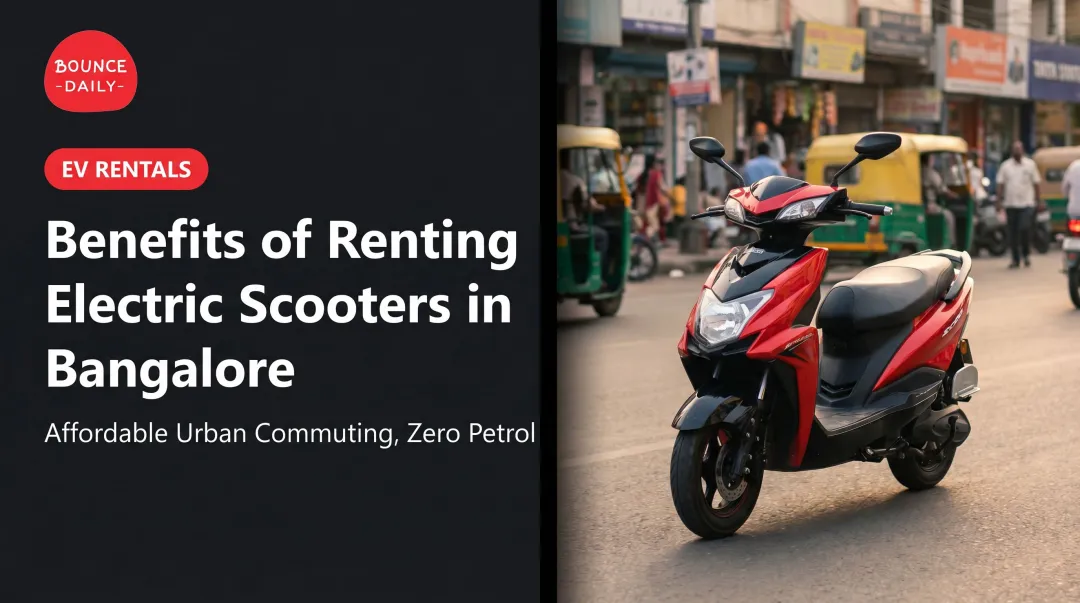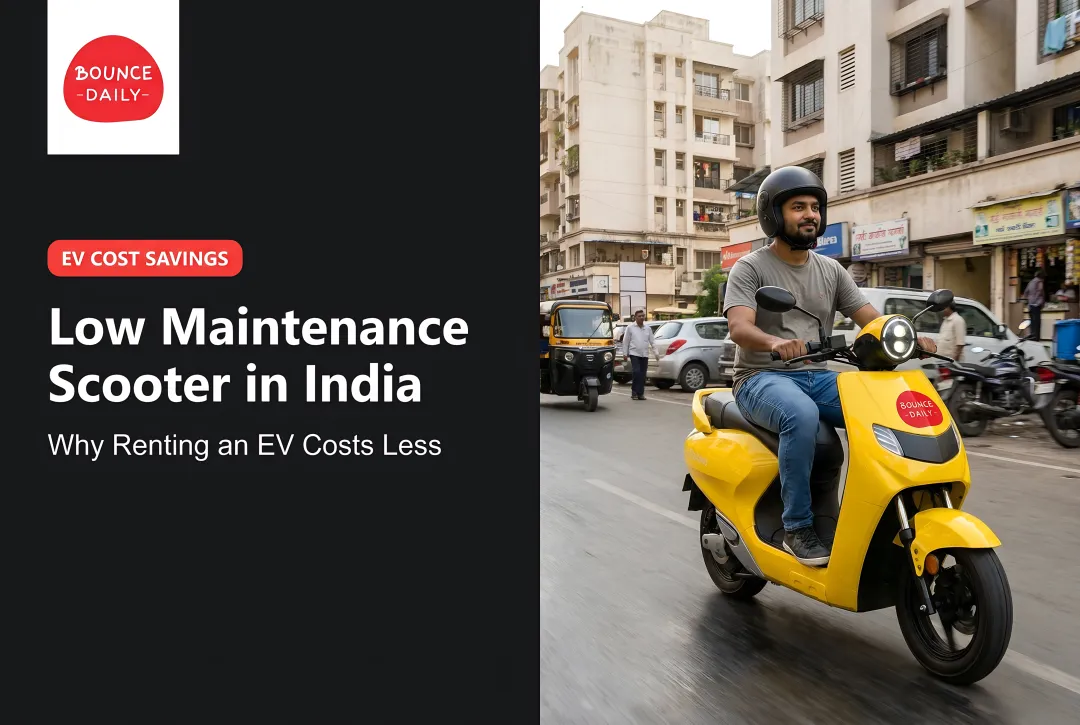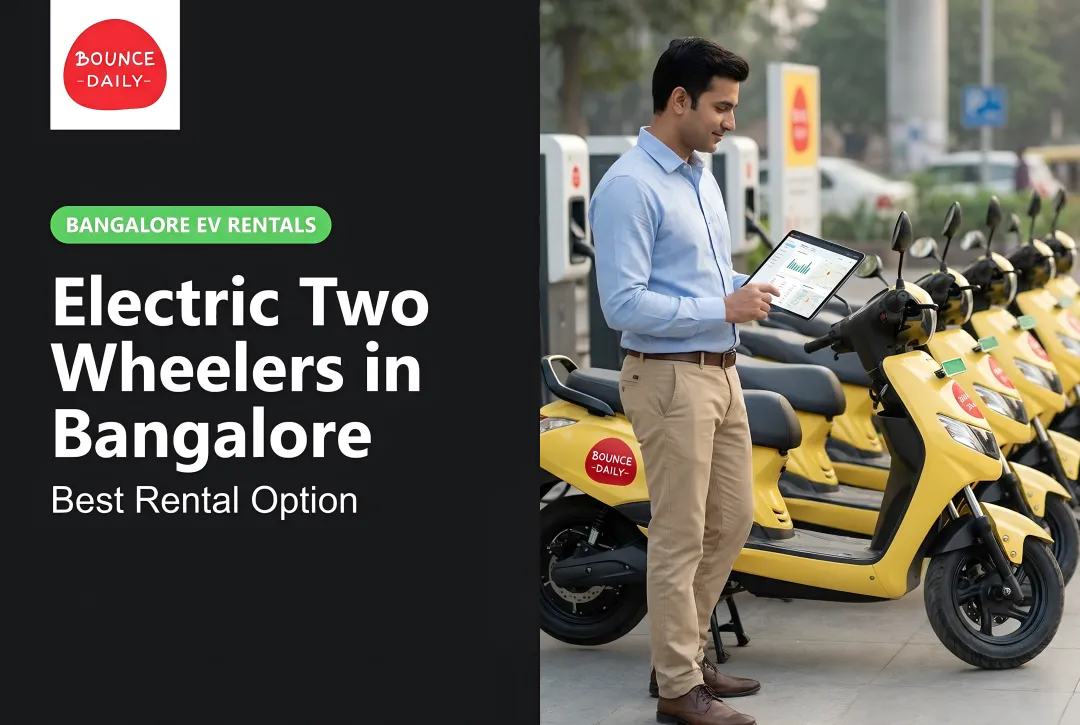
This article breaks down what makes an electric scooter genuinely suited for Indian cities, exposes the true cost of EV ownership that most buyers overlook, and explains why renting — especially through services like Bounce Daily in Bengaluru — is emerging as the smarter financial choice for delivery partners and daily commuters alike.
Key Takeaways
- EVs deliver 6-16x lower running costs than petrol scooters (₹0.15-0.35/km vs. ₹2.00-2.50/km), saving riders over ₹1,00,000 annually
- Buying hides major costs: battery replacement alone runs ₹45,000-₹1,20,000 after 3-5 years — potentially equal to the scooter's depreciated value
- Renting eliminates capital risk, fixed EMIs, battery liability, and maintenance headaches while offering usage flexibility
- For 100 km/day riders, battery-swap rental models protect earning hours and eliminate range anxiety
- Bounce Daily's instant digital onboarding gets riders on the road in Bengaluru with two EV variants — high-speed and low-speed, with driving licence assistance (available for a nominal ₹200-₹230 fee) at our hub. Visit us or check our app to know more.
What Makes an Electric Scooter Good for City Commuting?
Indian city commuting has specific demands that differ sharply from highway or recreational riding. Traffic in cities like Bengaluru moves at an average of just 13.9 km/h during rush hour, with commuters losing 168 hours per year stuck in jams. Most two-wheeler riders in Indian metros cover 6.6-9.8 km per trip, though delivery partners often exceed 100 km daily. Add congested parking, variable road quality, and the need for quick maneuvering, and the requirements become clear.
Key features that matter for city commuting:
- Range matching daily distance: 70-85 km covers most commuter needs; gig workers need swappable battery infrastructure
- Low running cost: Critical for high-mileage users
- Maneuverability: Compact design for lane-splitting and tight parking
- Regenerative braking: Recovers energy in stop-and-go traffic
Why EVs Outperform Petrol Bikes on City Metrics
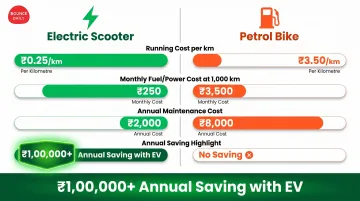
The numbers make a clear case. For a rider covering 1,000 km monthly, the cost gap between EVs and petrol bikes is significant — and it compounds fast.
| Metric | Electric Scooter | Petrol Bike |
|---|---|---|
| Running cost per km | ₹0.15–0.35 | ₹2.00–2.50 |
| Monthly fuel/power cost (1,000 km) | ~₹300 | ~₹2,200 |
| Annual maintenance | ₹500–1,500 | ₹3,000–6,000 |
| Annual saving (60,000 km) | ₹1,00,000+ | — |
Fewer moving parts mean no engine oil changes, no fuel filters, and far less time off the road.
Those savings grow further in stop-and-go city traffic. Regenerative braking systems convert kinetic energy at 60-70% efficiency, recovering up to 20% of energy in dense 15-25 km/h conditions — extending real-world range by 15-20%. Brake pad wear drops 50-70% as a result, cutting maintenance frequency and countering the battery anxiety that worries new EV buyers.
DL Support at Our Hub: Low-Speed EVs Widen Access
India's regulations give low-speed EVs a meaningful edge. Electric scooters with 250W or less motor power and top speeds of 25 km/h or below come with a minimum rider age of 16. driving licence assistance (available for a nominal ₹200-₹230 fee) is available at our hub - visit us or check our app to know more.
This opens city commuting to delivery workers, students, campus residents, and anyone making short urban trips who wants a simple onboarding path — a substantial population segment. Services like Bounce Daily offer a Low Speed variant (25 km/h top speed, 85 km range) specifically designed for this use, with easy access and sufficient range for daily use.
The Hidden Costs of Buying an EV Scooter in India
The sticker price is only the starting point. Registration, insurance, battery degradation, and depreciation stack up fast — and most buyers don't see them coming until the bill arrives.
Upfront Purchase Cost Reality
Mid-range electric scooters in India currently cost ₹80,000-₹1,50,000 on-road. Specific Bengaluru pricing examples:
- Ola S1 Air: ₹89,999 ex-showroom, ₹94,071 on-road
- Ather 450S: ₹1,24,000-₹1,64,000 ex-showroom, ₹1,39,834-₹1,70,090 on-road
- TVS iQube: ₹1,13,245 ex-showroom
For first-time buyers financing through EMI, a ₹1,00,000 scooter at 10-12% interest over three years translates to roughly ₹3,200-₹3,500 monthly — a fixed cost regardless of usage.
Mandatory Ownership Costs Buyers Underestimate
Registration and road tax: Under the Karnataka Motor Vehicles Taxation Amendment Act 2026, electric two-wheelers remain 100% exempt from lifetime road tax, even as EV cars now face 5-10% levies. This preserves a meaningful cost advantage for scooter buyers in Karnataka.
Insurance premiums: Comprehensive coverage runs ₹4,000-₹6,000 in year one. IRDAI mandates a 15% discount on third-party premiums for EVs, but new scooters require mandatory five-year third-party coverage paid upfront — a lump sum most buyers don't budget for.
Battery Degradation: The Cost Bomb Nobody Talks About
Battery replacement is where EV ownership gets genuinely expensive. Most Indian EV scooter batteries degrade significantly after 3-5 years, and the replacement bills reflect it:
| Battery Capacity | Replacement Cost Range | Common Models |
|---|---|---|
| 2-2.2 kWh | ₹45,000-₹50,000 | TVS iQube, Hero Vida base |
| 2.9-3.5 kWh | ₹60,000-₹80,000 | Ather 450S, Bajaj Chetak |
| 4-5.2 kWh | ₹85,000-₹1,20,000 | Ola S1 Pro, TVS iQube ST |
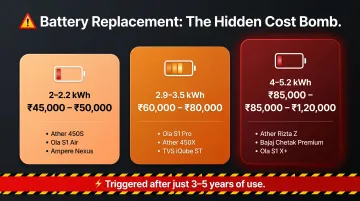
For a gig worker who purchased a ₹1,00,000 scooter, a ₹70,000 battery replacement in year four wipes out three years of fuel savings in a single hit. High temperatures above 45°C — routine in Indian summers — accelerate degradation, with range dropping 10-20% during peak heat.
Maintenance and Breakdown Risk
While EVs have fewer moving parts than petrol bikes, component failures carry steep costs:
- Controller replacement: ₹1,300-₹3,000
- Motor kit swap (500W-1500W): ₹3,000-₹8,000
- Display unit replacement: ₹1,400-₹2,800
- Tyre replacement: ₹700-₹1,500 per tyre
- Brake servicing: ₹400-₹1,000
For a delivery partner whose scooter is their income source, even a two-day repair delay translates directly to lost earnings. Authorized service centers may require appointments days out, compounding the income hit.
Depreciation: EVs Lose Value Faster Than Petrol Bikes
Electric two-wheelers retain approximately 55-60% of value at three years with good battery health, versus 68% for petrol counterparts. Poor battery health drops EV retention to 45-50%. Used-EV buyers discount aggressively because they fear inheriting a costly battery replacement — and that fear is priced into every resale.
The Indian EV market's rapid model churn accelerates this. TVS overtook Ola as market leader in 2025; Ola's sales fell 51% in one year. EV penetration sits at 6.3% in 2025, with projections toward 60-70% by 2030. That growth pace means constant new model launches — and today's scooter loses value faster than anything in the petrol segment.
Why Renting an EV Scooter Makes More Sense for City Riders
Renting flips the ownership equation entirely. Instead of absorbing capital risk, battery liability, and depreciation, you pay only for what you use — and the fleet operator handles everything else.
Zero Capital Outlay: Start Earning Day One
Renting requires no down payment, no loan approval, no EMI commitment. A delivery partner can begin earning immediately without tying up ₹20,000–₹30,000 in a down payment or committing to 36 months of fixed payments. This matters enormously in India, where median gig worker earnings sit at approximately ₹18,000 monthly and irregular income patterns limit formal credit access.
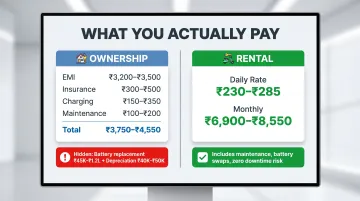
Monthly cost comparison (indicative):
Ownership costs (₹1,00,000 scooter):
- EMI (3-year loan): ₹3,200–₹3,500
- Insurance (amortized): ₹300–₹500
- Charging: ₹150–₹350
- Maintenance: ₹100–₹200
- Total: ₹3,750–₹4,550/month
- Hidden costs: Battery replacement risk, depreciation loss, downtime during repairs
Rental costs (Bounce Daily example):
- Daily rental: ₹230–₹285
- Monthly (30 days): ₹6,900–₹8,550
- Includes all maintenance, battery swaps, vehicle upkeep, no downtime risk
While rental appears costlier monthly, it eliminates the ₹45,000–₹1,20,000 battery replacement bomb and protects against depreciation losses of ₹40,000–₹50,000 over three years.
Maintenance-Free Operations: The Fleet Handles Everything
When you rent, the fleet operator owns the maintenance burden. Tire replacements, controller failures, brake servicing, software updates: none of it is your problem. For delivery partners, this eliminates the single biggest operational stress: unexpected downtime that directly cuts earnings.
Bounce Daily manages vehicle maintenance, tracking, and uptime centrally across all franchise hubs. A scooter with issues gets swapped out immediately — the rider doesn't lose a shift troubleshooting or waiting at a service center.
Usage Flexibility: Pay Only When You Earn
Gig work income fluctuates dramatically week to week. Festival seasons bring delivery surges; slower months may cut your days on the road. A fixed EMI of ₹3,500 doesn't care whether you worked 20 days or six. Daily or weekly rental plans align cost directly with earnings: work more days, rent more; work fewer, pay less.
Protection Against Technology Obsolescence
The Indian EV market is moving fast enough to strand buyers on outdated hardware. The segment leader shifted from Ola to TVS in a single year. Total e-2W sales hit 1.28 million in 2025, representing 11% YoY growth. With 86% of consumers now open to EVs over ICE, manufacturers are accelerating product cycles.
Buyers who purchased two years ago are already watching newer models offer longer range and faster charging at lower prices. Renters skip that risk entirely — the fleet upgrades around them, and they're always riding current, well-maintained vehicles.
Gig Workers and Daily Commuters: Who Should Rent Instead of Buy
Not everyone benefits equally from renting versus buying. Two segments gain the clearest advantage: high-mileage gig workers and flexible urban commuters.
Gig Workers: The Strongest Case for Rental
Food and e-commerce delivery workers represent the clearest rental use case. A field study of a Delhi delivery worker documented 105 km ridden in a single day, 23 deliveries completed, 15.5 hours worked — with net earnings of just ₹532 after fuel (₹34/hour). Those numbers aren't just low — they're structurally driven by three compounding problems that ownership makes worse:
- Range pressure: A 100 km daily requirement exceeds most fixed-battery EVs. Swappable battery infrastructure removes mid-shift charging stops that directly cut earning hours.
- EMI risk on variable income: With median monthly earnings around ₹18,000 and only 37% of workers reporting high earnings satisfaction, a ₹3,500 EMI consumes nearly 20% of gross income — unsustainable during slow weeks.
- Breakdown double loss: When an owned scooter breaks down, riders lose repair costs and daily earnings simultaneously. Rental models with instant vehicle swaps eliminate that double hit.
India's gig economy is projected to grow from 7.7 million workers in 2020-21 to 23.5 million by 2029-30, making rental-first models directly relevant to millions more workers each year.
Non-Gig Commuters Who Benefit from Rental
Beyond delivery partners, several commuter profiles gain from renting:
- New city residents testing EV commuting before committing to a purchase
- Last-mile commuters who rely on public transit for the main leg and need a scooter only for the final 5-10 km
- Seasonal workers who need transportation for 6-8 months, not year-round
- Students and riders interested in the low-speed variant (driving licence assistance (available for a nominal ₹200-₹230 fee) at our hub — visit us or check our app to know more)
Bounce Daily's Low Speed variant (25 km/h top speed, 85 km range, with driving licence assistance (available for a nominal ₹200-₹230 fee) at our hub) opens motorized two-wheeler commuting to riders who had no easy entry point before. Visit us or check our app to know more.
How Bounce Daily Makes EV Renting Simple in Bengaluru
Bounce Daily re-entered Bengaluru's EV rental market in April 2025 after a three-year pause, returning with a purpose-built model targeting gig workers and daily commuters. The service offers two scooter variants tailored to different usage profiles.
Two Scooter Variants for Different Needs
Low Speed variant:
- Top speed: 25 km/h
- Range: 85 km
- Battery: Swappable only
- DL: Support available at our hub — visit us or check our app to know more
- Ideal for: students, first-time riders, short urban commutes, campus travel
High Speed variant:
- Top speed: 55 km/h
- Range: 70 km
- Battery: Chargeable and swappable
- License: Required
- Ideal for: Delivery partners, longer commutes, faster city travel
The swappable battery infrastructure addresses the main challenge of high-mileage gig work: eliminating charging downtime during earning hours. Riders swap depleted batteries for fully charged ones in minutes, staying on the road through peak earning hours.
Instant Digital Onboarding: No Bureaucracy
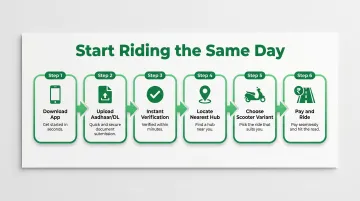
Traditional vehicle purchase and registration takes weeks. Bounce Daily's app-based system offers instant digital verification using Aadhaar and driving license (where applicable), allowing riders to start earning the same day they register.
The rental process:
- Download the Bounce Daily app
- Upload Aadhaar (and DL if renting High Speed variant)
- Instant verification
- Locate nearest hub
- Choose scooter variant
- Pay and ride
Proven Scale and Sustainability Credentials
Bounce Daily's numbers tell a straightforward story: 30M+ kilometers driven, 10K+ tons of CO2 avoided, and 50,000+ riders across Bengaluru. That's an active, operational network — not a pilot.
The franchise partnership model handles fleet management, maintenance, and uptime centrally, so riders aren't left dealing with vehicle issues on their own.
Frequently Asked Questions
What does "commuter scooter" mean?
A commuter scooter is a two-wheeled vehicle optimized for short-to-mid distance daily urban travel, prioritizing fuel efficiency, ease of use, and maneuverability in city traffic. Electric scooters increasingly dominate this category in India due to superior running economics and zero emissions.
What is the best scooter for city commute?
The best city commuter depends on your daily distance and whether you're buying or renting. For most Indian city riders, an electric scooter with swappable or fast-charge battery capability, low running costs (₹0.15-0.35/km), and minimal maintenance offers the best overall deal.
Which scooter is low maintenance?
Electric scooters require significantly less maintenance than petrol bikes — no engine oil changes, no fuel filters, fewer mechanical parts. When rented through services that handle all upkeep centrally, maintenance burden drops to zero for the rider.
Which scooter is best for daily 100 km running?
For 100 km daily usage, a scooter with swappable battery infrastructure is essential, since single-charge range typically caps at 70-85 km. Rental services offering battery-swap networks eliminate range anxiety and charging downtime that would otherwise disrupt earning hours.
Which scooty gives 70 kmpl mileage?
The "kmpl" metric applies only to petrol scooters — electric scooters are measured in km per charge or cost per km. Most mid-range EVs in India deliver 70-85 km per charge at ₹0.15-0.35/km, compared to ₹2.00-2.50/km for petrol equivalents.
For gig workers riding 80-100 km daily and urban commuters navigating congested Indian cities, renting an EV removes upfront cost, battery replacement risk, and maintenance overhead — while giving you the flexibility to scale up or step back as your work demands shift. Services like Bounce Daily in Bengaluru make this accessible through instant digital onboarding, swappable battery infrastructure, and two scooter variants built for city conditions. Ownership looks cheaper on paper; the hidden costs — depreciation, battery wear, servicing — tell a different story.