That scaffolding has gotten significantly more solid in 2025–2026. But for most riders, the picture is confusing: overlapping central schemes, state-level variations, subsidy amounts that keep changing, and the nagging question of whether any of this actually translates into money saved on a daily commute or delivery shift.
This article cuts through the noise. Here's what India's EV policy looks like in 2026 — which schemes are active, what financial benefits are real, how states like Delhi, Maharashtra, and Karnataka are moving, and what it all means if you're a delivery rider or gig worker deciding whether to make the switch.
Key Takeaways
- PM E-DRIVE (₹10,900 Cr, launched October 2024) is India's current flagship EV scheme, covering two-wheelers, three-wheelers, buses, and ₹2,000 Cr for public charging infrastructure
- EVs attract just 5% GST vs 18%+ for ICE vehicles — a 13-percentage-point gap that directly reduces purchase price
- Delhi's draft EV policy mandates 100% electric registration for three-wheelers by January 2027 and two-wheelers by April 2028, with front-loaded subsidies of ₹10,000/kWh in Year 1
- Import duty exemptions on 25 critical minerals and 35 battery components are lowering EV production costs — making vehicles cheaper over time for buyers and rental operators alike
- For gig workers, battery swapping and affordable EV rentals mean you don't need to buy a vehicle to capture the cost benefits of India's EV policy
India's EV Policy in 2026: Key Schemes and What Changed
India's EV policy has evolved through three distinct phases. FAME I (2015–2019, ₹895 Cr) was essentially a pilot — it validated the concept, supported about 2.8 lakh hybrid and electric vehicles, and seeded 520 charging stations. FAME II (2019–2024, ₹11,500 Cr) scaled everything up: according to PIB data from March 2026, it supported 16.71 lakh EVs and deployed 5,195 e-buses. It also approved 6,586 public charging stations, with 9,159 installed by January 2026.
Despite that scale, FAME II fell short on segment-wise targets and exposed a structural problem: subsidising demand without building the ecosystem around it — reliable charging, domestic battery manufacturing, standardised connectors — doesn't close the gap to 30% adoption. PM E-DRIVE was designed to fix exactly that.
PM E-DRIVE: The Flagship Scheme Running in 2026
PM E-DRIVE launched on October 1, 2024, with a ₹10,900 Cr outlay. Targets include 24.79 lakh electric two-wheelers and 3.16 lakh electric three-wheelers, plus 14,028 e-buses, e-ambulances, and e-trucks.
The subsidy structure works on a per-kWh basis:
| Vehicle Segment | FY 2024–25 Subsidy | FY 2025–26 Subsidy |
|---|---|---|
| E-2W (registered) | ₹5,000/kWh, capped at ₹10,000 | ₹2,500/kWh, capped at ₹5,000 |
| E-Rickshaws & E-Carts | ₹5,000/kWh, capped at ₹25,000 | ₹2,500/kWh, capped at ₹12,500 |
| E-3W (L5 category) | ₹5,000/kWh, capped at ₹50,000 | ₹2,500/kWh, capped at ₹25,000 |
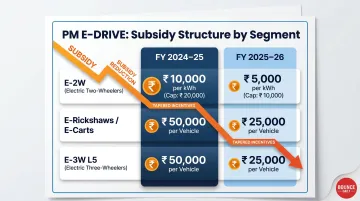
The deliberate halving of per-kWh subsidies signals a clear intent to taper central support as the market matures — not maintain it as a permanent crutch. The scheme has been extended to March 2028, but demand incentives for E-2Ws and E-3Ws were scheduled to expire March 31, 2026 — making state-level incentives increasingly important for riders shopping now.
The most significant philosophical shift in PM E-DRIVE is the ₹2,000 Cr dedicated to charging infrastructure — a direct acknowledgement that adoption without infrastructure doesn't stick. As of May 2026, 4,874 public EV chargers have been approved under the scheme.
PLI Schemes: The Supply-Side Bet
Two PLI schemes run alongside PM E-DRIVE, targeting India's near-total import dependence on battery materials:
- PLI for Advanced Chemistry Cell (ACC) Battery Storage: ₹18,100 Cr targeting 50 GWh domestic capacity. Reality check: of 40 GWh awarded to four firms, only 1 GWh has been installed (by Ola Cell Technologies), and no firm has claimed incentives yet.
- PLI for Automobiles and Auto Components: ₹25,938 Cr, covering EV components and advanced automotive technology.
India's domestic battery manufacturing ambitions are running well behind schedule — one reason EV prices haven't fallen as fast as anticipated. The import duty exemptions (covered below) are the government's pragmatic response while PLI production catches up.
Financial Incentives: Subsidies, Tax Benefits, and Import Duty Changes
Direct Subsidies for Two-Wheelers and Three-Wheelers
Central subsidies under PM E-DRIVE are declining — the FY25-26 cap of ₹5,000 per E-2W is roughly half what was available the year before. But they stack with state-level incentives, which in some cases are more generous than the central scheme.
Delhi's front-loaded model is the clearest example:
- Year 1: ₹10,000/kWh, capped at ₹30,000 per E-2W
- Year 2: ₹6,600/kWh
- Year 3: ₹3,300/kWh
- E-autos: ₹50,000 fixed (Year 1)
The tapering structure is intentional — maximum incentive early, when adoption inertia is highest. For a Delhi rider buying in Year 1, the combined central + state subsidy could reach ₹35,000+ on a single E-2W purchase. A rider in a state without an active EV policy may receive only ₹5,000 from the centre. Geography matters enormously right now.
EMPS 2024 (₹778 Cr) bridged the gap between FAME II's March 2024 close and PM E-DRIVE's October 2024 launch — relevant context if you're tracking vehicles purchased in that window. Beyond subsidies, the tax structure compounds these savings further.
Tax Benefits That Directly Reduce What You Pay
GST: EVs and EV chargers are taxed at 5%, while ICE vehicles face 18% (smaller vehicles) or 40% (larger SUVs) following the 56th GST Council reforms effective September 22, 2025. For a two-wheeler, that's a 13-percentage-point GST gap — meaningful on a ₹1–1.5 lakh vehicle. Home charging setups also got cheaper, with renewable energy devices cut to 5% GST.
Section 80EEB: Interest on EV loans is deductible up to ₹1.5 lakh/year under the old income tax regime — useful for salaried buyers financing a purchase.
Road tax waivers: Over 16 states have eliminated or significantly reduced road tax on EVs:
- Delhi: 100% road tax waiver for electric cars up to ₹30 lakh (excludes premium EVs above that threshold); registration fully waived for most EVs
- Maharashtra: 100% road tax and registration fee exemption for all EVs, plus toll exemptions on Mumbai-Pune Expressway, Samruddhi Mahamarg, and Atal Setu
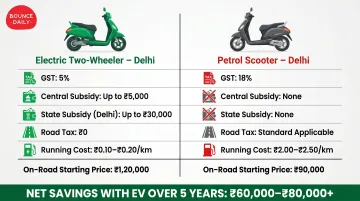
A realistic cost comparison for a ₹1.2 lakh E-2W in Delhi versus a comparable petrol scooter (₹90,000):
| Cost Factor | Electric Two-Wheeler | Petrol Scooter |
|---|---|---|
| GST applied | 5% (~₹6,000) | 18% (~₹16,200) |
| Central subsidy | Up to ₹5,000 (PM E-DRIVE) | None |
| State subsidy (Delhi Y1) | Up to ₹30,000 | None |
| Road tax | ₹0 (waived) | Standard rate |
| Running cost/km | ~₹0.15–0.35 | ~₹2–2.50 |
Import duty exemptions: Budget 2024–25 exempted duties on 25 critical minerals including lithium, cobalt, and nickel. Budget 2025–26 extended this further, removing duties on 35 battery assembly components and 28 critical parts. These reductions don't show up immediately in showroom prices, but they're gradually compressing the cost of domestic battery production, which will push retail EV prices lower over the next two to three years.
State-Level EV Policies: What's Changing in 2026
Delhi EV Policy 2024–2030: India's Most Aggressive State Roadmap
Delhi's draft EV policy (₹40,000 Cr) is the most ambitious state-level EV plan in India. Key elements:
- 100% electric registration for three-wheelers by January 2027
- 100% electric registration for two-wheelers by April 2028
- Scrappage incentives: Up to ₹1,00,000 for scrapping older BS-IV vehicles when purchasing an electric car
- OEM mandate: Every EV dealer must establish at least one public charging station
- Road tax 100% waived for electric cars priced up to ₹30 lakh until March 2030
With 67% of Delhi's registered vehicles being two-wheelers, the 2028 mandate isn't abstract — it affects the majority of the city's vehicle owners and every delivery rider working in the capital. The policy is still in draft form as of mid-2026, but the ICCT has already flagged it as a template other high-pollution cities should study.
Other States Moving Fast
Maharashtra (EV Policy 2025–2030, ₹1,993 Cr budget) is currently India's largest EV market by volume — 2.46 lakh EVs sold in FY2025, accounting for 12.5% of national sales. Incentives include:
100% road tax and registration fee exemption for all EVs
Purchase subsidies: up to ₹10,000 for E-2Ws, ₹30,000 for E-3Ws
Toll exemptions on major expressways
Target: 30% EV share in new registrations by 2030, with a 40% target specifically for 2Ws and 3WsKarnataka — home to Bengaluru's enormous delivery fleet — is among the top-performing states for EV adoption. Key incentives:
100% road tax exemption for all EVs
Purchase subsidies for E-2Ws
Strong adoption driven by Bengaluru's large gig and tech workforce
Metro cities — Delhi, Bengaluru, Pune, Mumbai — are pulling ahead fast. Most tier-2 cities and rural areas still lack basic charging infrastructure, EV service centres, and consumer awareness. States focus policy ambition where population density makes rollout financially viable. Until central-state alignment improves on infrastructure rollout, the 2030 target will be a metro-city story, not a national one.
Charging Infrastructure: How Far Has India Come in 2026?
India's charging network has grown substantially — though coverage and reliability tell different stories:
- FAME II: 6,586 public charging stations sanctioned; 9,159 installed as of January 2026
- PM E-DRIVE: 4,874 chargers approved as of May 2026, approaching the 5,000-station target
- National Highway corridors: Fast charging every 50 km mandated for heavy vehicles; corridors including Delhi–Jaipur and Bengaluru–Chennai are under active development
The Bureau of Energy Efficiency's revised guidelines (September 2024) brought standardisation that was badly needed — defined connector standards (CCS2 for fast charging, Bharat DC-001 and AC-001 for domestic), mandatory stations every 25 km on highways, and capped public charging tariffs to prevent price gouging.
Battery swapping addresses a different problem entirely. For delivery riders who can't afford to wait 3–4 hours mid-shift for a charge, swapping a depleted battery for a fully charged one in under a minute makes electric two-wheelers economically viable for full-day commercial use. India's Battery Swapping Policy formally recognises this as a distinct infrastructure category, separate from plug-in charging. It's most relevant for high-utilisation users — exactly the delivery and gig segment.
The persistent gaps: charger uptime remains inconsistent, connector compatibility across operators isn't uniform despite the BEE guidelines, and the urban–rural charging divide is still wide. For delivery riders clocking 100+ km daily, unreliable uptime and incompatible connectors aren't minor inconveniences — they're operational risks that erode the cost advantage of going electric.
What India's EV Policy Means for Gig Workers and Delivery Riders
The financial case for delivery riders is straightforward once you put numbers to it.
A typical Swiggy, Zomato, or Blinkit rider covering 50–80 km/day on a petrol scooter spends approximately ₹3,000–4,500/month on fuel alone, plus ₹500–800 in servicing and ₹150–300 in insurance — before factoring in unexpected breakdowns.
Total all-in: ₹4,500–6,500/month, on top of an ₹80,000–1,20,000 vehicle purchase or ₹2,500–3,500/month EMI.
On an electric two-wheeler, running costs drop to approximately ₹0.15–0.35/km — an 82–94% reduction in fuel-equivalent costs. At typical delivery distances, that's ₹33,000–47,000 in annual fuel savings before accounting for reduced maintenance.
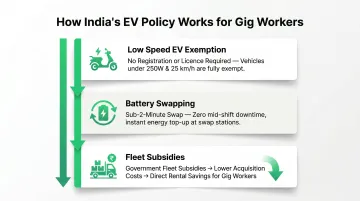
India's current EV policy specifically removes barriers for this segment in three ways:
- Low Speed EV exemption: Under CMVR rules, EVs with motor power below 250W and top speed under 25 km/h need no registration or driving licence — opening access to gig workers without formal documentation
- Battery swapping: Removes mid-shift downtime — a dealbreaker for 10–12 hour delivery shifts
- Fleet-focused subsidies: PM E-DRIVE and state schemes targeting commercial operators mean lower fleet acquisition costs, savings that can flow through to rental customers
These policy benefits matter most when they translate into daily earnings — and that's where rental removes the last barrier. Bounce Daily lets gig workers access policy-aligned EVs without the purchase cost, EMI, or maintenance burden. Currently available in Bengaluru with multi-city expansion underway, Bounce Daily offers two variants:
- High Speed (55 km/h, 70 km range) — for licensed riders handling standard delivery routes
- Low Speed (25 km/h, 85 km range) — suited to last-mile and campus delivery (driving licence assistance (available for a nominal ₹200-₹230 fee) at our hub — visit us or check our app to know more)
Battery swapping is included in every plan at no extra charge. Fleet management, maintenance, insurance, and GPS tracking are handled centrally by Bounce Daily. Delivery partner Karanbir Das put it plainly: "Way more cost-effective than petrol bikes, and I've never faced any issues with the battery."
Riders can onboard same-day via the Bounce Daily Android app with Aadhaar (Low Speed) or Aadhaar + driving licence (High Speed) — no long documentation, no EMI, no fuel costs.
Frequently Asked Questions
What is the new EV policy in India?
India's current EV policy framework (as of 2026) is anchored by PM E-DRIVE (₹10,900 Cr, launched October 2024, extended to March 2028), which covers subsidies for E-2Ws, E-3Ws, and buses plus ₹2,000 Cr for public charging. This builds on the FAME I and FAME II legacy and runs alongside PLI schemes targeting domestic battery manufacturing.
Does the Indian government give subsidies for EVs in India?
Yes. Under PM E-DRIVE, subsidies are available at ₹2,500/kWh for E-2Ws (capped at ₹5,000) and ₹2,500/kWh for E-3Ws (capped at ₹12,500–₹25,000 depending on category) in FY 2025–26. Vehicles must meet domestic manufacturing and safety certification standards to qualify. State-level subsidies can stack significantly on top of this.
How do I claim the EV subsidy in India?
In most cases, subsidies are applied at point of purchase — the dealer claims the incentive on your behalf and reduces your invoice price accordingly, so you don't need to file separately. Confirm that your chosen vehicle model appears on the approved list under PM E-DRIVE before purchasing, as eligibility is model-specific.
Which states in India offer subsidies for EVs?
Over 16 states offer road tax waivers or direct subsidies. Delhi waives road tax entirely for EVs up to ₹30 lakh; Maharashtra offers 100% road tax and registration exemption plus toll waivers; Karnataka also runs competitive incentive programs. Check your state transport department's website for current terms, as schemes update frequently.
What is EV policy 2.0 in India?
"EV Policy 2.0" most commonly refers to Delhi's updated EV policy (2024–2030), which moves beyond subsidies to enforce hard registration mandates (100% electric 3Ws by January 2027, 2Ws by April 2028), scrappage benefits up to ₹1,00,000, and OEM-level charging obligations. The term also describes India's broader 2024 policy shift — PM E-DRIVE plus PLI acceleration — moving from demand subsidies toward full ecosystem building.
What is the new EV import policy in India?
India has exempted 25 critical battery minerals (lithium, cobalt, nickel, and others) from customs duties under Budget 2024–25. Budget 2025–26 extended this to cover 35 battery assembly components and 28 manufacturing parts, reducing India's import dependency and putting downward pressure on end-consumer EV prices as domestic production scales.