Introduction: Zero Emission Vehicles in India Are No Longer a Distant Dream
India's position as the world's largest two-wheeler market and third-largest passenger vehicle market comes with a hidden cost: road transport currently accounts for 20-30% of urban air pollution across Indian cities. With 365.9 million vehicles registered as of March 2024, that pollution burden translates directly into public health costs, lost productivity, and mounting pressure on policymakers to act.
That pressure is accelerating a real shift. Zero emission vehicles (ZEVs) — which produce no tailpipe emissions during operation — now represent 7.8% of overall automobile sales, with EV registrations growing 15.68% year-on-year in FY 2024-25. Yet despite falling prices and generous government subsidies, millions of Indians still can't afford to buy one outright.
This is where EV rentals are bridging the gap. India's 7.7 million gig workers — projected to reach 23.5 million by 2030 — can rent an electric scooter instead of buying one, turning a prohibitive capital expense into a manageable daily cost and opening zero-emission mobility to those who need it most.
TLDR:
- ZEVs include battery electric vehicles and hydrogen fuel cells, with electric scooters dominating India's EV landscape
- Government schemes like FAME II and PM E-DRIVE have supported 16+ lakh EV sales with subsidies and reduced GST to 5%
- EV rentals eliminate ownership barriers for gig workers, converting ₹9,000-12,000 monthly fuel costs into affordable daily rentals
- Bounce Daily launched in April 2025, offering delivery partners electric scooter rentals with swappable batteries and instant digital onboarding
- India needs expanded charging infrastructure, better financing options, and awareness campaigns to scale ZEV adoption nationwide
What Counts as a Zero Emission Vehicle in India?
Zero emission vehicles are defined as vehicles producing no direct tailpipe emissions during operation. In India's policy framework, this primarily includes battery electric vehicles (BEVs), with hydrogen fuel cell vehicles also qualifying under this definition.
India's ZEV landscape spans two key categories:
Electric Cars:
- Tata Tiago EV (starting at ₹7,99,000)
- Tata Punch EV (starting at ₹9,69,000)
- MG Windsor EV
- Mahindra BE 6
- Tata Harrier EV
Electric Two-Wheelers:
- Ola S1 X (starting at ₹84,999)
- TVS iQube (starting at ₹1,00,322)
- Bajaj Chetak (up to ₹1,39,305)
- Ampere Magnus Neo (starting at ₹86,999)
Two-wheelers dominate India's roads — and that's where the EV transition will actually happen at scale.
Why Two-Wheelers Drive the ZEV Shift
Electric cars get most of the headlines, but two-wheelers make up 74.5% of India's total registered vehicles. Over 210 million two-wheelers were on the road as of August 2022, compared to just 70 million four-wheelers.
For everyday Indians navigating congested city traffic, electric scooters are the most practical ZEV option. They're affordable, easy to maneuver, and built for last-mile trips — which is exactly why gig economy workers in food delivery and e-commerce logistics are adopting them faster than any other segment.
India's EV Push: Policy, Market, and Growing Momentum
India's ZEV adoption is backed by a series of targeted policy schemes designed to make electric vehicles commercially viable.
Key Policy Drivers
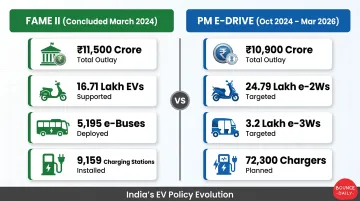
FAME II Scheme (Concluded March 2024):
- Total outlay: ₹11,500 crore
- Supported 16,71,606 electric vehicles sold during implementation
- Deployed 5,195 e-buses nationwide
- Installed 9,159 EV public charging stations
PM E-DRIVE Scheme (October 2024 – March 2026):
- Financial outlay: ₹10,900 crore
- E-2W subsidy: ₹5,000 per kWh (FY 2024-25); ₹2,500 per kWh (FY 2025-26), capped at 15% of ex-factory price
- Targets approximately 24.79 lakh e-2Ws, 3.2 lakh e-3Ws, 14,028 e-buses
- Plans to install 72,300 chargers nationwide
GST Reduction:
- GST on all electric vehicles reduced from 12% to 5%, effective August 1, 2019
- EV chargers also taxed at 5% (down from 18%)
- By comparison, petrol/diesel vehicles attract 28% GST plus cess
Market Momentum
These policy incentives have translated directly into sales volume:
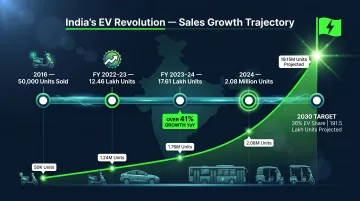
- FY 2022-23: 12,46,634 EV units sold
- FY 2023-24: 17,61,520 EV units sold
- FY 2024-25: 15.68% year-on-year growth
India's long-term trajectory is even more striking: EV sales grew from 50,000 units in 2016 to 2.08 million in 2024.
India aims to achieve a 30% share of electric vehicles in total vehicle sales by 2030. NITI Aayog has flagged that current progress lags behind this target, yet JMK Research projects a 49.79% CAGR — pointing to annual sales of 191.5 lakh EVs by 2030.
India's ZEV push serves two strategic purposes: reducing carbon emissions from transport (currently 20-30% of urban air pollution) and cutting dependence on imported oil. For gig workers and delivery riders especially, this national shift creates real on-the-ground opportunity — lower fuel costs and a growing infrastructure of chargers and rental hubs to support daily operations.
The Real Barrier: Why Most Indians Can't Simply Buy a ZEV
Falling prices and government subsidies have made ZEVs more accessible on paper. In practice, three barriers keep ownership out of reach for most gig workers and daily commuters: upfront cost, charging infrastructure, and financing gaps.
The Upfront Cost Hurdle
Even entry-level electric vehicles remain prohibitively expensive for gig workers and daily-wage earners:
- Electric scooters: ₹84,999 to ₹1,39,305
- Electric cars: ₹7,99,000 to ₹10,00,000+
For delivery partners earning ₹15,000-25,000 monthly, finding ₹1 lakh or more upfront is nearly impossible — especially when that money is needed to earn income in the first place.
Beyond Price: The Hidden Barriers
1. Home Charging Infrastructure
For apartment residents, renters, and PG dwellers, installing a home charger presents multiple obstacles:
- Requires fixed parking slot close to electricity meter
- Needs clearance from Residents' Welfare Associations (RWAs)
- Raises safety concerns (fire risk, electrical load capacity)
- Regulatory guidelines recognize charging as a "basic service", but implementation varies widely
Renters and PG residents face additional barriers: no dedicated parking and no authority to modify electrical infrastructure.
2. Financing Gaps
Most EV loans carry higher interest rates, shorter tenures, and low loan-to-value ratios compared to conventional vehicle loans. Key roadblocks include:
- Uncertainty of resale value
- Unknown probability of default
- Evolving technology risk
- Higher upfront costs
Gig workers with no formal income proof and lack of credit history face particular difficulty accessing financing, making them high-risk borrowers in the eyes of traditional lenders.
3. Range Anxiety and Battery Life
For riders new to EVs, the unknowns pile up fast: battery degradation over time, replacement costs that can exceed ₹30,000–₹50,000, and patchy public charging networks outside major metro corridors. These concerns delay adoption — regardless of how much an EV saves on fuel costs month to month.
How EV Rentals Are Democratizing Zero Emission Mobility
EV rentals solve the ownership barrier through a fundamentally different model: converting capital expense into operational expense.
Access Without Ownership
Instead of paying ₹1 lakh+ upfront, riders pay a daily or weekly rental fee. For gig workers, this transforms an impossible purchase into an affordable operational cost that scales with their income.
Key advantages for delivery partners:
- Get on the road without savings or a loan approval
- Pay only for days worked, skipping costs during idle periods
- Replace unpredictable fuel expenses with a fixed daily rate
Rental operators also remove the most common EV ownership anxieties — battery health monitoring, regular servicing, insurance, and vehicle tracking. For delivery partners, that means zero unexpected repair bills or downtime, which is critical for income stability.
Digital-First Onboarding
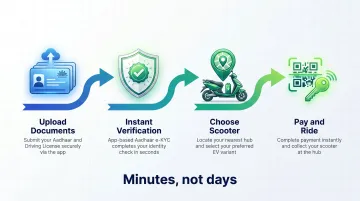
Modern EV rental platforms enable instant access:
- Upload Aadhaar card and driving license (for high-speed scooters)
- Instant verification through the app
- Locate nearest hub and choose scooter
- Make payment and pick up
This process takes minutes or hours, not the days or weeks required for vehicle loan approval.
Measurable Environmental Scale
Because rental fleets concentrate many rides into a single managed pool of vehicles, their collective environmental impact compounds. Bounce Infinity's fleet has driven over 30 million kilometers and avoided 10,000+ tons of CO2 emissions — demonstrating how centralized fleet operators can accumulate measurable green impact faster than individual ownership models.
That scale also creates a foundation for a different kind of opportunity: entrepreneurship in the green economy.
The Franchise Angle
EV rental platforms enable entrepreneurs to start their own rental businesses. Companies like Bounce Daily provide fleet, training, and marketing support — creating a distributed network for ZEV access across cities without requiring centralized infrastructure from a single company.
Franchise partners benefit from:
- Centrally managed fleet maintenance and tracking
- Access to a verified, ready-to-rent pool of delivery riders
- End-to-end training and marketing creatives
- Fast digital onboarding with minimal documentation
This model democratizes not just vehicle access, but also entrepreneurial opportunity in the green economy.
ZEV Rentals and the Gig Economy: A Perfect Match
India's gig economy runs on two wheels. With 7.7 million workers currently engaged and projections reaching 23.5 million by 2030, the pressure to keep mobility costs low is growing fast.
The Fuel Cost Reality
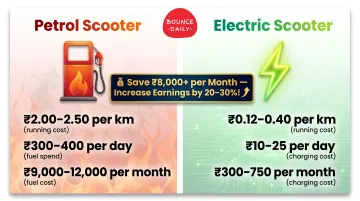
A typical delivery rider covering 100-150 km daily spends approximately ₹300-400 on fuel, with petrol priced around ₹100 per liter. This translates to ₹9,000-12,000 per month — a massive chunk of take-home earnings.
Electric scooters cost ₹0.12 to ₹0.40 per km on home electricity, compared to ₹2.00 to ₹2.50 per km for petrol scooters. For 70-85 km daily usage, charging costs approximately ₹10-25 per day — or just ₹300-750 monthly.
Switching to electric can save riders ₹8,000+ per month, increasing take-home earnings by 20-30%.
Features Tailored to Gig Work
EV rentals address three practical barriers that keep gig workers stuck on petrol bikes:
- Swappable batteries eliminate range anxiety — instead of a 3-4 hour charge wait, riders swap in minutes and keep working through full 8-12 hour shifts
- Low Speed variants (under 250W, capped at 25 km/h) provide an accessible entry point for new workers. Visit us or check our app to know more about driving licence assistance (available for a nominal ₹200-₹230 fee) at our hub.
- Commercial-grade durability handles daily high-mileage use; as delivery partner Goutam Behera puts it: "The build quality is top-notch and it runs smoothly every single day. Truly a reliable ride."
These features aren't add-ons — they're built around the specific demands of delivery work. Bounce Daily's two-variant lineup puts them into practice directly.
Bounce Daily: A Model for Gig-Focused EV Rentals
Launched in April 2025 in Bengaluru after a three-year operational pause, Bounce Daily specifically targets gig workers in e-commerce and food delivery.
Two Variants for Every Need:
| Feature | High Speed | Low Speed |
|---|---|---|
| Top Speed | 55 km/h | 25 km/h |
| Range | 70 km | 85 km |
| Battery | Chargeable & swappable | Swappable only |
| DL | Required | Support at hub |
Both variants are fully electric with zero tailpipe emissions, and both support swappable batteries for uninterrupted shifts. Onboarding is digital — riders upload documents, verify instantly via Aadhaar, and get on the road within minutes, skipping the paperwork that traditional vehicle financing requires.
As delivery partner Karanbir Das puts it plainly: "Bounce is way more cost-effective than petrol bikes."
The Quality-of-Life Factor
Beyond cost savings, electric scooters offer operational advantages:
- Quieter operation for late-night residential deliveries
- Smoother ride with fewer moving parts
- Less physical fatigue over long shifts
- No frequent oil changes, clutch replacements, or engine servicing
For delivery partners working 6-7 days weekly, these improvements add up — in energy, health, and the ability to keep riding long-term.
What Still Needs to Change for ZEVs to Scale Across India
Despite promising momentum, three core gaps continue to slow ZEV adoption at scale: charging infrastructure, policy awareness, and financing access.
Charging and Swapping Infrastructure
As of August 2025, India has 29,277 public EV charging stations operational nationwide — a six-fold increase since 2022. However:
Geographic Concentration:
- Over 55% of stations located in just 5 states
- Karnataka leads with 6,097 stations; Maharashtra has 4,155
Operational Challenges:
- Average utilization only 5-20%
- Just 50-60% of public chargers reliably operational
- Grid integration issues with high-power DC chargers
- Digital fragmentation across multiple proprietary apps
India has approximately 1,200 active battery swapping stations as of 2025, processing roughly 300,000 daily swaps. While this supports fleet operators and delivery partners, rollout needs to keep pace with rental fleet expansion — otherwise, operational bottlenecks will follow.### Policy Consistency and Awareness
Many potential users — gig workers and franchise partners alike — remain unaware of existing EV subsidies or how to access them. Key gaps include:
- Complex subsidy claim processes
- Lack of vernacular language resources
- Limited grassroots awareness campaigns targeting gig workers
- Inconsistent state-level EV policies
Simplified subsidy access and vernacular-language outreach could move the needle for India's most price-sensitive users — the delivery riders and gig workers who stand to benefit most.
Financing and Insurance Products
While rentals reduce the ownership barrier for riders, fleet operators themselves still need accessible financing to grow their fleets. Current gaps include:
- Limited EV-specific loan products for fleet operators
- Higher interest rates and shorter tenures
- Low loan-to-value ratios
- Lack of credit guarantees or extended warranties
Insurance products also lag behind — fleet operators managing hundreds of vehicles across multiple cities need policies that account for battery degradation, swap infrastructure downtime, and multi-city operations, none of which standard motor insurance currently covers.
Frequently Asked Questions
Which cars are zero-emission vehicles in India?
Zero-emission cars in India include Tata Punch EV, Tata Nexon EV, Tata Tiago EV, MG Windsor EV, and Mahindra BE 6. However, zero-emission vehicles also include electric two-wheelers like Ola S1 X, TVS iQube, and Bajaj Chetak, which are more widely used for daily commuting and delivery work.
Are electric vehicles cheaper than petrol vehicles in India?
EVs typically have higher upfront purchase prices, but their running costs are far lower. Delivery partners covering 100–150 km daily can save ₹8,000+ per month on fuel alone, increasing take-home earnings by 20–30%.
What happens to electric vehicles after 15 years in India?
India's scrappage policy requires mandatory fitness testing after 15 years for commercial EVs and 20 years for private ones. Battery recycling regulation is still evolving. For EV rental users, this isn't a concern — fleet operators manage the entire vehicle lifecycle.
Do I need a driving license to rent an electric scooter in India?
For low-speed scooters (below 250W, top speed under 25 km/h), driving licence assistance (available for a nominal ₹200-₹230 fee) is available at our hub - visit us or check our app to know more. High-speed variants above 25 km/h require a valid license.
How do EV rentals work for delivery partners in India?
Delivery partners sign up digitally with minimal documentation (Aadhaar + driving license for high-speed scooters), pay a daily or weekly rental fee, and ride a fully maintained electric scooter. No upfront vehicle purchase is needed, and the rental operator handles all servicing, battery management, and insurance.
What is the Indian government doing to promote zero emission vehicles?
The government has launched schemes like FAME II (supporting 16+ lakh EVs with ₹11,500 crore outlay) and PM E-DRIVE (₹10,900 crore targeting 24.79 lakh e-2Ws). GST on EVs has been reduced from 12% to 5%, and several state governments offer additional purchase and registration incentives.