Introduction
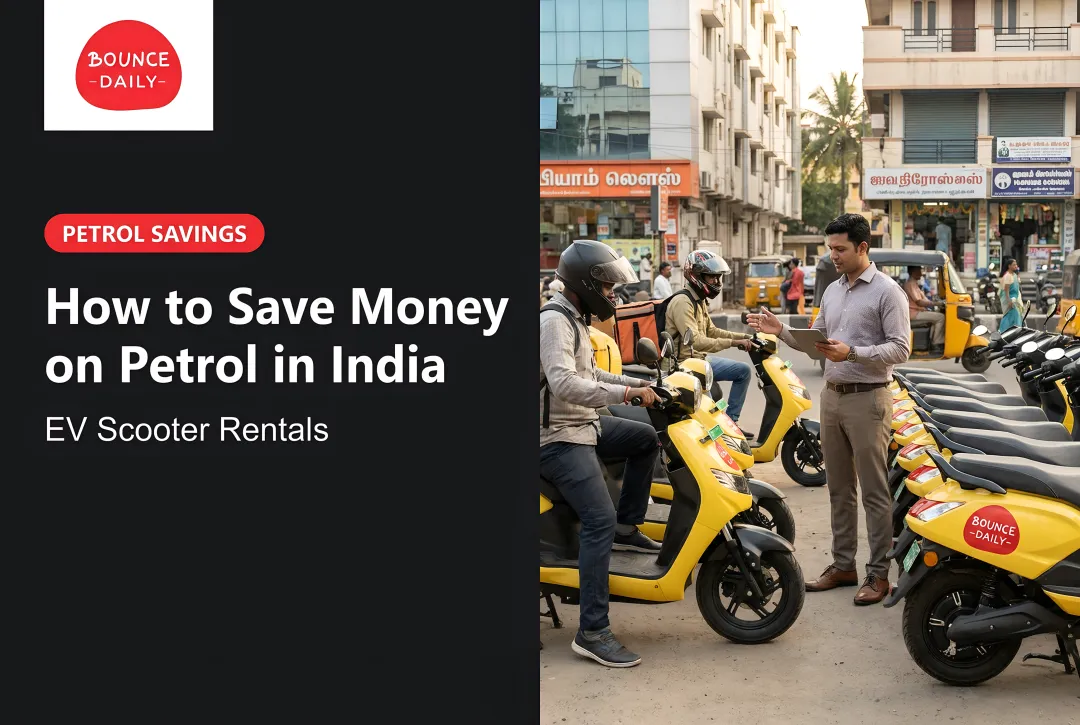
Every morning, millions of petrol-powered two-wheelers flood Indian city streets, coughing exhaust into air already thick with congestion. For the delivery rider racing to meet a deadline, the office commuter stuck in standstill traffic, and the gig worker covering 100 km daily, the carbon cost of urban mobility compounds with every kilometer. Over 210 million two-wheelers now choke India's roads—the single largest vehicle category—yet no fuel consumption standards govern them. Meanwhile, cities like Bengaluru report 74.4% average congestion, and air quality targets remain largely unmet. The real barrier isn't awareness—it's access: most riders can't absorb the upfront cost of switching to electric.
Zero emission vehicles (ZEVs)—electric scooters in particular—offer a direct solution. The rental model removes the three biggest obstacles: purchase cost, maintenance responsibility, and charging downtime. Swappable batteries keep riders moving without stopping to charge; central fleet management means no repair bills.
This article explains what qualifies as a ZEV, why electric scooters fit the definition, and how rental fleets can cut carbon at the scale India's cities actually need.
Key Takeaways
- Electric scooters are Battery Electric Vehicles (BEVs)—producing zero tailpipe emissions under all operational conditions
- India's 210 million+ two-wheelers account for 38 megatonnes of annual CO2; electrifying this category makes two-wheelers the highest-impact EV category for Indian cities
- No upfront ownership cost (vs. ₹50,000–60,000 to buy) and zero maintenance burden make rentals the practical entry point for most riders
- Swappable batteries and app-based onboarding keep gig workers running 95+ km daily without downtime
- Shared fleet scooters cut more carbon per vehicle than privately owned EVs — they're on the road far more hours each day
What Are Zero Emission Vehicles? The Basics Explained
The Official ZEV Definition
A zero emission vehicle is defined by the California Air Resources Board (CARB) as a vehicle that produces "zero exhaust emissions of any criteria pollutant (or precursor pollutant) or greenhouse gas under any and all possible operational modes and conditions." Criteria pollutants include particulate matter (PM), nitrogen oxides (NOx), carbon monoxide (CO), and sulfur dioxide (SO2). Greenhouse gases include CO2 and methane. This standard—adopted internationally as the benchmark for zero-emission classification—draws a clear line: if the vehicle produces any exhaust during operation, it's not a ZEV.
Tailpipe vs. Well-to-Wheel Emissions
Understanding what "zero emission" means requires distinguishing three emission scopes:
- Tailpipe (Direct) Emissions: What comes out of the vehicle's exhaust during operation—electric scooters produce zero; petrol scooters don't
- Well-to-Wheel Emissions: Includes upstream emissions from fuel extraction, processing, and electricity generation
- Cradle-to-Grave (Life Cycle): Adds vehicle and battery manufacturing, recycling, and disposal
Electric scooters eliminate tailpipe emissions entirely. The US Department of Energy confirms that "all-electric vehicles produce zero direct emissions." However, electricity generation may produce upstream emissions depending on the grid mix. Even accounting for India's current grid (0.710 tCO2/MWh as of FY 2024-25), electric scooters emit 37.5 gCO2eq/km on a life-cycle basis versus 60.9 gCO2eq/km for petrol scooters—a 38.4% reduction that widens as India's renewable energy share grows.
Three ZEV Categories
| Category | Full Name | Key Characteristic |
|---|---|---|
| BEV | Battery Electric Vehicle | Runs entirely on grid-charged electricity; zero tailpipe emissions |
| FCEV | Fuel Cell Electric Vehicle | Uses hydrogen fuel cell to generate electricity; emits only water vapor |
| NZEV/PHEV | Near-Zero Emission Vehicle / Plug-in Hybrid | Combines ICE with battery; operates in electric mode for limited range; not a full ZEV |
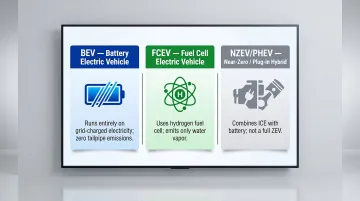
Electric scooters are BEVs by design—they run on battery power alone, with no internal combustion engine to produce exhaust under any condition.
Why ZEVs Matter for Indian Cities
That BEV classification matters most where air pollution is a daily reality. Transport accounts for 20-30% of PM2.5 and PM10 concentrations in Indian cities. In Delhi, vehicular emissions contribute 28% of PM2.5 in winter and 17% in summer. Bengaluru, Jaipur, Kanpur, and Surat show similar patterns.
Only 51 of 100 monitored cities achieved initial air quality targets under the National Clean Air Programme (NCAP). With revised PM10 reduction goals of 40% now due by 2025-26, switching to zero-emission vehicles has moved from a policy preference to a practical necessity.
The Carbon Cost of Urban Mobility in India
India's Two-Wheeler Dominance
Over 210 million two-wheelers are registered in India—more than 80% of total vehicle sales. This fleet consumed 60% of India's petrol in FY 2020-21 and emitted an estimated 38 megatonnes of tailpipe CO2 in calendar year 2020. No other vehicle category matches this scale of impact, which makes two-wheeler electrification the single highest-leverage intervention for urban carbon reduction. Yet as of August 2022, fewer than 545,000 of these were electric—less than 0.3% of the total fleet.
Per-Kilometre Emissions: The Petrol vs. Electric Gap
The International Council on Clean Transportation (ICCT) quantifies the difference:
- Fleet average tailpipe CO2 for all two-wheelers: 41.2 gCO2/km (FY 2018-19)
- Life-cycle emissions for petrol scooter (109.5 cc): 60.9 gCO2eq/km
- Life-cycle emissions for electric scooter (2.9 kWh): 37.5 gCO2eq/km
Even under India's coal-heavy grid mix, electric scooters deliver 38.4% lower emissions across their full lifecycle. The gap widens daily as renewable energy generation rises—non-fossil sources reached 50% of installed capacity in June 2025, five years ahead of India's Paris Agreement target.
Gig Workers: The High-Mileage Carbon Multiplier
Those per-km figures hit hardest where daily distances are highest. Delivery and gig workers cover an average of 94.9 km per day, with long-shift workers hitting 118 km daily. At these mileage levels, the per-vehicle emission footprint far exceeds that of the average commuter.
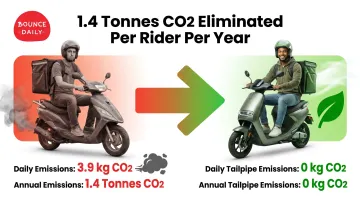
A delivery rider covering 95 km/day on a petrol scooter (using the 41.2 gCO2/km fleet average) emits approximately 3.9 kg CO2 daily or 1.4 tonnes annually from tailpipe emissions alone. Across thousands of riders in a single city, that adds up to tens of thousands of tonnes per year—emissions that shift entirely to near-zero the moment those riders switch to electric.
Bengaluru: Where Stop-Start Conditions Amplify the Case for Electric
Bengaluru ranks among India's most congested cities, with 74.4% average congestion and evening rush-hour speeds of just 13.2 km/h. Petrol engines operate least efficiently in stop-start traffic, wasting fuel during idling and acceleration. Electric scooters, by contrast, thrive in these conditions—regenerative braking converts energy that would otherwise dissipate as heat back into stored battery charge.
In a city where the average 10 km trip takes 36 minutes and riders lose 168 hours annually to congestion, every kilometre on an electric scooter avoids 41.2 gCO2 in tailpipe emissions that a petrol equivalent would release—at the exact speeds where that gap is widest.
Why Electric Scooters Qualify as Zero Emission Vehicles
Battery Electric Vehicles by Definition
Electric scooters meet every CARB requirement for ZEV classification:
- Run entirely on electricity stored in rechargeable batteries
- Use electric motors, not internal combustion engines
- Produce zero exhaust emissions under all operational modes—idle, acceleration, cruising, braking
There is no hybrid system, no backup petrol engine, and no emissions control equipment necessary because there are no emissions to control.
Regenerative Braking: Efficiency in Stop-Start Traffic
Electric scooters employ regenerative braking—a mechanism where the electric motor reverses during braking, converting kinetic energy back into electricity and storing it in the battery. This feature is most effective in urban stop-start conditions like Bengaluru's 13.2 km/h evening rush hour, where frequent braking events become opportunities to recover energy rather than waste it. Peer-reviewed studies confirm that regenerative braking improves driving efficiency for two-wheeled electric vehicles, giving them a natural advantage in congested urban environments where petrol scooters burn fuel inefficiently.
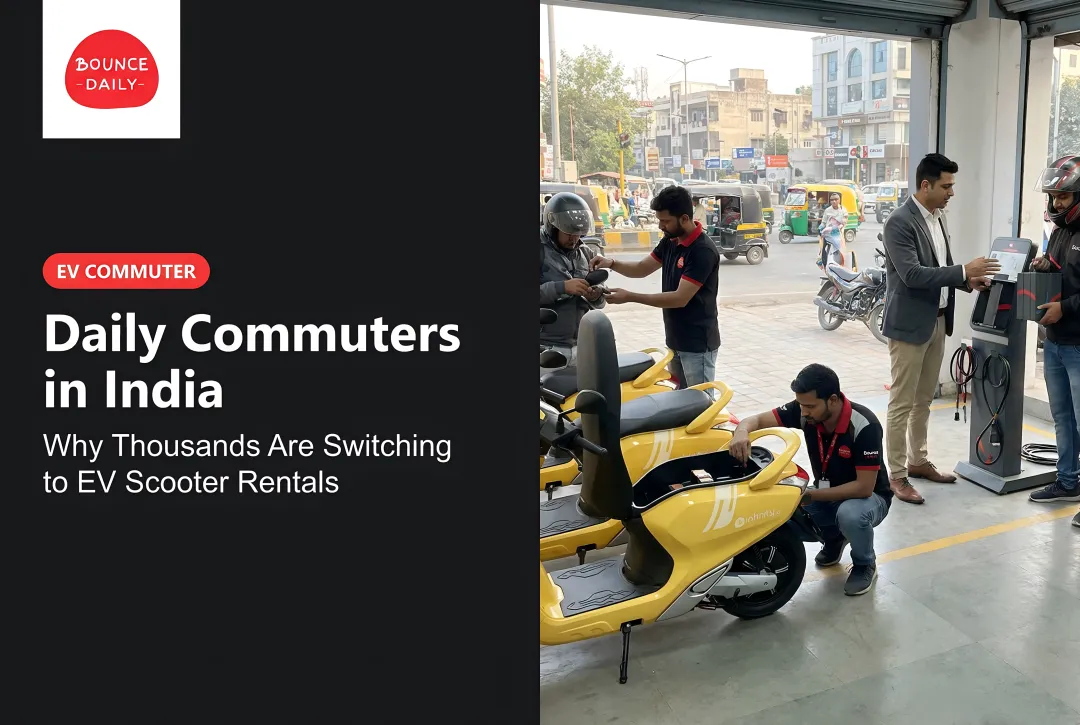
Swappable Batteries: Zero-Emission Range Without Downtime
The "range" of an electric scooter—the distance it can travel on a full charge—depends on battery capacity, speed, load, and terrain. For gig workers covering 95-118 km daily, range anxiety and charging downtime are legitimate concerns. Swappable battery technology solves both problems. Bounce Daily offers two variants:
- High Speed Variant: 55 km/h top speed, 70 km range, chargeable and swappable battery (requires driving licence)
- Low Speed Variant: 25 km/h top speed, 85 km range, swappable battery (driving licence assistance (available for a nominal ₹200-₹230 fee) at our hub — visit us or check our app to know more)
Swappable batteries allow depleted batteries to be replaced with fully charged ones in minutes, eliminating multi-hour charging waits and enabling all-day zero-emission operation with no loss of range.### The Well-to-Wheel Nuance: Honest Accounting
Electric scooters produce zero tailpipe emissions, but if the electricity grid is coal-heavy, emissions shift upstream to power plants. India's weighted average grid emission factor was 0.710 tCO2/MWh in FY 2024-25, down from 0.774 in FY 2013-14. Even on today's grid, electric scooters deliver 38.4% lower lifecycle emissions than petrol equivalents.
India reached 50% non-fossil installed capacity in June 2025 and is on track for 500 GW of non-fossil capacity by 2030, which will widen this gap further. The ICCT projects that 60% electric two-wheeler penetration by 2030 would reduce annual tailpipe CO2 from the segment to 32 megatonnes—a 42% reduction versus business-as-usual.
DL Support at Our Hub: Accessing the Low-Speed Variant
Under Indian regulations, electric vehicles with motor power of 250 watts or less and top speed of 25 km/h or below are classified as non-motorized vehicles. driving licence assistance (available for a nominal ₹200-₹230 fee) is available at our hub - visit us or check our app to know more. Bounce Daily's Low Speed variant (25 km/h, 85 km range) fits this category, expanding ZEV access to gig workers and commuters.
How Renting (Not Owning) an Electric Scooter Accelerates Carbon Cuts
Eliminating the Upfront Cost Barrier
Upfront cost remains the single biggest obstacle to ZEV adoption in India. Entry-level electric scooters start from approximately Rs 50,000–60,000, with mid-range models reaching Rs 1,65,000. For gig workers earning daily wages, that's weeks or months of income tied up before a single delivery is made.
Renting eliminates this barrier entirely. Instead of saving for a purchase, riders access zero-emission transport immediately through an app-based system with instant digital verification (Aadhaar + DL), multiple rental plans, and no long-term capital commitment.
Fleet Utilisation Amplifies Per-Vehicle Impact
The International Energy Agency confirms that shifting to EVs for shared and fleet services leads to "much larger per-vehicle reductions in GHG and local pollutant emissions compared to privately owned EVs." The mechanism: fleet vehicles have higher utilisation rates and heavier use patterns than privately owned vehicles. A scooter that sits parked 22 hours a day produces zero emissions—but also displaces zero petrol. A rental fleet scooter covering 95+ km daily across multiple shifts displaces far more fossil fuel per vehicle deployed.
Bounce Daily's fleet model is built to maximise hours on the road:
- Centrally managed maintenance keeps scooters operational across shifts
- Real-time tracking ensures uptime is monitored and protected
- Swappable batteries eliminate charging downtime entirely
The result: higher per-vehicle emission displacement than private EV ownership can achieve.
Real Numbers: 30M+ Kilometres, 10K+ CO2 Tons Avoided
Bounce Daily's fleet has driven over 30 million kilometres and avoided more than 10,000 tonnes of CO2 emissions. These numbers show what fleet-level ZEV adoption actually looks like in practice. Scaling this model across more cities—backed by digital onboarding, swappable batteries, and franchise partnerships—can improve India's urban air quality far faster than waiting for individual ownership to reach scale.## The Real-World Carbon Impact: Numbers That Matter
Annual Emissions: Petrol vs. Electric for a Gig Worker
Using the ICCT's fleet average of 41.2 gCO2/km for petrol scooters and assuming a delivery rider covers 95 km/day (NCAER average):
- Daily petrol scooter emissions: 95 km × 41.2 gCO2/km = 3.9 kg CO2
- Annual petrol scooter emissions: 3.9 kg × 365 days = 1,424 kg CO2 (1.4 tonnes)
- Electric scooter tailpipe emissions: 0 kg CO2
Over a year, switching one high-mileage gig worker from petrol to electric eliminates 1.4 tonnes of tailpipe CO2. Across a fleet of 1,000 riders, that's 1,400 tonnes annually—or roughly the total avoided by Bounce Daily's fleet after driving 30 million kilometres.
Scaling Fleet Impact: What 10,000 Tonnes Means
Bounce Daily's milestone of 10,000+ CO2 tonnes avoided represents the cumulative tailpipe emissions eliminated by its fleet across 30 million+ kilometres. For context, the ICCT estimates India's two-wheeler segment emitted 38 megatonnes of tailpipe CO2 in 2020 — eliminating 10,000 tonnes accounts for 0.026% of that annual sector total.
That fraction grows fast at scale. Expand rental fleets across Bengaluru, Delhi, Mumbai, Hyderabad, and Chennai, and the math shifts from thousands of tonnes to hundreds of thousands.
Policy Momentum: PM E-DRIVE and NCAP Alignment
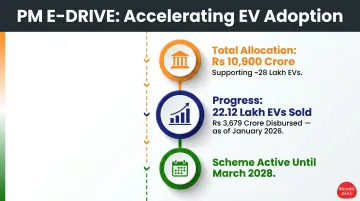
Government support is accelerating what fleet operators are already doing on the ground. India's PM E-DRIVE scheme backs this transition directly:
- Total allocation: Rs 10,900 crore supporting approximately 28 lakh EVs, including electric two-wheelers
- Progress to date: 22.12 lakh EVs sold under the scheme as of January 2026, with Rs 3,679 crore in demand incentives disbursed
- Timeline: Scheme runs to March 2028, signalling sustained policy commitment
Meanwhile, NCAP mandates a 40% particulate matter reduction across 131 cities — yet only 23 have met that target. Electrifying the two-wheeler segment is one of the fastest levers available to cities falling short. Electric scooter rentals align with both goals: they accelerate EV adoption while maximising emission cuts through high fleet utilisation.
Frequently Asked Questions
What qualifies as a zero-emission vehicle?
A ZEV produces zero tailpipe exhaust emissions of any criteria pollutant or greenhouse gas under all operational conditions. Battery electric vehicles like electric scooters are the most common ZEV type on Indian roads today.
Which vehicles are zero-emission?
Zero-emission vehicles include battery electric vehicles (BEVs like electric scooters, cars, and buses), hydrogen fuel cell electric vehicles (FCEVs), and human-powered vehicles like bicycles. Among these, BEVs are the most widely used in India.
Do electric vehicles produce zero emissions?
Electric vehicles produce zero tailpipe emissions during operation. Well-to-wheel emissions depend on how electricity is generated, but EVs still deliver significantly lower total lifecycle emissions than petrol vehicles even on India's current grid.
What are the types of zero-emission vehicles?
The three main types are BEV (battery electric), FCEV (hydrogen fuel cell), and PHEV (plug-in hybrid, which is near-zero rather than fully zero). Electric scooters fall under the BEV category.
What is the zero-emission range?
Range for a battery electric scooter is the distance it can travel on a full charge before the battery is depleted. This varies based on battery capacity, speed, load, and terrain. Swappable battery systems address this directly — riders swap a depleted pack for a full one in minutes, keeping range from becoming a daily constraint.