This article challenges that assumption. For delivery partners, food delivery riders, and daily commuters across Indian cities, renting an electric scooter removes both the ownership burden and the maintenance headache entirely—while delivering the lowest per-kilometre cost available today.
Key Takeaways
- Electric scooters cost ₹0.15–0.35 per km versus ₹2.00–2.50 per km for petrol—a 6–16x cost advantage that adds up fast for high-mileage riders
- Rental eliminates capital requirements: no down payment, no EMI, no depreciation risk, no insurance renewal stress
- Maintenance falls on the fleet operator, not you — no service center trips, no surprise repair bills eating into earnings
- Platforms like Bounce Daily make EV rental accessible in Bengaluru with instant Aadhar-based verification and multiple plan options
- For gig workers, a scooter that stays road-ready means more deliveries completed and more money earned each day
What Is EV Scooter Rental in India?
EV scooter rental is a subscription or short-term arrangement where you pay a daily or weekly fee to use a fully maintained electric scooter without owning it. You get access to a ready-to-ride vehicle, the operator handles all maintenance, and you avoid the capital commitment of purchase.
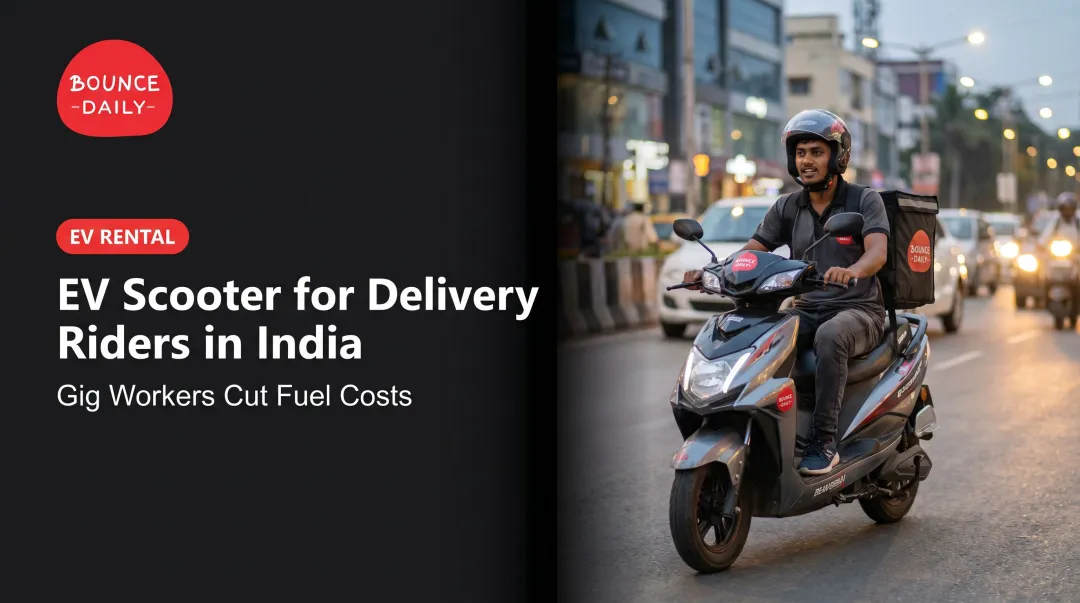
Gig economy workers are the primary users — delivery partners for Zomato, Swiggy, Blinkit, and e-commerce platforms, plus urban commuters in cities like Bengaluru. These riders prioritize earning capacity over asset ownership. For them, the rental model solves one problem directly: maximum daily mobility at the lowest total cost, with zero ownership risk.
Bounce Daily operates this model in Bengaluru, with two variants built around different rider needs:
- High-Speed: 55 km/h top speed, 70 km range — requires a driving licence
- Low-Speed: 25 km/h top speed, 85 km range (driving licence assistance (available for a nominal ₹200-₹230 fee) at our hub — visit us or check our app to know more)
Onboarding is app-based with instant Aadhaar and DL verification. Rentals start from ₹250 per day.
Key Advantages of Renting an EV Scooter in India
These aren't theoretical benefits. Each advantage directly affects what you pay and earn every single day—measured in rupees saved on fuel, service bills avoided, and capital freed up for other uses.
Advantage 1: Dramatically Lower Running Costs Per Kilometre
According to CEEW's June 2025 report, electric two-wheelers cost ₹1.48 per km versus ₹2.46 per km for petrol on a total cost of ownership (TCO) basis. The pure running cost gap is wider still: ₹0.15–0.35 per km for electric versus ₹2.00–2.50 per km for petrol — a 6–16x difference that compounds fast at high daily distances.
What this means in real money:
- A delivery rider covering 100 km daily spends ₹4,000-5,000 monthly on petrol alone
- The same distance on an electric scooter costs ₹750-1,500 in energy
- Monthly savings: ₹2,500-4,250 just on fuel
IDInsight's 2024 study found that delivery drivers using EVs earn approximately 20% more than petrol counterparts, specifically because operating costs are lower. That 20% translates directly into take-home pay on every delivery completed.
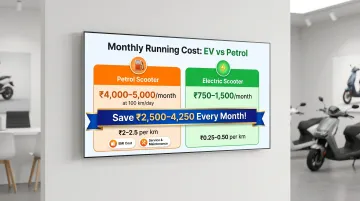
How rental pushes this advantage: When you rent from Bounce Daily, you pay a fixed daily fee. Your energy cost per trip is either included or minimal, versus a petrol bike owner who pays fuel costs plus EMI, insurance, and service expenses every month regardless of ride frequency.
When this matters most:
- High daily distances (delivery partners, multi-zone commuters)
- Periods of rising petrol prices (the EV advantage widens as fuel costs climb)
- Gig work where earnings are calculated per delivery — lower costs directly increase take-home pay
KPIs impacted: Monthly fuel expenditure, cost per km, net daily income, total monthly mobility cost
Advantage 2: Zero Maintenance Responsibility — The Fleet Operator Handles Everything
Electric scooters are inherently simpler than petrol engines: no oil changes, no spark plugs, no clutch servicing, no CVT belt replacements, no exhaust issues. When you rent, you don't even handle the minimal EV maintenance that remains — the operator does.
The maintenance burden on ownership: Annual petrol scooter maintenance ranges from ₹2,500-5,500 for standard usage, but for high-mileage delivery riders covering 36,000 km yearly, costs escalate to ₹8,000-15,000 when factoring in:
- 6-7 service center visits per year (every 5,000-6,000 km)
- CVT overhaul every 15,000-20,000 km (₹5,000-8,000 each time)
- Tyre replacements
- Brake work
Electric scooters reduce this to ₹1,000-2,500 annually with 40-60% less brake wear due to regenerative braking. Renters pay ₹0 because maintenance is the fleet operator's responsibility.
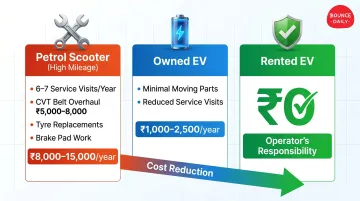
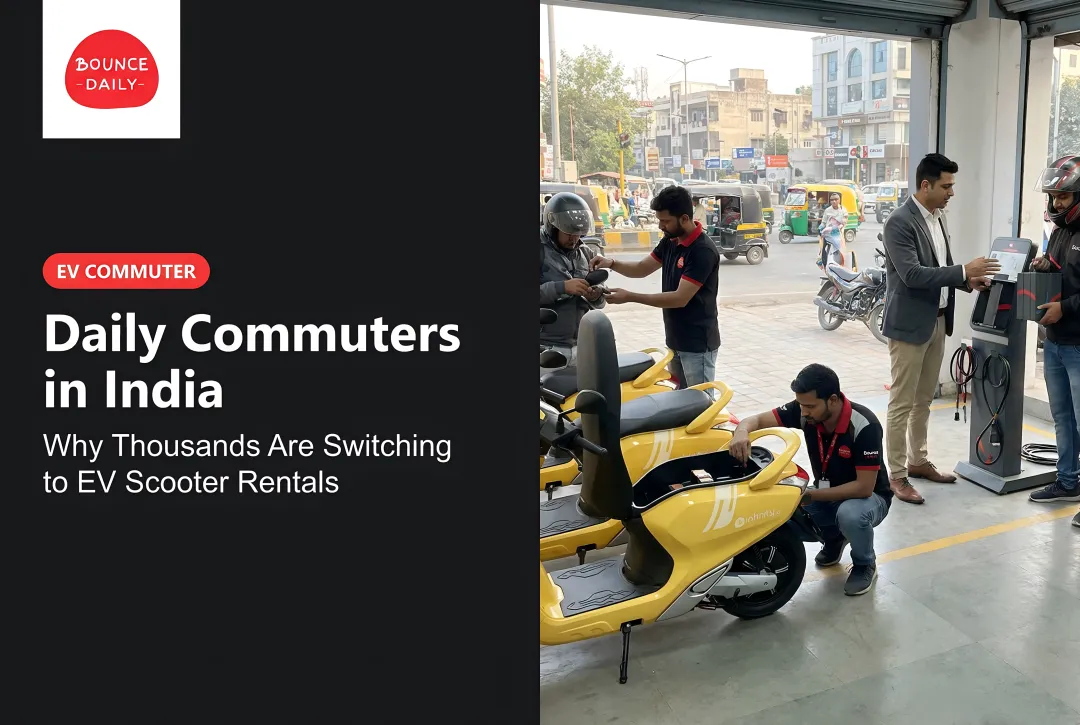
How Bounce Daily handles this: Fleet maintenance, battery health monitoring, and vehicle servicing are managed centrally. Riders pick up a ready-to-ride scooter with a fully charged or swappable battery and return it at the end of their shift — no service appointments, no repair bills, no waiting at a workshop.
Why this protects income: For gig workers, vehicle downtime equals zero earnings that day. Operating expenses consume approximately 32% of gross earnings for delivery workers, and maintenance-related downtime directly cuts earning capacity. Rental eliminates this risk entirely.
At 80 km daily, a petrol scooter needs servicing every 30-50 working days. Each visit takes 2-4 hours including travel and waiting — hours you're not delivering and not earning. Over a year, that's 12-24 hours of lost work from routine maintenance alone, before counting any breakdowns.
When this matters most:
- Full-time gig workers whose income depends entirely on daily riding hours
- Riders who lack mechanical knowledge or access to nearby service centers
- Anyone who has experienced the financial stress of an unexpected repair bill
KPIs impacted: Service cost per month, vehicle downtime frequency, lost income due to breakdowns, service center visits per year
Advantage 3: No Capital Investment, No Ownership Risks
Buying any scooter — even a "low maintenance" one — requires significant upfront capital. In Bangalore, on-road prices range from ₹98,054 for a Honda Activa to ₹1,07,626-1,44,140 for electric models like the Bajaj Chetak. Most buyers finance this through loans, creating an EMI obligation that lasts 2-3 years.
The total ownership cost:
- Honda Activa on-road price: ₹98,054
- Down payment: ₹4,903
- Monthly EMI (3 years, 10% interest): ₹3,364
- Total EMI outgo: ₹1,21,104
- Total cost including down payment: ₹1,26,007
- Additional cost due to interest: ₹28,000
That EMI is due every month regardless of whether you ride or earn. Add depreciation — 20% by Year 2, 30% by Year 3 per IRDAI schedules — and you're watching asset value erode while still making payments.
Rental converts capital into operating expense: Bounce Daily's ₹250/day rental (approximately ₹7,500/month for 30 days) requires:
- No down payment
- No credit score requirements
- No long-term commitment
- No depreciation risk
- No insurance paperwork or lapse risk
Why this matters for financial flexibility: 60% of gig workers struggle to obtain formal credit, and 75% lack traditional credit scores. Even those who qualify face real stress — approximately 33% of gig worker borrowers missed at least one repayment. Rental removes the credit barrier entirely.
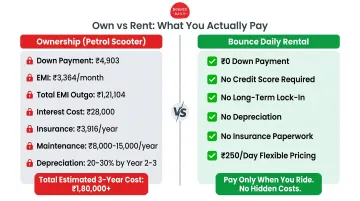
Rental also scales with work. Busy week? Rent more days. Slow week? Pause and avoid fixed costs. An owner pays EMI whether they ride 10 km or 100 km.
When this matters most:
- New entrants to gig work without upfront capital
- Riders testing EV mobility before committing to purchase
- Periods of economic uncertainty when locking capital into a depreciating asset carries higher risk
KPIs impacted: Upfront capital required, monthly fixed cost commitment, financial flexibility, total cost of mobility over 24 months
What Happens When Riders Stick to Ownership
Owning a scooter locks you into fixed costs whether you ride two hours or ten. EMI payments hit every month regardless of ride frequency. Fuel costs fluctuate unpredictably—petrol in Bengaluru has ranged between ₹100-105 over the past year. Service intervals arrive every few weeks for high-mileage riders, each visit taking hours and costing hundreds or thousands of rupees.
Hidden costs rarely discussed:
- Insurance renewal: ₹3,916+ annually
- RTO paperwork and fees
- Battery replacement for owned EVs: ₹40,000-70,000 after 5-8 years
- Lost earnings during every workshop day
When a seized engine, worn brake assembly, or failed battery presents a ₹5,000-15,000 repair bill, the choice is stark: go into debt or stop working entirely. 50% of gig workers who own vehicles took loans to finance them.
Repair emergencies routinely trigger missed EMI payments, pulling riders deeper into debt. Renting removes that risk entirely—maintenance stays the operator's problem, not yours.
How to Get Maximum Value from EV Rental
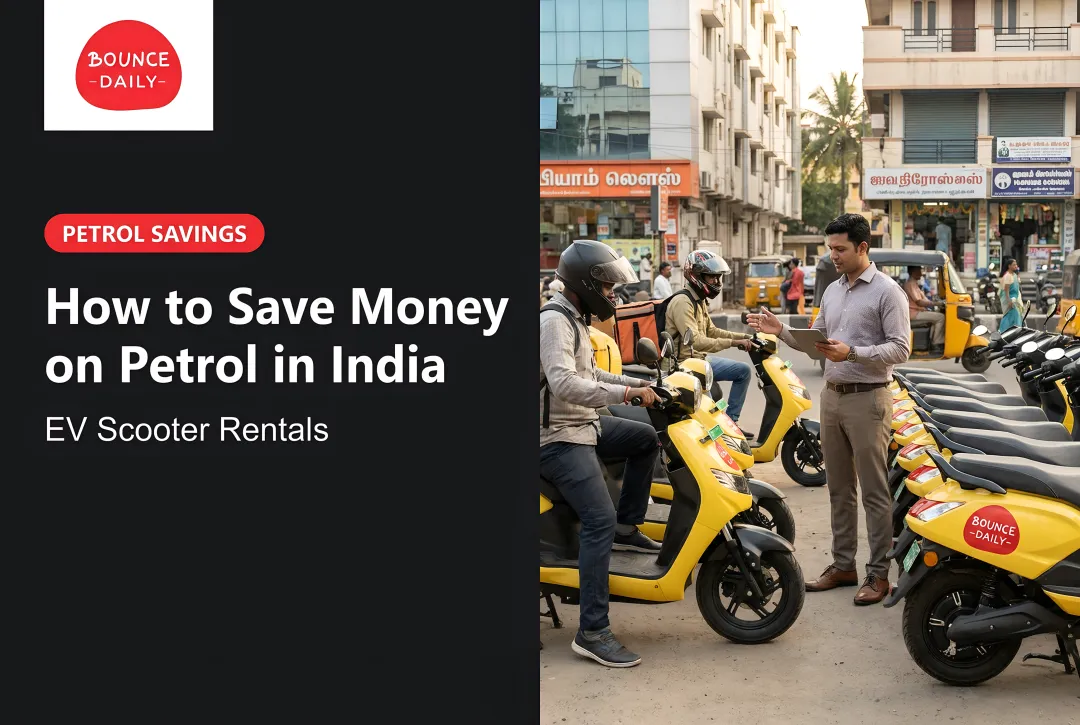
Treat EV rental as a deliberate cost strategy. Track your daily ride distance, energy savings versus a petrol alternative, and monthly net income after rental fees. This gives you a clear picture of actual financial gain.
Choose the right platform based on these criteria:
- Fleet maintenance included in the rental fee
- Swappable or chargeable battery options to avoid mid-day range anxiety
- Quick digital onboarding without lengthy documentation
Bounce Daily covers all three — instant Aadhaar-based verification, chargeable and swappable batteries, and end-to-end rider support.
Match the vehicle variant to your work:
- Low-speed variant (25 km/h, 85 km range) — suited for short-distance city delivery (driving licence assistance (available for a nominal ₹200-₹230 fee) at our hub — visit us or check our app to know more)
- High-speed variant (55 km/h, 70 km range) — licence required; better for longer urban routes and faster turnaround
Both variants run 100% electric with zero emissions. Bounce Daily operates over 300 battery-swapping stations in Bengaluru alone.## Conclusion
The lowest-maintenance scooter in India isn't a specific petrol model or even an owned EV. It's a rented electric scooter—because rental combines the inherently simple electric drivetrain with complete removal of ownership costs, service responsibilities, and capital risk.
For gig workers, delivery partners, and cost-sensitive daily commuters, the advantages compound month after month:
- Fuel: ₹3,000–4,500 saved every month vs. petrol
- Maintenance: ₹2,500–5,500 saved with zero service bills
- Ownership costs: ₹0 in EMI payments or depreciation losses
More of each day's earnings stay in your pocket—every single month.
Frequently Asked Questions
Which low maintenance scooter is best in India?
Electric scooters have far fewer moving parts than petrol bikes: no oil changes, no spark plugs, no clutch wear. Renting through a service like Bounce Daily goes further—maintenance is handled entirely by the fleet operator, so you just ride and earn.
Which scooter is best for daily use in India?
For daily gig work covering 60-100 km, electric scooters cost ₹0.15–0.35 per km versus ₹2.00–2.50 for petrol. A rental model removes the service burden and upfront investment that ownership requires, petrol or electric.
Which scooter has the best mileage in India?
Electric scooters don't have "mileage" in the petrol sense, but their cost per km runs 6-16x lower than petrol fuel costs. In stop-and-go urban traffic, that gap widens further, making EVs the clear efficiency winner for Indian city riding.
Which scooter is best for long-term use in India?
For long-term use, total cost matters more than sticker price. EV rental beats petrol ownership on running costs, sidesteps depreciation completely, and transfers all maintenance to the operator. That combination makes it the most cost-effective long-term option for daily riders.
Which scooter brand is most reliable in India?
In a rental context, reliability means consistent vehicle availability and quality upkeep by the provider. The operator's maintenance standards and battery swap infrastructure matter more than any single brand's track record.
Which scooter is best for a middle class family in India?
For families where one member commutes daily or does gig work, an EV rental can eliminate that transportation cost entirely. That directly reduces the household's monthly mobility spend without tying up capital in a depreciating asset.