Introduction
For millions of delivery riders across India—especially the gig workers powering food and e-commerce platforms—every minute off the road equals income lost. A scooter sitting idle while charging for 4–6 hours isn't just inconvenient; for a delivery partner covering 100–150 km daily, it's financially devastating. This daily reality has made battery swapping technology one of the most significant developments in India's electric two-wheeler market.
Battery swapping is reshaping how gig workers think about "refueling" their scooters. Unlike traditional EVs that require hours of charging downtime, swap-enabled scooters let riders exchange a depleted battery for a fully charged one in under a minute.
Yet despite this technology becoming increasingly common—over 12.8 lakh electric two-wheelers sold in India in 2025—most riders don't fully understand how it works. That knowledge gap leads to poor choices between rental services, costing riders orders and daily income. This guide breaks down exactly how swap technology works, why it matters for delivery work, and what to look for when choosing a swap-enabled scooter rental.
Key Takeaways
- A swappable battery is a removable lithium pack that can be exchanged for a fully charged one in under a minute at designated stations
- Manual swapping is standard for two-wheelers: remove depleted pack, insert charged one, resume delivery route immediately
- Built-in BMS chips monitor safety, charge levels, and cell health through every swap cycle
- Gig workers skip the 3–6 hour charging wait and stay on the road earning
- Bounce Daily's scooters support both chargeable and swappable modes, offering flexibility for different rider schedules
What Is a Swappable Battery?
A swappable battery is a self-contained, removable lithium battery pack designed to be swapped out without tools, disassembly, or connecting to a wall charger. The term "swappable" means the battery exits the vehicle entirely—you're not charging the scooter, you're replacing its power source.
This design solves a fundamental operational problem: traditional EV charging locks a vehicle out of service for hours. Swappable batteries separate charging from the vehicle entirely. The scooter stays in use while the battery charges separately at a station, allowing continuous operation for riders who can't afford downtime.
Swappable vs. Simply Removable
Most EV batteries can be detached with tools for repair or replacement, but swappable batteries are purpose-built to slot in and out in under 60 seconds without additional disassembly. They're designed for routine operational exchange at dedicated swap stations—not workshop maintenance. It's the difference between swapping a drained petrol canister for a full one versus waiting at a pump.
What Swappable Batteries Are Not
- Not wireless charging systems
- Not fixed batteries being charged in-vehicle
- Not battery upgrades or repairs
- Not one-time replacements—they're routine operational exchanges
The battery type used in a swappable system matters as much as the swap mechanism itself. Two lithium chemistries dominate India's swappable battery market, and they trade off differently on weight, lifespan, and safety.
NMC vs. LFP: The Two Chemistries Behind Battery Swapping
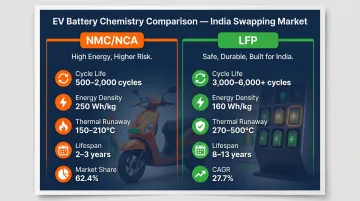
Lithium-Ion NMC/NCA:
- 500–2,000 charge cycles before dropping to 80% capacity
- Higher energy density (~250 Wh/kg) means lighter packs
- Thermal runaway risk at 150–210°C
- Shorter lifespan: 2–3 years under daily use
Lithium Iron Phosphate (LiFePO4):
- 3,000–6,000+ charge cycles before significant degradation
- Lower energy density (~160 Wh/kg) results in 10–20% heavier packs
- Superior thermal stability: runaway onset at 270–500°C
- Longer lifespan: 8–13 years under daily use
NMC chemistry held 62.40% of India's E2W swapping market in 2025. LFP is gaining ground at 27.70% CAGR—driven by its safety profile and longer cycle life, both critical for fleet operators running rotating battery inventories.
How Does Battery Swapping Work in an EV Scooter?
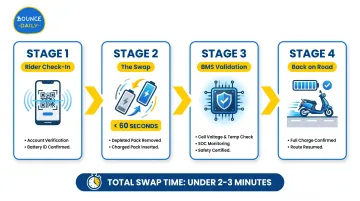
For two-wheelers, battery swapping is a manual, rider-operated process—no robotic arms or automated systems. The sequence is designed for speed and simplicity, keeping delivery riders moving.
Rider Check-In
The rider arrives at a swap station and initiates the process through a mobile app, QR code scan, or kiosk interaction. The system then:
- Verifies the rider's account and scooter model compatibility
- Identifies an available charged pack
- Logs the condition of the depleted battery for health tracking
This health tracking catches degraded units before they fail in the field, keeping the entire rotating fleet reliable.
The Swap Itself
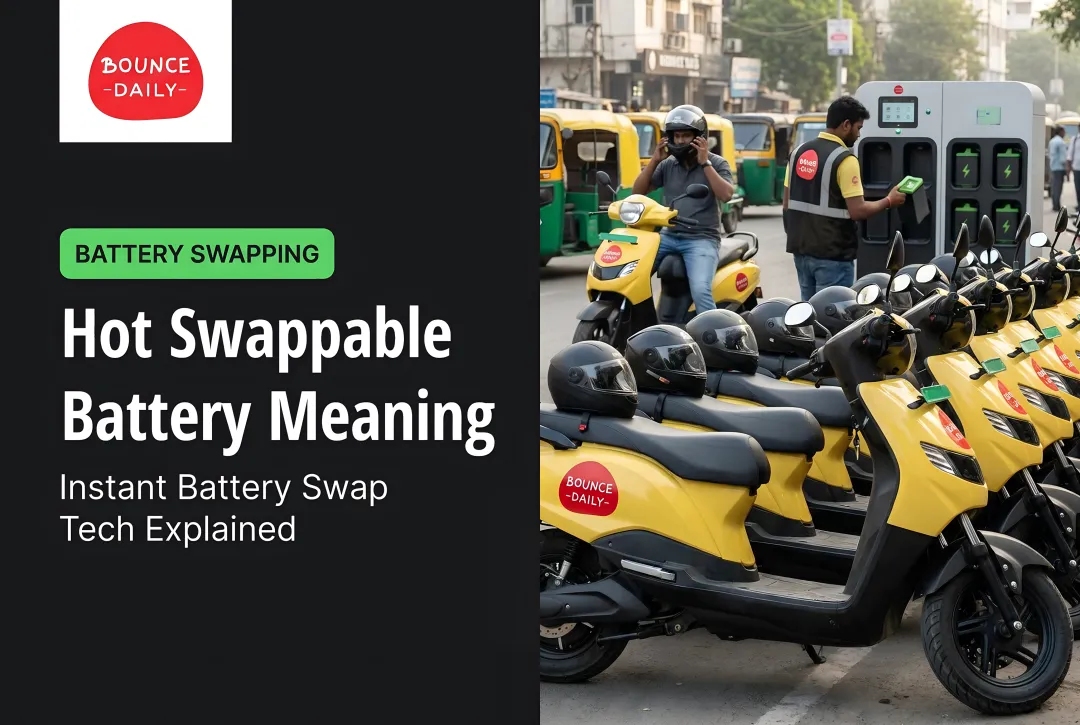
The physical exchange takes under 60 seconds at a dedicated swap station. The rider removes the depleted battery from the designated slot in the scooter's deck or frame (no tools needed), either hands it to station staff or slots it into the charging cabinet, then retrieves a fully charged pack.
Compatibility is critical: the charged battery must match the scooter's voltage (typically 48V, 60V, or 72V) and connector specifications. NITI Aayog's policy framework specifically targets standardizing connector design, communications protocols, and pack dimensions to enable compatibility across different scooter brands.
Battery Management System (BMS) in Action
A Battery Management System embedded in each pack is continuously active during and after every swap. It monitors:
- Individual cell voltage and overall pack voltage
- Temperature across multiple points
- State of charge (SOC) and depth of discharge
- Charge/discharge current
- Cycle count and cell balancing
The BMS communicates with the swap station's central platform via GSM/GPRS or Bluetooth, sending real-time data on battery health, completed charge cycles, and anomalies. Battery Smart's AI-driven system identifies and isolates 500–600 anomalous batteries weekly before they become safety risks. Advanced systems like SUN Mobility's S2.1 pack use over 30 sensors with active thermal management to prevent overheating.
Only packs that pass BMS certification are made available to riders. Everything else stays offline until it's safe.
Back on the Road
At the end of the process, the rider has a scooter with a fully charged battery ready for its rated range—70 km for high-speed variants, 85 km for low-speed models in Bounce Daily's fleet. This output is only reliable because the BMS has validated the pack's fitness. For a delivery rider, this means effectively doubling their operational range for the day without any downtime beyond the swap itself.
Swappable vs. Chargeable Battery: What's the Difference?
Many modern EV scooters—including those from Bounce Daily—support both modes. A chargeable battery can be plugged into a wall charger when the rider is parked overnight. A swappable battery can be exchanged at a station mid-day without waiting. Bounce Daily's High Speed variant offers both options, making it flexible for different rider schedules.
Practical Use Cases:
Chargeable mode suits riders with:
- Predictable schedules and overnight parking access
- Single-shift operations (6–8 hours)
- Home or workplace charging infrastructure
- Lower daily mileage (under 70 km)
Swappable mode suits high-usage riders who:
- Work 8–12 hour shifts covering 100–150 km daily
- Can't plan charging around downtime
- Need guaranteed range extension mid-shift
- Lack reliable home charging access
Common Misconception Cleared
Swappable and chargeable are not mutually exclusive categories. A battery can be physically swappable AND rechargeable at a station. The terms describe how the battery is replenished, not what it's made of. Bounce Daily's dual-mode approach gives riders operational flexibility—charge overnight at home when convenient, swap mid-shift when needed.
Time Comparison:
| Method | Time Required |
|---|---|
| Battery swap | Under 1–2 minutes |
| Standard AC home charging | 4–8 hours (full charge) |
| Fast charging (select models) | 30–60 minutes (partial charge) |
The numbers make the trade-off clear. Even fast-charging options need 12–15 minutes for partial range recovery. A swap delivers a full battery in under two minutes—critical for delivery riders who lose earnings every minute they're off the road.
Why Swappable Batteries Change the Game for Delivery Riders and Commuters
For gig workers—especially food and e-commerce delivery partners—time off the road is income lost. A traditional EV with fixed charging would ground their scooter for 3–6 hours mid-shift, wiping out earning potential during peak demand hours. Swappable battery systems eliminate this downtime entirely, making them the single most operationally significant feature for high-usage riders.
The Range Anxiety Advantage
58% of potential Indian EV buyers cite range anxiety as a deterrent, driven partly by India's sparse charging infrastructure—only 12,146 public charging stations nationwide as of 2024, translating to 1 charger per 135 EVs. With swap stations accessible across cities (Battery Smart operates 1,500+ stations in 50 cities; SUN Mobility has 620+ Swap Points with stations every 2 km in Delhi), riders no longer monitor battery percentage anxiously or plan routes around charging points. They swap and continue.
Battery Health Benefits
When batteries charge centrally at swap stations, the BMS applies optimal slow-charge protocols during off-peak periods rather than fast-charging repeatedly from empty to full. Slow charging maintains over 3,000 cycles, while fast charging reduces lifespan to approximately 1,000 cycles.
Limiting charge to 80% state of charge extends life to 4,200 cycles versus 956 cycles at 100% SOC. This centralized approach extends individual pack lifespan and reduces the degradation riders would otherwise see in personally owned fixed batteries.
Rider Economics Transform
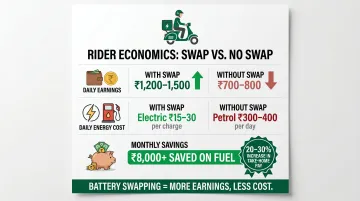
Better battery health is only part of the story—the real impact shows up in a rider's daily earnings. The numbers make the case clearly:
- Battery Smart users earn ₹1,200–1,500 daily versus ₹700–800 without swap access—roughly 50% more income from eliminated charging downtime
- Electric scooters cost ₹15–30 per full charge versus ₹300–400 daily for petrol (at ₹100/liter for 100–150 km)
- Monthly fuel savings exceed ₹8,000, a 20–30% increase in take-home pay for delivery partners
Battery-as-a-Service (BaaS) Removes Financial Risk
Batteries account for 30–40% of total EV purchase cost. In a BaaS model tied to swappable systems, riders don't own or maintain the battery—the service provider manages degraded packs and replaces them transparently.
Odysse Snap's BaaS model offers scooters at ₹49,999 without battery versus ₹79,999 with battery—a 37.5% upfront cost reduction. Monthly subscriptions range from ₹999 (25 kWh, low usage) to ₹2,499 (75 kWh, high usage), turning a large upfront cost into a predictable monthly expense while eliminating the risk of owning a battery that loses value over time.
Conclusion
Swappable battery technology represents a fundamental redesign of how EV scooters handle energy replenishment. The "park and wait" charging model simply doesn't fit the pace of real-world urban riding in India — the "swap and go" model does.
For gig workers and delivery partners, this technology difference translates directly to earning potential. Understanding how these systems work — from the BMS that monitors safety to the centralized charging that extends battery life — helps riders choose the right rental service with confidence.
Top speed and range specs only tell part of the story. The more important question is whether the operational design holds up under the demands of daily, high-mileage use in Indian cities.
As India's E2W battery swapping market grows from USD 26.72 million in 2025 to a projected USD 105.54 million by 2031, gig-economy fleets will continue driving adoption. The technology that keeps delivery riders moving is the same technology reshaping India's electric mobility landscape.
Frequently Asked Questions
What does swappable battery mean?
A swappable battery is a removable lithium pack on an EV scooter that can be physically exchanged for a fully charged one at a swap station in under a minute, without tools or waiting for a charge cycle. The design prioritizes speed of exchange, not repair.
Is battery swapping faster than charging?
Yes—battery swapping takes under 60 seconds to a few minutes compared to 4–8 hours for standard AC charging or 30–60 minutes for fast charging. This speed advantage makes it significantly faster for riders who need continuous road time during working hours.
How long does battery swapping take?
Total station time—including check-in and verification—typically runs under 2–3 minutes. The physical battery exchange itself takes under 60 seconds.
How much does battery swapping cost?
Costs vary by service model—riders may pay ₹50–₹120 per swap or subscribe to monthly plans ranging from ₹999 to ₹2,499. Pricing is designed to compete with petrol costs. Some rental services like Bounce Daily bundle swap access into their daily or monthly rental fees.
Which EV has a swappable battery?
Swappable batteries are most common in two-wheelers rather than cars. In India, several EV scooter manufacturers and rental services offer swap-compatible models. Bounce Daily's fleet includes both High Speed and Low Speed variants that support swappable batteries, with the High Speed model offering both swappable and chargeable options.
What happens to an EV battery after 8 years?
EV batteries typically experience capacity degradation over 8–15 years depending on usage and charging habits. In a Battery-as-a-Service (BaaS) model, the service provider monitors and replaces degraded packs—so riders never carry the cost of a depreciating battery.