Electric scooters are increasingly positioned as the cleaner alternative. But the "zero emission" label deserves scrutiny — because emissions don't begin and end at the tailpipe. Manufacturing, battery production, electricity sources, and end-of-life disposal all factor into the full picture.
This article walks through that complete picture: the genuine emissions benefits, the manufacturing costs that often go unmentioned, the role of India's evolving electricity grid, and what actually makes an e-scooter as green as it can be.
Key Takeaways
- E-scooters produce zero tailpipe emissions and have roughly 33–50% lower lifecycle CO₂ than petrol two-wheelers in India
- Manufacturing carries an upfront carbon cost, but operational savings pay it back over the scooter's working life
- India's grid now has 274.68 GW of installed renewable capacity (March 2026), making EV charging progressively cleaner
- Longer scooter lifespans and hub-based battery swapping are the two highest-impact levers for reducing fleet emissions
- Switching from petrol two-wheelers to electric scooters delivers some of the highest per-vehicle emissions gains available in Indian urban transport
How E-Scooters Cut Emissions Compared to Petrol Vehicles
Two-wheelers are India's dominant vehicle category — the single largest segment in the country's registered vehicle stock, according to MoRTH's Annual Report 2024–25.
A peer-reviewed study found that on-road transport contributes approximately 10–17% of daily mean PM2.5 over Delhi when both local and regional sources are counted. Because two-wheelers make up the majority of that traffic, decarbonising them has an outsized effect on urban air quality.
Tailpipe vs. Well-to-Wheel Emissions
The most immediate benefit is simple: petrol scooters emit CO₂, carbon monoxide, nitrogen oxides, and particulate matter on every trip. Electric scooters emit none of these at the point of use. In cities with already poor air quality, that local zero-emission advantage matters regardless of what happens upstream.
The broader well-to-wheel picture — accounting for electricity generation — still favours electric. ICCT's lifecycle assessment for India found:
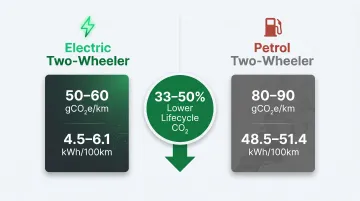
- Electric two-wheelers: approximately 50–60 gCO₂e/km (full lifecycle)
- Petrol two-wheelers: approximately 80–90 gCO₂e/km (full lifecycle)
That's a 33–50% lifecycle reduction using India's current grid. Cenex's controlled lab tests go further, showing electric scooters use 72–91% less energy per kilometre than a comparable 250cc petrol scooter — just 4.5–6.1 kWh/100 km versus the petrol equivalent of 48.5–51.4 kWh/100 km.
India's Grid Is Getting Cleaner
Those well-to-wheel figures hinge on the grid emission factor — and India's is falling. The weighted-average currently sits at 711.7 gCO₂/kWh (FY2024–25, per CEA Baseline Database V21.0), down from a peak of 729 gCO₂/kWh in FY2023–24. India added a record ~45 GW of solar capacity in 2025–26, bringing total renewable installed capacity to 274.68 GW. At that trajectory, the lifecycle emissions advantage for e-scooters will widen further without any change to the vehicle itself.
Bounce Daily's fleet illustrates what this looks like at scale: 10,000+ tonnes of CO₂ avoided across 30M+ kilometres driven — a direct measure of what fleet-level electrification achieves in a real Indian city.
The Hidden Environmental Costs: Manufacturing and Battery Concerns
The environmental case for electric scooters is genuine, but it isn't cost-free upfront. Understanding where the costs lie is important for making accurate comparisons.
Manufacturing's Share of the Footprint
A landmark study from North Carolina State University (Hollingsworth et al., 2019) analysed shared e-scooters and found that roughly 50% of total global warming potential came from manufacturing — the frame, wheels, motor, and battery production. For shared fleets, another ~43% came from petrol-powered collection and redistribution vehicles, with charging itself contributing only ~5%.
For anyone evaluating an e-scooter's real environmental impact, how it's serviced and how long it lasts matters nearly as much as what powers it.
Battery Production
Lithium-ion battery production requires mining lithium, cobalt, and other materials through energy-intensive extraction that carries real environmental costs. The IEA's Global EV Outlook notes that battery production emissions are declining as manufacturing energy mixes improve and processes grow more efficient. It remains a genuine upfront cost the industry is still working to reduce.
The Lifespan Problem
Early shared e-scooters had a serious durability problem. Some first-generation models lasted only weeks to a few months before damage and poor build quality forced replacement, meaning manufacturing emissions were incurred repeatedly for almost no operational return. Fleet-grade designs built for multi-year service lives change this calculation entirely — and this is exactly where battery swapping infrastructure, like what Bounce Daily operates across its Bengaluru hubs, helps: centralised maintenance and purpose-built hardware extend vehicle life far beyond what individually owned scooters typically achieve.
End-of-Life Disposal
Many e-scooter components are difficult to recycle, and improperly disposed batteries can leach toxic materials into soil and groundwater. India's Battery Waste Management Rules 2022 establish extended producer responsibility (EPR) obligations for EV batteries, requiring documented collection and recycling pathways. Choosing providers who comply with these rules — and can demonstrate their recycling partnerships — matters.
The Carbon Payback Framing
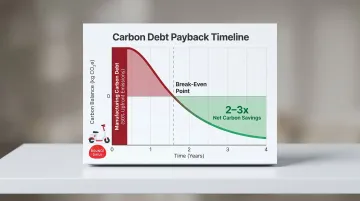
All of these manufacturing costs represent a one-time upfront "carbon debt." The longer a scooter stays in service and the more kilometres it covers, the more that debt is paid back through operational emissions savings.
A scooter replaced after six months never breaks even. One running for three or four years does — research suggests operational savings at that point outweigh manufacturing emissions by a factor of 2–3x, depending on grid mix and kilometres ridden annually.
Energy Efficiency: Why Electric Drivetrains Win
Electric motors convert a far higher proportion of input energy into motion than internal combustion engines, which lose a large share as heat and mechanical friction. According to the US Department of Energy's Alternative Fuels Data Center, EVs are substantially more efficient on a tank-to-wheel basis than their petrol equivalents.
For scooters specifically, several design factors compound this advantage:
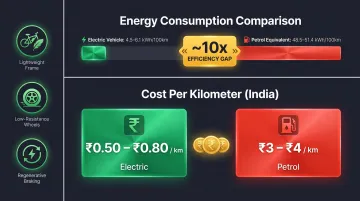
- Lightweight frames reduce the energy required to move the vehicle
- Small wheels with low rolling resistance cut energy waste at speed
- Regenerative braking recaptures energy during deceleration that would otherwise be lost as heat
The result: Cenex's testing measured just 4.5–6.1 kWh/100 km for electric scooters versus the petrol equivalent of 48.5–51.4 kWh/100 km — roughly a 10x efficiency gap. In practical terms, that translates to operating costs of around ₹0.50–0.80 per km on electricity versus ₹3–4 per km on petrol at current Indian fuel prices.
Delivery riders covering 50–80 km per day in stop-start Bengaluru traffic, and commuters doing 10–15 km each way, benefit most from this gap. Stop-start urban conditions — exactly where petrol engines waste the most fuel idling — are where electric drivetrains pull furthest ahead.
What Trips Are E-Scooters Actually Replacing?
The environmental benefit of switching to an electric scooter depends entirely on what it replaces. This is called the substitution effect, and the difference between a high-impact switch and a negligible one comes down to what was being ridden before.
When Substitution Works Well
In India's gig economy context, the substitution story is compelling. Delivery workers running shifts for Swiggy, Zomato, Blinkit, and Zepto who previously operated petrol bikes are now switching to electric. Over 75% of gig delivery workers have reportedly moved away from petrol two-wheelers, driven by both cost savings and reliability. Every trip that replaces a petrol bike cuts emissions directly — one for one.
A typical full-time food delivery rider on a petrol scooter generates approximately 350–450 kg of CO₂ per year. Switching that rider to an electric scooter removes that emission stream entirely.
When Substitution Doesn't Help Much
A US-based NCSU study found that in a Western shared scooter context, around 49% of rides would otherwise have been made by walking or cycling — meaning those trips had near-zero emissions to begin with. The environmental benefit in that scenario is minimal.
The lesson for India is straightforward: the environmental gains are largest when e-scooters replace petrol-bike commutes and delivery shifts. Using them to replace walking or short public transit hops barely moves the needle.
Making E-Scooters Greener: Fleet Management, Battery Swapping, and Lifecycle
The gap between a well-managed electric fleet and a poorly managed one is significant in environmental terms. Several factors determine whether an e-scooter delivers on its potential.
Operational Lifespan Is the Biggest Variable
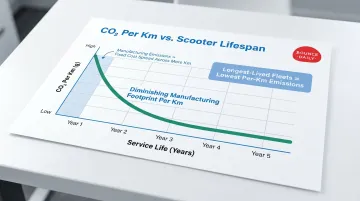
Research from the Sustainable Technologies Lab at Bochum University synthesises lifecycle evidence showing that extending a scooter's operational life is the single highest-impact measure for reducing per-km emissions. As more kilometres are driven on the same vehicle, the upfront manufacturing emissions are spread across a larger operational base — driving the per-km footprint down. Severengiz et al. (2020) and Gebhardt et al. (2022) both quantify how CO₂ per km drops sharply as service life increases.
Professionally managed fleets — with regular servicing, scheduled maintenance, and breakdown recovery — are the practical mechanism for achieving this. Bounce Daily's model is built around this directly: maintenance, GPS tracking, insurance, and uptime are managed centrally, not left to individual riders or franchise operators.
Battery Swapping vs. Petrol-Van Collection
The NCSU study identified a critical problem for shared scooter fleets: deploying petrol-powered vans to collect, charge, and redistribute scooters accounted for ~43% of the total lifecycle emissions. That's almost as large as the manufacturing footprint — and it's entirely avoidable.
Swappable battery systems address this directly. When riders bring their scooters to hubs and exchange depleted batteries for charged ones in minutes, there's no need for collection vehicles running separate logistics routes.
Bounce Daily operates on this hub-based model — battery swaps are included in all rental plans, with riders accessing the network across Bengaluru. Both the High Speed variant (55 km/h, 70 km range) and Low Speed variant (25 km/h, 85 km range) support swappable batteries.### Grid Decarbonisation Over Time
As India's renewable capacity grows, the same charging activity produces fewer emissions. Aligning charging with daytime solar generation — and procuring green power where feasible — accelerates this benefit for fleet operators. India's record solar additions in 2025–26 mean fleet emissions will continue declining even without any changes to vehicle operations.
Battery Second Life and Recycling
Batteries retired from e-scooter fleets don't have to end as waste. Second-life applications for stationary energy storage — using packs that retain 70–80% capacity but are no longer suitable for vehicle use — are already commercially active in India and globally. India's Battery Waste Management Rules 2022 create the regulatory framework for responsible end-of-life management, covering:
- EPR obligations for battery producers and importers
- Collection and recycling targets phased in over time
- Traceability requirements to track batteries through their full lifecycle
Frequently Asked Questions
Are electric scooters good for the environment?
Yes — during operation they produce zero tailpipe emissions and have roughly 33–50% lower lifecycle CO₂ than petrol two-wheelers in India. Manufacturing and electricity source add to the picture, but both are improving as battery production becomes more efficient and India's grid gets cleaner.
How much CO₂ does an electric scooter save compared to a petrol scooter?
ICCT's India lifecycle assessment puts electric two-wheelers at approximately 50–60 gCO₂e/km versus 80–90 gCO₂e/km for petrol two-wheelers. For a delivery rider covering 60 km daily, that's a saving of roughly 1.5–2.4 kg of CO₂ per day — over 350–450 kg per year.
Is the battery in an electric scooter bad for the environment?
Battery production carries an environmental cost through mining and manufacturing, but this is offset over the battery's operating life through emissions savings. Recycling programs, second-life applications for stationary storage, and India's Battery Waste Management Rules 2022 are steadily shrinking the net end-of-life impact.
Do electric scooters cause pollution during manufacturing?
Manufacturing accounts for roughly 50% of an e-scooter's lifetime emissions in lifecycle studies. However, longer-lasting fleet-grade scooters spread this cost over more kilometres, and cleaner manufacturing energy sources are reducing the footprint over time. The key is ensuring scooters stay in service long enough to pay back the upfront carbon cost.
Are electric scooters environmentally friendly in India?
Particularly so. Two-wheelers dominate Indian traffic and are a major source of urban pollution — meaning switching them to electric has an outsized impact compared to many other transport modes. India's rapid solar expansion also makes charging progressively cleaner, widening the advantage over petrol alternatives.
What happens to electric scooter batteries at the end of their life?
Used batteries follow two main paths: recycling to recover lithium, cobalt, and other materials, and second-life use in stationary energy storage. India's Battery Waste Management Rules 2022 establish formal EPR obligations requiring producers to manage collection and recycling — so choosing providers who comply directly affects the full environmental equation.