This isn't a bad day. This is Tuesday.
Bengaluru ranked 2nd most congested city in the world in 2025, with commuters losing 168 hours per year to rush-hour traffic — that's seven full working days, gone. And yet most people treat this as unavoidable. It isn't.
This article covers the real trade-offs between common commute options, practical tips to cut stress immediately, a breakdown of what your commute is actually costing you, and why electric scooter rentals are gaining serious ground among Bengaluru commuters.
Key Takeaways
- Bengaluru commuters lose up to 168 hours annually to traffic — time that adds up to real money
- Personal vehicles dominate Indian city commutes, but the all-in monthly cost is higher than most people realise
- Leaving 15–20 minutes earlier and prepping the night before can meaningfully reduce daily stress
- Electric scooters cost 82–94% less per kilometre to run than petrol scooters
- Renting an electric scooter removes upfront costs, maintenance, and insurance headaches entirely
What Makes the Daily Office Commute in Indian Cities So Draining?
The numbers are stark. Bengaluru's average rush-hour speed sits at just 13.9 km/h — slower than many people cycle. A 10 km trip during evening peak takes over 45 minutes on average. For context, the global one-way commute average is 27.2 minutes; Bengaluru's commuters are well beyond that before they've even hit a traffic signal.
But congestion is only part of the problem. Indian city commuters deal with a compounding set of stressors that don't exist in most global cities:
- Unpredictable road conditions — potholes, construction diversions, and waterlogging during monsoon season
- Rising petrol costs — currently around ₹106/litre in Bengaluru, with no downward trend expected
- Last-mile gaps — metro and bus networks simply don't reach most suburban residential areas
- Limited hybrid/remote options — many job roles in manufacturing, retail, hospitality, and even parts of IT still require daily physical presence
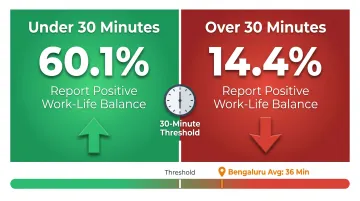
The mental toll compounds over time. A 2026 study of 481 Indian employees found that workers commuting over 30 minutes reported only 14.4% positive work-life balance, compared to 60.1% for those commuting under 30 minutes. For most Bengaluru commuters, whose average 10 km trip crosses 36 minutes even without peak-hour delays, that stress threshold isn't an edge case — it's the daily baseline. The question isn't whether the commute is a problem, but how much it's costing you.
Popular Ways People Commute to the Office (and Their Real Trade-offs)
Personal vehicles account for 35–45% of motorised trips in Indian cities, while public transport covers only about 25%. Here's an honest look at every major option.
Driving Your Own Car or Bike
The most popular choice for good reasons — flexibility, door-to-door convenience, and coverage in areas where buses and metros don't reach. But the costs add up fast.
A typical Bengaluru commuter on a petrol scooter covering 15 km each way spends roughly ₹1,400–1,560/month on fuel alone (at ₹106/litre and 45–50 kmpl real-world mileage). Add ₹213–458/month in servicing, insurance, parking fees (₹15/hour for two-wheelers in commercial areas), and EMI if the vehicle is financed — and the actual monthly cost crosses ₹3,500–5,000 comfortably.
Then there's the traffic fatigue. Riding in stop-start congestion for 45+ minutes twice a day is physically draining in a way that passengers rarely notice until they stop doing it.
Public Transport (Metro, Bus, Train)
The case for public transit is real: a fraction of the monthly cost of owning a vehicle, zero driving stress, and the ability to use travel time productively. A metro commuter can listen to a podcast, respond to messages, or simply rest — none of which are possible while weaving through traffic.
The honest limitation is last-mile connectivity. An IISc study found that Bengaluru commuters living more than 2 km from metro stations tend to revert to private vehicles — essentially making the metro unusable for a large portion of the city's population.
Auto-Rickshaws and Cab Aggregators
Autos and app-based cabs (Ola, Uber, Rapido) fill the first/last-mile gap effectively but expensively. Daily commuters who rely on ride-hailing for the full route can spend ₹6,000–12,000/month — more than most people spend on a petrol scooter including all running costs.
The daily friction is real:
- Surge pricing spikes precisely when you need a ride most — peak hours, rain, and Monday mornings
- Wait times are unpredictable, turning a 10-minute buffer into a late arrival
- No consistent monthly cost, making budgeting difficult
Cycling and Walking
Genuinely good options for commutes under 4–5 km — zero cost, good for health, zero emissions. The practical barriers are real though: road safety concerns, Bengaluru's heat from March through June, and the absence of dedicated cycling infrastructure on most routes. For commutes beyond 5 km or routes without footpaths, neither option holds up as a daily solution.
Electric Scooters (Owned or Rented)
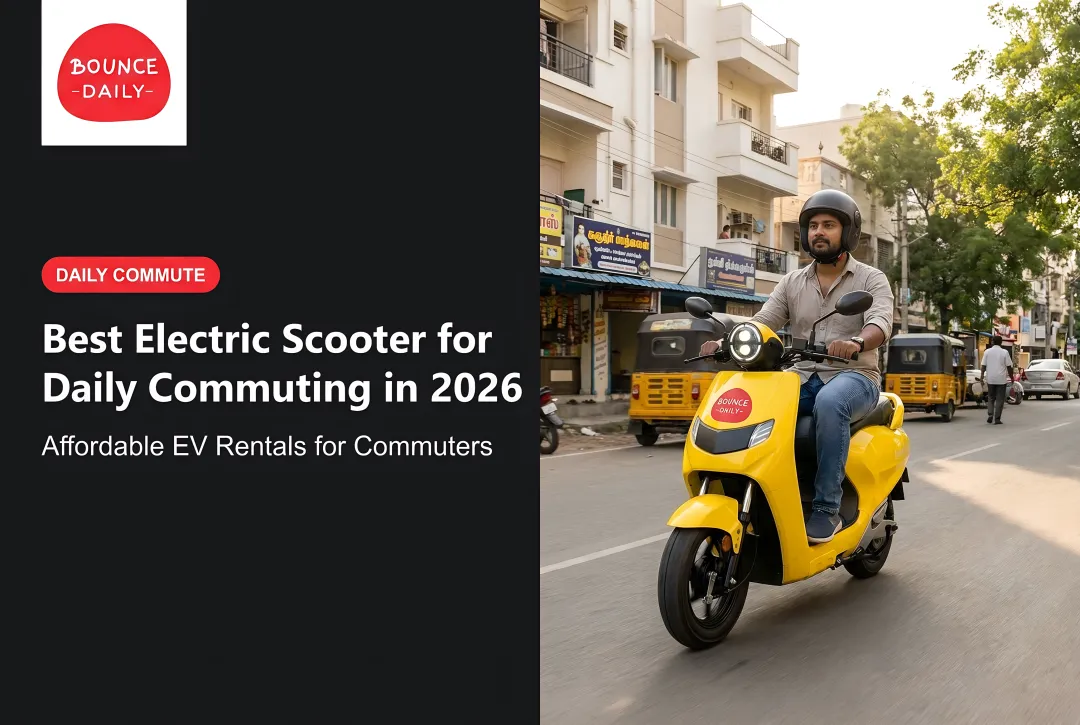
Electric scooters give you the flexibility of a personal vehicle without fuel costs, maintenance bills, or parking fees at most destinations. For Bengaluru commuters, rentals through services like Bounce Daily mean no upfront purchase, no EMI, and no breakdown headaches — just ride and swap the battery when needed.
Practical Tips to Simplify Your Daily Office Commute
Small, consistent changes have more impact than most people expect.
Prepare the Night Before
A five-minute routine the evening before eliminates the rushed, reactive start that makes commutes feel worse before they've begun. Run through this before you sleep:
- Pack your work bag and lay out everything you need
- Charge devices, power banks, or your scooter if applicable
- Check tomorrow's weather and your planned route
If you're targeting a 7:30 AM departure to beat Bengaluru's morning peak, this prep is what makes that departure time actually stick.
Time Your Commute Strategically
Bengaluru's evening rush is worse than the morning — average congestion hits 115.2% between 4–7 PM versus 94.2% in the morning peak. On the morning side, leaving at 6 AM versus 8 AM can shave 6–11 minutes off a 10 km trip, based on TomTom's hourly congestion data. That's 10–22 minutes saved daily, or roughly 3–4 hours per month.
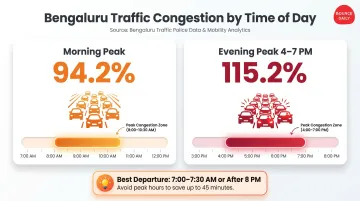
For most Bengaluru commuters, a 7:00–7:30 AM departure or a post-8 PM return consistently beats the worst congestion windows.
Use Your Commute Time Productively
- Public transit commuters: Use travel time for podcasts, audiobooks, task planning, or language learning — not passive scrolling
- Vehicle commuters: A curated playlist or a useful podcast transforms a stressful drive into something resembling a mental reset
- Two-wheeler commuters: Hands-free audio via earphones (one ear only, for safety) works well for audio content
Even a 30-minute commute adds up to 10+ hours monthly — enough to finish a book, complete an online course module, or simply decompress before the workday starts.
Choose Your Route Wisely
Check Google Maps or Waze before leaving, not after you're already in traffic. The 2-minute check before departure can save 15 minutes mid-route. Map out 2–3 alternate routes for your regular commute in advance and learn the secondary roads that bypass known bottleneck stretches — that familiarity pays off when traffic apps reroute you somewhere unfamiliar.
How Much Is Your Daily Commute Really Costing You?
Most people track fuel costs and nothing else. Here's what a realistic monthly cost looks like for a Bengaluru commuter doing a 15 km one-way commute:
| Cost Component | Monthly Cost (Petrol Scooter) |
|---|---|
| Fuel (660 km/month at ₹106/litre, 47 kmpl) | ₹1,480 |
| Servicing and maintenance | ₹213–458 |
| Parking (commercial area, 2 hrs/day) | ₹660 |
| Insurance (amortised monthly) | ₹150–250 |
| Total monthly running cost | ₹2,500–2,850 |
| Vehicle EMI (if financed) | +₹2,500–3,500 |
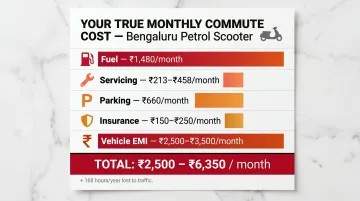
That's before accounting for the 168 hours per year lost to congestion — equivalent to over 4 working weeks that simply disappear into traffic.
The environmental cost runs parallel. India's two-wheeler fleet averages 41.2 gCO2 per kilometre, meaning a 15 km one-way commute generates roughly 550 kg of CO2 annually — from a single vehicle, for a single commuter. Bengaluru's AQI hit an average of 143 in 2025, the worst in five years. Each petrol commute adds directly to that figure. Switching to an electric scooter eliminates that contribution entirely.
Why More Commuters Are Switching to Electric Scooters
The economics have genuinely shifted. Running an electric scooter costs approximately ₹0.15–0.35 per kilometre in electricity, compared to ₹2.00–2.50 per kilometre for a petrol scooter depending on fuel price and mileage. On a 660 km monthly commute, that's the difference between roughly ₹1,320–1,650 in fuel and roughly ₹99–231 in electricity — an 82–94% reduction in energy costs alone.
Beyond fuel, the savings keep stacking:
- Zero parking fees at most locations
- Lower maintenance costs (electric motors have far fewer moving parts than petrol engines)
- No surprise repair bills
The financial case is clear.
The Upfront Cost Problem — and the Rental Solution
The obvious barrier to switching is the purchase price. A decent electric scooter costs ₹80,000–1,20,000 upfront — the same as a petrol scooter — plus EMI, insurance, and the ongoing responsibility of ownership.
Renting removes all of this. Instead of buying, commuters pay a single predictable monthly rental that includes the vehicle, insurance, maintenance, and breakdown support. No EMI. No insurance renewal. No servicing appointments. No depreciation concerns.
Bounce Daily: Purpose-Built for Bengaluru Commuters
Bounce Daily (the EV rental service from Bounce Infinity) offers daily electric scooter rentals in Bengaluru with two variants designed for different commute needs:
| Feature | High Speed Variant | Low Speed Variant |
|---|---|---|
| Top speed | 55 km/h | 25 km/h |
| Range | 70 km | 85 km |
| Battery | Chargeable + swappable | Swappable |
| License required | Yes (two-wheeler DL) | driving licence assistance (available for a nominal ₹200-₹230 fee) at hub |
| Best for | Cross-city commutes | Short-radius, first-time riders |
The low-speed variant is particularly notable for accessibility to students and first-time riders. driving licence assistance (available for a nominal ₹200-₹230 fee) is available at our hub — visit us or check our app to know more.
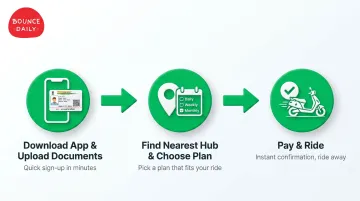
Onboarding takes minutes through the Bounce Daily Android app:
- Download the app and upload your Aadhaar (plus DL for the high-speed variant)
- Locate your nearest hub and choose a daily, weekly, or monthly plan
- Pay and ride
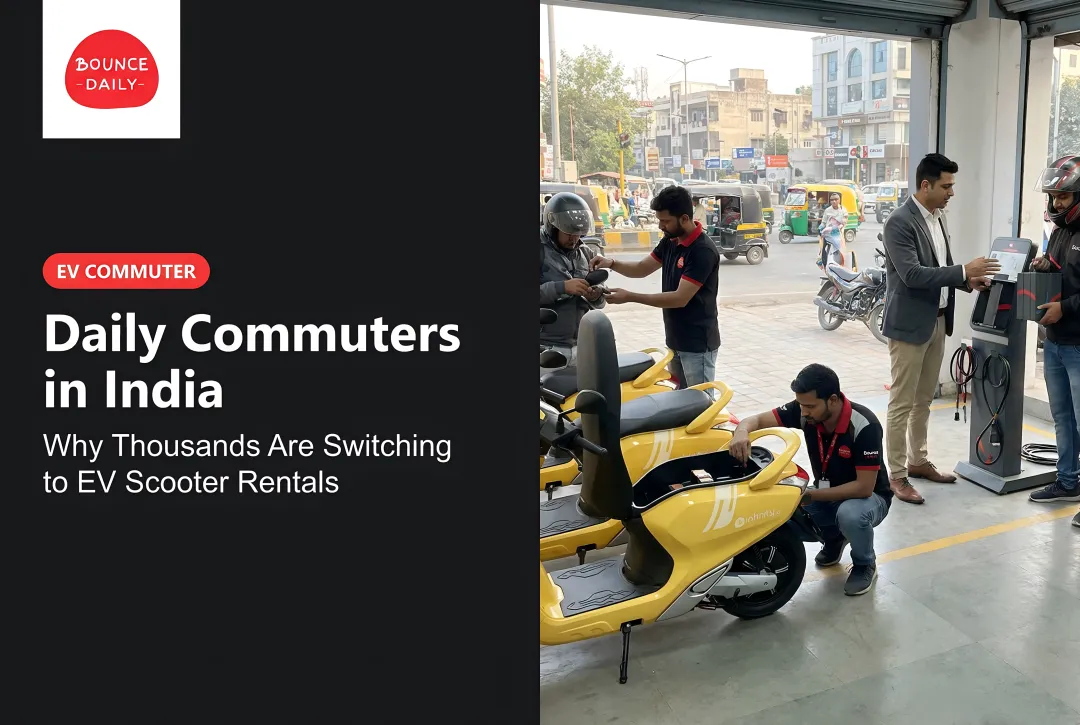
Battery swaps are walk-in, included in every plan, and take about as long as filling petrol.
Every rental includes insurance, GPS tracking, anti-theft, and breakdown support — Bounce manages the vehicle, you just ride it.
The fleet has collectively covered 30M+ kilometres and helped avoid over 10,000 tonnes of CO2 to date. For Bengaluru commuters, that translates to real money saved daily and measurably cleaner air on roads that carry millions of two-wheelers every morning.
Frequently Asked Questions
What does daily commute to the office mean?
A daily office commute is the regular journey between home and workplace on working days, using any mode of transport. It typically refers to both directions — the morning trip in and the evening trip home.
What is a daily commute expense?
Commute expenses cover all direct and indirect costs of travelling to work: fuel or transit fares, parking, vehicle wear-and-tear, and insurance — plus the time you spend in transit each day, which adds up fast.
How do you commute to the office?
Common options include personal vehicle (car or two-wheeler), metro, bus, auto-rickshaw, app-based cabs, cycling, or electric scooter rental. For Bengaluru commuters, combining metro for the main stretch with an electric scooter rental for last-mile connectivity is increasingly the most cost-effective setup.
How can I reduce my daily commute cost in Bengaluru?
Switch to public transit for the main stretch where metro coverage exists, use an electric scooter rental for last-mile connectivity, time your departure to avoid peak-hour congestion windows (before 7:30 AM or after 7:30 PM), and consider carpooling for longer highway stretches.
Is renting an electric scooter better than buying one for daily commuting?
For most daily commuters, yes. Renting eliminates the upfront purchase cost (₹80,000–1,20,000), ongoing insurance, maintenance appointments, and depreciation. Services like Bounce Daily bundle insurance, maintenance, and GPS tracking into a monthly plan — converting unpredictable ownership costs into one fixed payment.
What is a reasonable commute time in Indian cities?
It varies significantly — Hyderabad averages 18 minutes for 10 km, while Bengaluru averages 36 minutes. Research shows commutes over 30 minutes one-way are linked to lower work-life balance and productivity; anything beyond 45–60 minutes is worth actively trying to cut down.