2026 is a particularly good year to make the switch. The PM E-DRIVE scheme has extended incentive eligibility for electric two-wheelers through July 2026, battery ranges have improved meaningfully across price points, and public charging infrastructure now covers over 14,000 stations nationally. The practical barriers that once held buyers back — range anxiety, sparse service networks, limited model choice — have largely been addressed.
This guide covers everything you need to choose the right commuter e-scooter for Indian city riding: what to look for, which five models stand out in 2026, and how to think through the decision based on your city, commute distance, and budget.
Key Takeaways
- Electric scooters now cover the 20–50 km daily commutes typical of Indian urban riders on a single charge, with claimed ranges of 143–320 km across top models
- Key buying factors: real-world range, charging access, ride comfort, and service network density
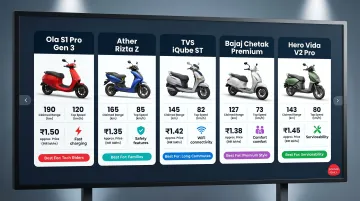
- Top 2026 picks include the Ola S1 Pro Gen 3 (tech-forward), Ather Rizta Z (family commuter), TVS iQube ST (serviceability), Bajaj Chetak Premium (build quality), and Hero Vida V2 Pro (budget value)
- Not buying yet? Bounce Daily's EV rental service in Bengaluru puts you on an electric scooter from day one, with no upfront cost, no EMI, and maintenance fully covered
Why Electric Scooters Are Perfect for Daily Commuting in India
The average Indian urban commuter travels roughly 20–50 km per day. Every scooter on this list claims well over 100 km per charge — meaning most city riders can comfortably go two days on a single overnight charge. Range anxiety isn't a real concern for typical city use.
The Cost Difference Is Substantial
Petrol scooter ownership costs add up fast. Bounce Daily's cost data for Bengaluru-based delivery riders breaks it down:
- Fuel: ₹3,000–4,500/month (at 50–80 km/day, ₹100–110/litre, ~40–45 km/L mileage)
- Servicing, oil changes, brake wear: ₹500–800/month additional
Electric scooters cut the per-km energy cost significantly. At typical domestic electricity tariffs, charging a 3–5 kWh battery costs a fraction of equivalent petrol:
| Mode | Cost per km (city conditions) |
|---|---|
| Electric scooter | ₹0.30–0.50 |
| Petrol scooter | ₹2.50–3.50 |
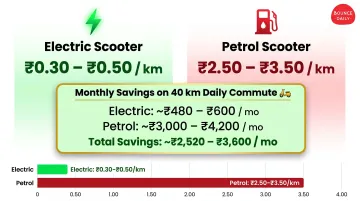
Over a 40 km daily commute, that difference compounds to meaningful monthly savings.
For daily commuters in Bengaluru who rely on autos or ride-hailing at ₹250–400/day, the monthly bill runs ₹6,000–12,000. An owned electric scooter — or a monthly rental through a service like Bounce Daily — substantially undercuts that figure.
The numbers make a strong case for switching. The harder question is matching the right scooter to your specific route, riding style, and budget.
What to Look for in a Daily Commuter E-Scooter
Range and Battery Type
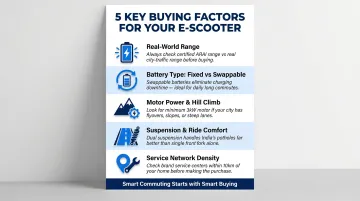
Real-world range (not the IDC or claimed figure on the spec sheet) is what matters. Manufacturer-claimed ranges can be 30–40% higher than what riders actually see at typical city speeds, with a pillion, on undulating roads. Treat any claimed figure as an upper ceiling, not a guarantee.
Battery type also matters for your living situation:
- Fixed-battery models require home or public charging — suitable if you have dedicated parking with a plug point
- Swappable-battery models work for apartment dwellers, PGs, or riders without charging infrastructure; swap a depleted battery at a hub in minutes, the way you'd fill petrol
Motor Power and Hill Performance
For flat city riding, a 3–5 kW motor is adequate. If your commute includes sustained inclines (common in Bengaluru, Pune, and Hyderabad), prioritise peak torque and hill-climb ability over top speed. A scooter rated at 82 km/h that struggles on a 12% gradient is a poor commuter choice for hilly cities.
Ride Comfort and Suspension
Indian urban roads demand real suspension — broken stretches, speed breakers, and crater-sized potholes are daily reality. Look for:
- Telescopic front forks (minimum baseline)
- Rear monoshock or adjustable hydraulic twin-tube
- Tubeless tyres (puncture resistance directly reduces commuter downtime)
Charging Infrastructure and Speed
Home charging overnight is the norm for most riders. Fast-charging support matters if you run high daily distances or occasionally skip a nightly charge. Ola's Hypercharger network claims 50 km range in 12 minutes; Ather Grid puts 30 km back in roughly 10 minutes — real options worth checking against your route.
After-Sales Service and Warranty
For a daily driver, service network density matters more than brand prestige. A breakdown in a city with no nearby service centre costs you a day of work. Before committing, check:
- TVS and Hero — deepest Tier-1 and Tier-2 coverage by volume
- Ola and Ather — expanding networks, but currently stronger in metros
- Your city specifically — look up the nearest authorised centre; a 40 km service trip on a broken scooter defeats the purpose of owning one
Best Electric Scooters for Daily Commuting in India in 2026
These five scooters were shortlisted based on real-world range, build reliability, commuter comfort, and value for money in the Indian market.
Ola S1 Pro Gen 3
Ola Electric is India's highest-selling EV brand by volume, and the S1 Pro Gen 3 is their flagship commuter offering. It comes with one of the longest certified ranges in the segment across three battery variants (3 kWh, 4 kWh, and 5.2 kWh), with OTA software updates delivered via the MoveOS platform.
For tech-forward urban riders, the standout package includes a large touchscreen dashboard, multiple regenerative braking modes, Hyper mode for spirited riding, and access to the Ola Hypercharger fast-charging network. If performance headroom and a connected experience matter to you, it's the strongest pick in this list.
| Spec | Details |
|---|---|
| Claimed Range (IDC) | 176 km (3 kWh) / 242 km (4 kWh) / 320 km (5.2 kWh) |
| Claimed Top Speed | Up to 130 km/h (5.2 kWh variant) |
| Approx. Ex-Showroom Price | Starting ~₹1,24,999 (verify current pricing at Ola configurator) |
Note: All figures above are manufacturer-claimed. Independent real-world range tests for the Gen 3 are limited — validate through recent Indian road tests before purchase.
Ather Rizta Z
Bengaluru-based Ather Energy built its reputation on build quality and OTA updates, and the Rizta Z is their family-commuter focused scooter. It offers a wider deck, a comfortable upright riding posture, and 56 litres of combined storage — practical for daily grocery runs or carrying a laptop bag.
The AtherGrid fast-charging network adds approximately 30 km in ~10 minutes (claimed) — useful on long workdays. Among urban professionals, Ather also holds one of the stronger resale values in this segment. Real-world owner reports on the 2.9 kWh variant suggest 105–115 km in mixed city riding, which is worth weighing alongside the official IDC figure.
| Spec | Details |
|---|---|
| Claimed Range (IDC) | Up to 159 km |
| Claimed Top Speed | ~80 km/h |
| Approx. Ex-Showroom Price | ~₹1.33 lakh (Bengaluru); verify on Ather configurator |
TVS iQube ST
TVS Motor brings decades of two-wheeler manufacturing credibility to the iQube ST — and for commuters who prioritise serviceability, that matters. The iQube ST's biggest advantage isn't any single spec; it's the fact that a TVS service centre is rarely far away, even in smaller cities.
Disc brakes front and rear, IP67 water resistance (rated for monsoon riding), and connected features via the SmartXonnect app round out a well-built daily commuter. The large owner base also means real-world reliability data is easy to find before you commit.
| Spec | Details |
|---|---|
| Claimed Range (IDC) | 212 km (5.3 kWh variant) |
| Claimed Top Speed | 82 km/h |
| Approx. Ex-Showroom Price | ~₹1.55 lakh (verify current city pricing on TVS site) |
Bajaj Chetak Premium
The Chetak nameplate carries significant emotional weight in India, and the 2025 Premium model earns its reputation on substance rather than nostalgia. The all-metal body construction is uncommon at this price point — most competitors use plastic panels that show wear faster.
Riding dynamics are smooth and refined, and IP67 water resistance is confirmed for monsoon conditions. Bajaj's established dealership network keeps servicing straightforward across India. The 0–80% charge time of ~3 hours 25 minutes is among the fastest standard-charge times in this list — a practical edge if you're working with a shorter overnight window.
| Spec | Details |
|---|---|
| Claimed Range | Up to 153 km (3.5 kWh battery) |
| Claimed Top Speed | 73 km/h |
| Approx. Ex-Showroom Price | Check city-specific pricing on Chetak configurator |
Hero Vida V2 Pro
Hero MotoCorp operates India's largest two-wheeler dealer network, and for commuters in Tier-2 cities — or anyone who values proximity to a service centre — that network depth is a genuine advantage.
The Vida V2 Pro is the value pick here: competitive pricing, solid real-world range for typical Indian commutes, and no meaningful compromises on daily usability. The removable battery option is particularly useful for apartment dwellers who can carry it indoors to charge rather than relying on building parking access. Standard charging runs ~5.15 hours — the slowest in this group — so overnight charging discipline matters.
| Spec | Details |
|---|---|
| Claimed Range | ~143 km |
| Claimed Top Speed | 85 km/h |
| Approx. Ex-Showroom Price | ~₹1,45,000 (Bengaluru ex-showroom; verify on Hero Vida site) |
How We Chose the Best Electric Scooters for Commuting
The shortlist was built around commuter-first criteria — not spec sheet bragging rights. Every model here was evaluated on:
- Real-world range verified through independent Indian EV reviewers (not IDC or OEM marketing claims)
- Ride comfort on mixed urban terrain, including broken roads and speed breakers
- Charging practicality — home charging overnight plus fast-charge access where available
- After-sales reliability — service centre density in Tier-1 and Tier-2 cities
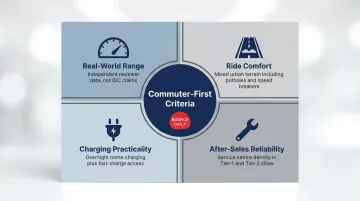
These criteria catch problems that spec sheets hide. Before you shortlist a model, there are a few common traps worth knowing.
Common Buying Mistakes to Avoid
- IDC range figures run 30–40% above real-world city speeds — always check independent reviewer tests
- No nearby service centre makes any scooter a liability for daily use, regardless of brand reputation
- Top speed above 80 km/h is irrelevant for urban commuting; prioritise comfort and range instead
Not Ready to Buy? Consider Renting First
For riders in Bengaluru who want to experience electric commuting without the upfront cost, Bounce Daily offers a practical alternative. Their rental fleet runs two variants — High Speed (55 km/h, 70 km range) and Low Speed (25 km/h, 85 km range) — on daily, weekly, and monthly plans, with battery swaps, maintenance, insurance, and GPS tracking all handled centrally.
Getting started takes under a day:
- Download the Bounce Daily Android app
- Upload your Aadhaar (plus DL if renting the High Speed variant)
- Locate the nearest Bounce hub
- Pick up your scooter — same-day activation is standard
Karanbir Das, a delivery partner who has used the service for over a year, puts it simply: "Way more cost-effective than petrol bikes, and I've never faced any issues with the battery."
Conclusion
The best commuter electric scooter in 2026 depends on your specific situation:
- Tech and performance: Ola S1 Pro Gen 3
- Family commuting and comfort: Ather Rizta Z
- Service network depth: TVS iQube ST
- Build quality and refinement: Bajaj Chetak Premium
- Budget and wide dealer access: Hero Vida V2 Pro
Whichever you choose, verify real-world range through recent Indian road tests, confirm fast-charging availability in your city, and check PM E-DRIVE scheme eligibility before finalising your purchase. The incentive window runs through July 2026.
If you're a gig worker, delivery partner, or new EV adopter in Bengaluru who isn't ready to commit ₹1.25–1.55 lakh upfront, Bounce Daily's electric scooter rental model offers a zero-investment entry point. There's no EMI, no servicing hassle, and no fuel cost: just sign up on the app and ride the same day.
Frequently Asked Questions
Is an electric scooter good for commuting?
Yes. For typical Indian urban commutes of 20–50 km per day, modern electric scooters are well-suited. Running costs are significantly lower than petrol bikes, maintenance is minimal, and most models handle city traffic and parking more easily than larger vehicles.
Which electric scooter is best for daily use in India?
The Ola S1 Pro Gen 3, Ather Rizta Z, and TVS iQube ST are the strongest all-round daily commuter picks in 2026. The right choice depends on your budget, how much you value fast-charging access versus service network coverage, and whether tech features or build simplicity matter more to you. If you'd rather skip the upfront cost entirely, EV rental services like Bounce Daily offer a flexible alternative — no EMI, no maintenance, just a monthly plan.
Which electric scooter has the longest range for commuting?
The Ola S1 Pro Gen 3 leads on claimed range (up to 320 km for the 5.2 kWh variant), but real-world figures will be lower. Rider weight, speed, terrain, and AC/accessory use all reduce range. For most 40–60 km daily commutes, any model on this list is sufficient on a single charge.
What is the best electric scooter for long-distance commuting for adults?
For commutes above 60 km per day, the Ola S1 Pro Gen 3 or Ather Rizta Z are the better choices, given their larger battery options and fast-charging network access. Fast-charging infrastructure becomes a critical deciding factor once daily distances push toward 80–100 km.
Which electric scooter has the highest top speed?
The Ola S1 Pro Gen 3 claims 130 km/h on the 5.2 kWh variant, the highest in this group. For daily urban commuting in India, top speed matters far less than real-world range, suspension comfort, and the availability of a nearby service centre.