Introduction
India's 10 million gig workers face a daily challenge: they need reliable, affordable two-wheelers to earn a living, but upfront costs and maintenance burdens make vehicle ownership difficult. Many delivery partners and e-commerce riders struggle with petrol bike expenses, loan repayment stress, and vehicle downtime that directly cuts into their income.
The FOCO (Franchise Owned, Company Operated) model addresses this directly: entrepreneurs provide the fleet capital, and brands like Bounce Daily handle all daily operations, rider onboarding, and maintenance.
The model solves two problems at once. Gig workers get affordable EV access without ownership costs. Investors enter India's EV rental market without operational complexity. According to NITI Aayog estimates, India's gig workforce will more than double — from 1 crore in 2024-25 to 2.35 crore by 2029-30 — creating sustained demand for rental two-wheelers.
If you're an investor or entrepreneur weighing franchise opportunities in India's electric mobility sector, this guide breaks down exactly how the asset-light FOCO model works — and what returns it can realistically generate.
Key Takeaways
- You invest in the EV fleet; the brand manages operations, riders, and maintenance
- Ownership means collecting returns, not managing staff or daily logistics
- India's 14.7 million platform gig workers create built-in demand for EV rentals
- FOCO lowers operational risk by centralizing fleet management under the brand
- Ideal for first-time investors who want predictable returns without day-to-day operational burden
What Is the FOCO Model?
FOCO stands for Franchise Owned, Company Operated. The franchise partner provides capital and owns the physical assets — typically the rental fleet or outlet space — while the brand controls and executes all daily operations: staffing, logistics, customer handling, quality control, and service delivery.
How FOCO compares to other franchise structures:
| Model | Who Owns Assets | Who Runs Operations | Investor's Role |
|---|---|---|---|
| FOCO | Franchise partner | Brand/Company | Capital provider only |
| FOFO | Franchise partner | Franchise partner | Capital + day-to-day management |
| COCO | Brand/Company | Brand/Company | No franchise involvement |
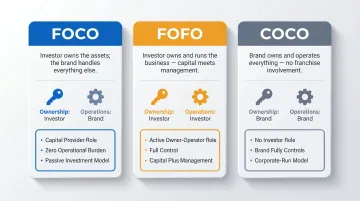
The FOCO structure is "asset-light" for the investor because capital flows into physical assets (vehicles, space), while human capital, operational systems, and management overhead stay with the brand. The partner earns returns without hiring staff, managing logistics, or building internal operations from scratch.
Why the FOCO Model Works for EV Rentals in India
High Demand, Low Ownership
India's gig economy creates a unique demand dynamic. Millions of delivery partners and e-commerce riders need two-wheelers daily but cannot or do not want to purchase one outright. Research from Prosus and CII estimates that platform-based gig workers will increase by 60% to reach 23.5 million by FY 2029-30. Kearney projects that 25-30% of gig workers will prefer rental or leasing models over outright purchase to avoid high upfront costs. This creates steady, recurring rental demand that directly benefits franchise partners.
EV Economics Strengthen the Model
Electric two-wheelers offer a clear cost advantage over petrol bikes. CEEW reports that electric two-wheelers offer a total cost of ownership (TCO) of ₹1.48/km versus ₹2.46/km for petrol models — approximately 40% cheaper. The Prosus/CII study puts the E2W TCO advantage even higher at 57.5% lower than ICE (internal combustion engine) counterparts, with fleet operators seeing 70-80% fuel cost savings.
What this means for franchise partners:
- Riders are more likely to rent EVs due to lower running costs
- Higher rider stickiness translates to consistent utilization rates
- Better unit economics improve revenue predictability
Operational Complexity Requires Brand-Level Systems
Those cost advantages only hold if the fleet is managed well. The EV rental sector demands:
- Fleet condition checks and battery health monitoring
- Charging or battery swap infrastructure that riders can count on
- Rider onboarding with license and identity verification
- GPS tracking and real-time usage monitoring
- Maintenance response before downtime cuts into earnings
These tasks require brand-level systems, not just individual operator knowledge. Without centralized management, EV rentals often suffer from inconsistent maintenance, poor rider vetting, untracked vehicle usage, and revenue leakage. FOCO removes these risks by keeping operations under the brand's control while allowing the partner to earn from the asset.
Policy Tailwinds Support Growth
India's policy environment strongly supports EV adoption. The PM E-DRIVE scheme (successor to FAME II) allocates ₹10,900 crore targeting 24.79 lakh electric two-wheelers. State-level policies add momentum — Karnataka's Clean Mobility Policy 2025-30 targets ₹50,000 crore in investments, offers zero road tax on EVs, and provides 25% subsidies for battery swapping stations.
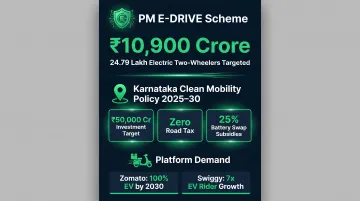
Delivery platforms are moving fast in the same direction. Zomato targets 100% EV-based deliveries by 2030 and has piloted EV rental fleets for delivery partners. Swiggy's EV delivery partner count grew 7x in the last year.
With policy subsidies reducing infrastructure costs and platforms actively pushing riders toward EVs, the rental demand side is already building. A FOCO franchise positions partners to capture it without taking on the full capital risk of fleet ownership.
How the FOCO EV Rental Model Works
The model follows a simple four-step cycle: the franchise partner invests in the fleet, Bounce Daily deploys operations and onboards riders, verified gig workers rent daily and generate revenue, and the partner earns returns while the brand handles everything in between.
Step 1: The Franchise Partner Invests in the Fleet
The partner's involvement begins and ends with the capital commitment. They fund the acquisition of EV scooters and, where applicable, the rental hub space. No operational setup, staffing, or vendor coordination is required from the partner's side. The investment covers the physical assets — the vehicles themselves — while the brand takes responsibility for deploying them effectively.
Step 2: The Brand Deploys Operations and Onboards Riders
After investment, the company handles:
- Fleet deployment to the rental hub location
- Digital rider onboarding and verification (Aadhaar + driving license)
- Setting rental pricing and terms
- Managing charging or battery swap logistics
- Establishing the local rental hub infrastructure
Bounce Daily's app handles instant digital verification, letting riders upload documents and get approved without manual review. The company manages vehicle maintenance, tracking, and uptime centrally, so partners never need to recruit or vet riders themselves.
Step 3: Riders Rent Daily, Partner Earns Revenue
Verified gig workers — e-commerce delivery partners, food delivery riders — rent scooters on a daily or shift basis, generating consistent rental income. The partner receives their share of this revenue without being involved in any individual transaction or rider interaction. The brand collects payments, manages customer relationships, and distributes earnings to the franchise partner according to the partnership agreement.
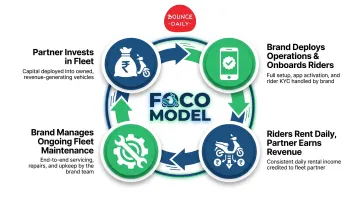
Step 4: Ongoing Fleet Management Stays with the Brand
Maintenance, battery health monitoring, vehicle servicing, and rider dispute resolution all remain the brand's responsibility. The partner owns the assets; Bounce Daily keeps them running, serviced, and occupied — without requiring the partner's day-to-day involvement.
What Franchise Partners Get Under the FOCO Model
Comprehensive Operational Support
The brand manages:
- Fleet maintenance, tracking, and uptime monitoring
- Rider onboarding systems with digital verification
- Daily hub operations and customer service
- Battery swap or charging logistics
The partner's day-to-day involvement is minimal once the initial investment is made. Bounce Daily's digital onboarding process keeps setup delays short, so the hub can start generating rental income quickly.
Built-In Customer Pipeline
Bounce Daily brings a pipeline of verified, active gig workers who already need rentals — delivery riders sourced directly through the brand's network. The franchise partner does not need to find customers or manage acquisition at all.
Marketing and Local Visibility
Marketing creatives, local visibility campaigns, and digital assets are provided as part of the partnership. Partners receive training on how to promote their hub, so brand communication and customer acquisition are handled through Bounce Daily's system — not figured out independently.
Genuinely Asset-Light Investment
The partner owns the fleet (asset) but does not carry staff costs, operational overhead, or working capital stress beyond the initial investment. The fleet earns rental income under Bounce Daily's operational system while the partner stays hands-off. That separation of ownership from operations is what keeps execution risk low.
Common Misconceptions About FOCO EV Franchises
"FOCO Means Zero Involvement"
FOCO does reduce day-to-day operational burden, but it doesn't mean zero partner accountability. The partner still plays an important role in:
- Choosing the hub location strategically
- Meeting investment commitments and timelines
- Staying informed about fleet performance and utilization
Passive income is not the same as zero accountability. Partners need to understand their market and review performance data to ensure their investment is being deployed effectively.
"FOCO Is Like a Fixed Deposit"
Unlike a fixed deposit or mutual fund, FOCO involves owning a physical asset — vehicles, space — with real operational risk, even if the brand handles day-to-day management. There are no guaranteed interest payouts.
Returns depend on fleet utilization rates, local demand, rider activity, and seasonal fluctuations. Revenue tracks directly with how much the fleet gets rented, not a fixed financial schedule.
"FOCO Is Only for Large Investors"
Smaller fleet sizes are a perfectly valid starting point. Partners can launch lean and scale as local demand grows — the modular nature of EV fleets makes this straightforward. While exact investment thresholds vary by brand, the FOCO structure is built to lower entry barriers compared to fully self-operated businesses, making it accessible to first-time investors as much as experienced operators.
Frequently Asked Questions
What is the FOCO model in a franchise in India?
FOCO stands for Franchise Owned, Company Operated. The investor owns the hub or fleet while the brand manages all daily operations — staffing, logistics, customer service, and maintenance. It's a low-involvement investment structure designed to generate returns without requiring the partner to run the business day-to-day.
How does an EV rental franchise partner earn money under the FOCO model?
The partner earns a share of rental revenue generated when gig workers or commuters rent the EV fleet daily. The brand collects payments, manages transactions, and distributes earnings to the partner according to the franchise agreement.
What is the difference between FOCO and FOFO in EV franchising?
In FOCO, the brand manages operations so the partner is not involved in daily management, hiring, or execution. In FOFO (Franchise Owned, Franchise Operated), the partner both owns and operates the outlet, requiring active involvement, staff management, and operational expertise — essentially running the business independently.
Who handles fleet maintenance in a FOCO EV rental model?
Fleet servicing, battery management, scheduled maintenance, and breakdown response are the brand's responsibility under FOCO. The partner owns the vehicles but plays no role in keeping them operational — all upkeep remains centralized under the brand.
Is the FOCO model suitable for first-time investors with no prior business experience?
Yes. FOCO works well for first-time investors because the brand handles all operational complexity. The partner needs to understand the investment terms and revenue structure, but no prior business experience or staff management is required.
What happens if rental demand is low in my area — does the brand guarantee returns?
FOCO does not guarantee fixed returns. Revenue depends on fleet utilization and local demand, which vary by location and season. Review the franchise agreement thoroughly — including any performance projections and support commitments — before committing capital.