Introduction
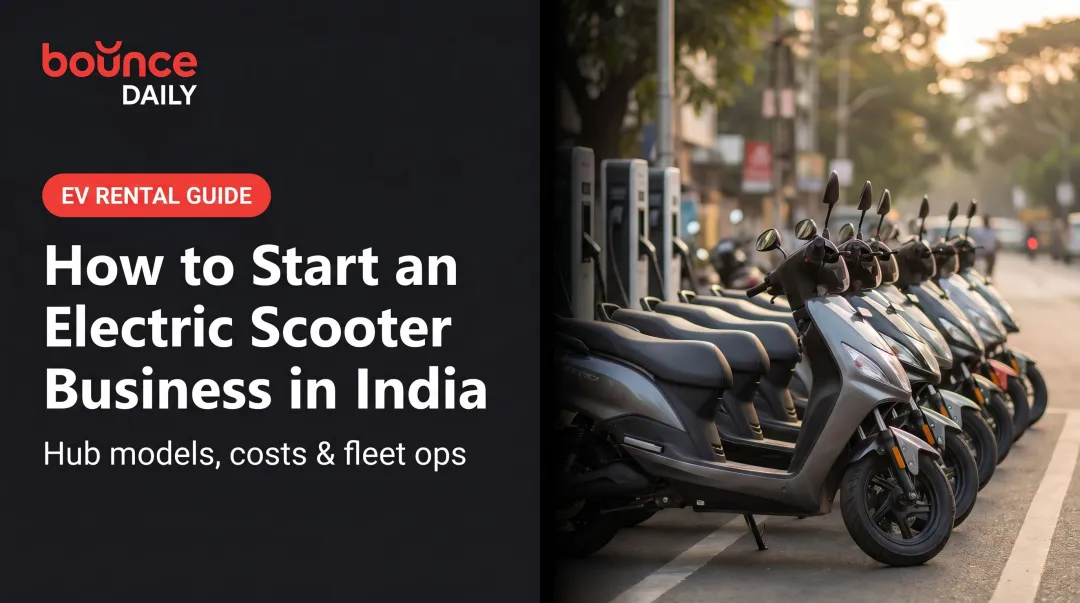
Scooter rental businesses in Indian cities like Bengaluru, Hyderabad, and Pune have experienced sharp growth over the past three to four years. This expansion is fueled by the boom in gig work, surging last-mile delivery demand, and India's aggressive push toward electric mobility. According to government data, India's gig workforce reached 1 crore (10 million) in 2024-25 and is projected to grow to 2.35 crore (23.5 million) by 2029-30—creating sustained demand for affordable two-wheeler rentals.
More people are now considering starting a scooter rental business: salaried professionals seeking secondary income, local entrepreneurs wanting recurring demand over seasonal footfall, and investors drawn to the EV opportunity.
This article breaks down what starting a scooter rental business in India actually involves, including the EV franchise route, covering validation, costs, compliance, operations, and customer acquisition in step-by-step detail.
Key Takeaways
- Scooter rental means managing a fleet and renting to gig workers or commuters — independently or through an EV franchise
- Demand is strong: electric scooters cost ₹0.15–0.35/km to run vs. ₹2.00–2.50 for petrol, making them the gig economy's preferred vehicle
- Independent setup covers sourcing, compliance, and customer acquisition; EV franchises handle most of this for you
- First revenue arrives in 2–4 weeks via franchise or 2–4 months if you build independently
- Key steps: validate location, choose business model, manage finances and legalities, build operations, and attract renters
What Is a Scooter Rental Business in India?
A scooter rental business involves making one or more scooters available to customers on a short-term or daily rental basis, collecting a recurring fee for each rental period. Customers get reliable, affordable access to a vehicle without the burden of ownership, insurance, or maintenance. The business owner earns from each rental.
Two common structures exist in India:
Independent owner-operator model: You buy the fleet, find customers, and manage everything yourself—full control, but higher effort and risk.
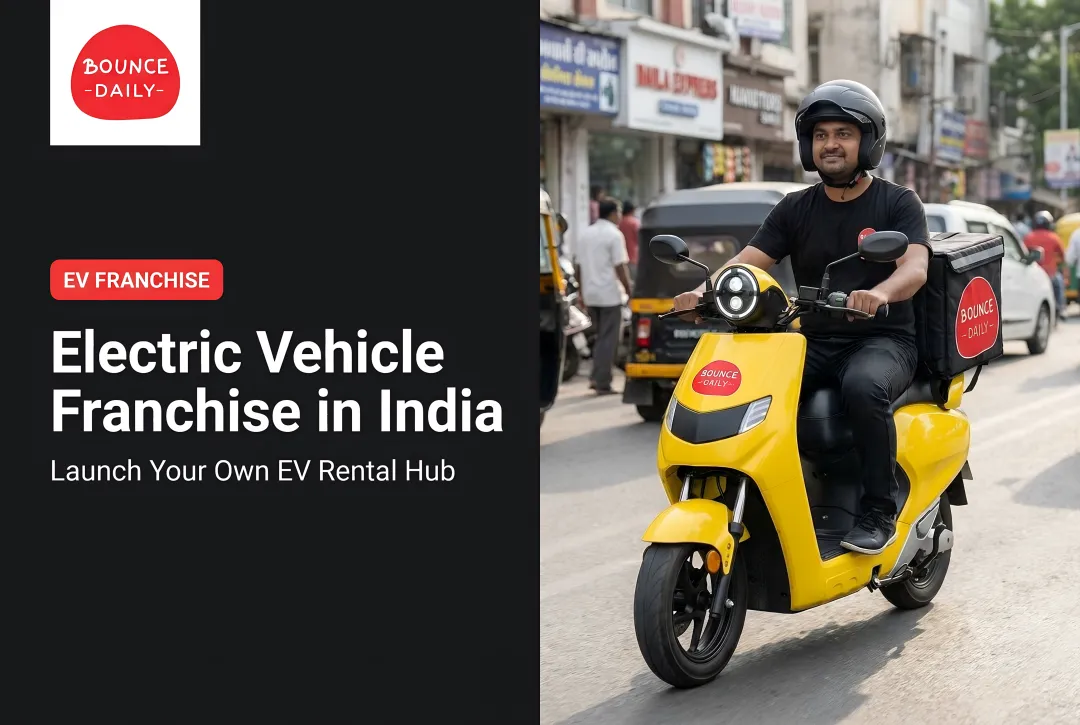
EV franchise model: You partner with an established brand that handles fleet management, customer sourcing, and support, while you own the assets and earn rental income. Bounce Daily, for example, provides digital onboarding, a steady flow of verified gig workers ready to rent, and support covering everything from training to marketing creatives—so you focus on ownership and earnings, not operations.
What to Know Before You Start a Scooter Rental Business
It's easy to focus on income potential and underestimate the day-to-day operational load. Scooters need to be available, charged or battery-swapped, maintained, and tracked. Even with a franchise model, the first few weeks demand active involvement — setup, rider onboarding, and learning the operational rhythm. The tasks below are what that looks like in practice.
Time and effort in the early stage:
- Setting up infrastructure (parking space, charging or swap stations)
- Onboarding riders and verifying documents
- Learning fleet tracking and maintenance schedules
- Building trust with your first customers
How long until steady income? Revenue starts once the fleet is active and riders begin renting. With consistent occupancy, most operators begin seeing predictable returns within the first 60-90 days. Break-even depends heavily on fleet size, daily rental rates, and location.
Two mistakes commonly delay profitability:
- Buying fleet before confirming demand — secure your location and test rider interest first
- Underpricing rentals — low rates shrink margins fast and are hard to walk back once riders expect them
Why Start an EV Scooter Rental Business in India?
Starting an EV scooter rental business makes operational sense under specific conditions: you're in a city with dense gig worker activity, have capital to invest in a small fleet, and want a business with predictable recurring demand.
Three factors make this a viable entry point right now:
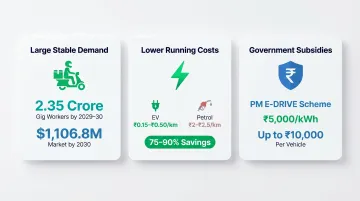
- Large, stable demand: The India bike and scooter rental market is projected to reach $1,106.8 million by 2030 at ~19% CAGR. India's gig workforce is expected to more than double by 2029-30, and delivery partners from Swiggy, Zomato, Amazon, and Flipkart need reliable daily vehicles. Zomato's EV delivery fleet alone reached 27,884 vehicles by March 2024, nearly double the previous year.
- Lower running costs improve margins: Electric scooters cost ₹0.15–₹0.50 per kilometre to run versus ₹2–₹2.5 per km for petrol, a 75–90% reduction in fuel costs. Riders pay less per shift; owners retain more per vehicle.
- Government subsidies lower your entry cost: India's PM E-DRIVE scheme (which replaced FAME II) provides ₹5,000 per kWh in Year 1, capped at ₹10,000 per vehicle. For low-speed scooters (below 25 km/h and 250W), driving licence assistance (available for a nominal ₹200-₹230 fee) is available at our hub - visit us or check our app to know more - which opens up a broader pool of potential renters.
These conditions together reduce the three biggest risks in a rental business: demand uncertainty, operating costs, and renter eligibility. For first-time operators, partnering with an EV franchise like Bounce Daily adds another layer of support — verified delivery partner demand, fleet management, and marketing resources — without requiring you to build that infrastructure from scratch.
How to Start a Scooter Rental Business in India – Step by Step
This section breaks the process into six practical stages. Common mistakes include rushing to buy scooters before confirming demand, underpricing rentals, and delaying legal setup.
Step 1 – Validate Market Demand and Choose Your Location
Before spending a rupee on scooters, confirm that enough renters exist in your chosen area.
Identify genuine daily demand:
- Look for areas with high delivery partner activity
- Target industrial zones and residential clusters near logistics hubs
- Focus on metro-adjacent neighbourhoods where last-mile commuting is common
- Check proximity to corporate parks or transit points
Talk to potential renters before investing:
- Understand how much they currently spend on fuel
- Ask whether they prefer daily or weekly rental agreements
- Learn their typical riding range per day
- Gauge their willingness to switch to electric
Common mistake: Choosing a location based on availability of space rather than density of renters. A low-demand area will keep your fleet idle regardless of pricing.
Step 2 – Choose Between an Independent Setup and an EV Franchise
Independent route:
- You source scooters and build your own rental process
- Handle customer acquisition and maintenance yourself
- Set your own pricing and terms
- Full control, but higher effort and risk in early months
EV franchise route:
- You invest in the fleet but partner with an established brand
- Access a ready customer pipeline and fleet management systems
- Receive training and operational support
- Faster to revenue, lower early-stage uncertainty
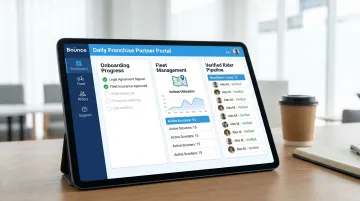
Bounce Daily's franchise model is built for operators who want to focus on ownership and returns. Onboarding is digital with minimal documentation, and franchise partners receive a consistent pipeline of verified gig workers ready to rent. The company handles vehicle maintenance, tracking, and uptime management — and supplies marketing creatives and rider leads so you're not starting from scratch.
Step 3 – Understand Your Startup Costs and Plan Your Finances
Key cost heads:
- Fleet acquisition: Electric scooters (purchased or financed)
- Registration and insurance: Per vehicle (commercial insurance typically ₹3,500–6,000 per vehicle per annum)
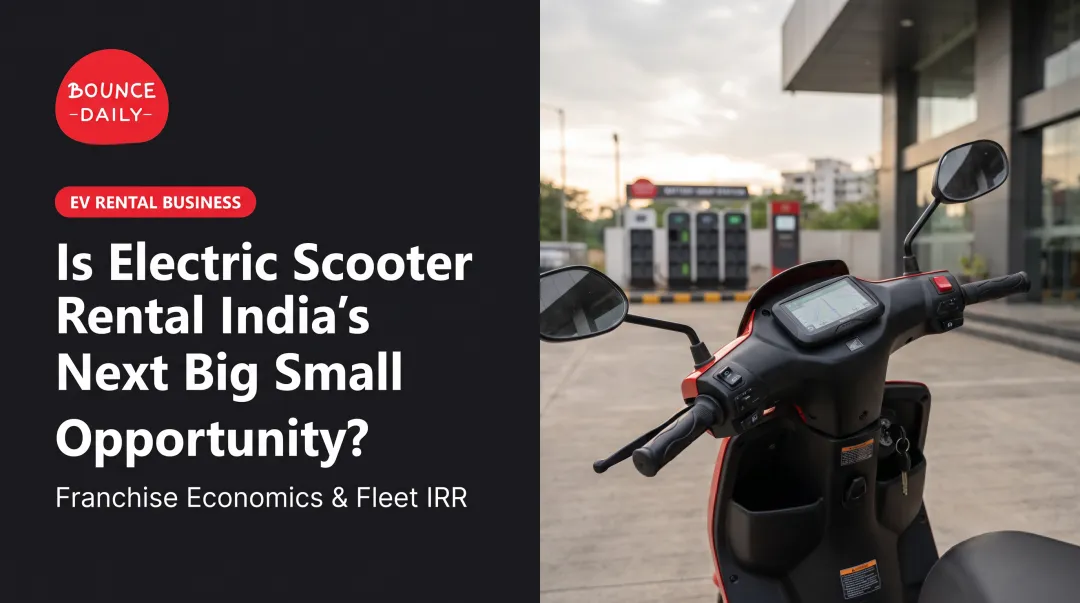
- Operational costs: Charging infrastructure or battery swap stations
- Marketing/onboarding costs: If going independent
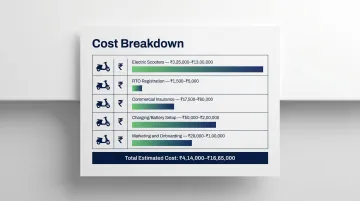
Realistic cost range for starting with 5–15 scooters:
| Item | Cost (₹) |
|---|---|
| Electric scooters (5–10 units at ₹65,000–1,30,000 each) | ₹3,25,000 – ₹13,00,000 |
| RTO registration (₹300–500 per vehicle) | ₹1,500 – ₹5,000 |
| Commercial insurance (₹3,500–6,000 per vehicle) | ₹17,500 – ₹60,000 |
| Charging/battery swap setup | ₹50,000 – ₹2,00,000 |
| Marketing and onboarding | ₹20,000 – ₹1,00,000 |
| Total initial investment | ₹4,14,000 – ₹16,65,000 |
Estimated monthly running costs:
- Electricity/battery costs: ₹5,000–15,000
- Maintenance: ₹3,000–8,000
- Staff (if hired): ₹15,000–30,000
- Miscellaneous: ₹5,000–10,000
Typical daily rental income per scooter: ₹300–800 per day, or ₹6,000–15,000 per month.
Common mistake: Budgeting for the fleet but not for the first 60–90 days of operating costs before rental income stabilises. That gap is where most new operators run into trouble.
For context, Bijliride's FOFO franchise model offers entry at ₹14–16 lakh for a 50-vehicle fleet, with breakeven projected within 13 months of stable operations.
Step 4 – Complete Legal Registration and Compliance
Business registration requirements:
- Choose structure: sole proprietorship, partnership, or private limited company
- GST registration mandatory if annual turnover exceeds ₹20 lakh (rental income attracts 18% GST)
- MSME/Udyam Registration
- Trade licence from local municipal corporation
EV-specific compliance:
High-speed scooters (above 25 km/h and 250W) used for rental must be registered as commercial vehicles with green plates. The Rent a Motor Cycle Scheme, 1997 sets out additional obligations for rental operators:
- Obtain a licence from the State Transport Authority
- Own a minimum of 5 motorcycles/scooters registered in the business name
- Maintain a fixed place of business with adequate parking
- Keep a register recording hirer details, licence number, and rental duration
Insurance requirements: All high-speed and commercial-use EVs must carry valid commercial insurance covering third-party liability and own damage.
Common mistake: Skipping vehicle insurance or operating without proper commercial registration creates liability exposure and can result in fleet seizures or fines.
Step 5 – Build Your Fleet and Set Up Operations
Define your initial fleet size and type:
- Low-speed variants (under 25 km/h, under 250W): driving licence assistance (available for a nominal ₹200-₹230 fee) at our hub - visit us or check our app to know more - broader renter eligibility
- High-speed variants (above 25 km/h): Require driving licence, suited for longer-distance delivery work
For example, Bounce Daily offers two variants: a Low Speed scooter (25 km/h top speed, 85 km range, swappable battery, with driving licence assistance (available for a nominal ₹200-₹230 fee) at our hub) and a High Speed scooter (55 km/h top speed, 70 km range, chargeable and swappable battery, licence required). Visit us or check our app to know more about driving licence assistance (available for a nominal ₹200-₹230 fee).
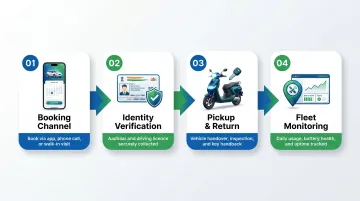
Set up the rental process in four steps:
- Booking channel — decide whether riders book via app, phone, or walk-in
- Identity verification — collect Aadhaar and driving licence at onboarding
- Pickup and return — define procedures for handover, inspection, and key handback
- Fleet monitoring — track daily usage, battery health, and vehicle uptime
Common mistake: Buying more scooters than you can manage early on. Starting with a fleet size you can fully utilise and maintain is more profitable than spreading thin across a larger idle fleet.
Step 6 – Attract Renters and Build a Reliable Customer Base
Identify your primary customer segment clearly:
- If targeting gig workers and delivery partners, work directly with delivery platforms or residential logistics hubs
- If targeting daily commuters, focus on proximity to transit points and corporate parks
Build credibility early:
- Transparent pricing with no hidden fees
- Clean, well-maintained scooters
- Simple booking process
- Prompt response to issues and breakdowns
Word of mouth among delivery communities spreads quickly — it is one of the most reliable acquisition channels in this segment. For franchise partners, Bounce Daily supplies marketing creatives and handles the initial rider pipeline, which takes pressure off early-stage acquisition.
Common mistake: Expecting digital marketing alone to drive volume in early days. For scooter rentals targeting gig workers, ground-level presence and direct community outreach tend to be far more effective in the first three months.
Frequently Asked Questions
How much to start a scooter business?
Starting a small EV scooter rental fleet in India typically requires ₹4–17 lakh, covering fleet cost (₹3–13 lakh for 5–10 scooters), registration, commercial insurance, and initial operations. A franchise model like Bounce Daily reduces upfront complexity with built-in support and a verified rider pipeline.
Is electric scooter business profitable?
Yes, with the right location and customer base. Profitability depends on daily fleet utilisation, rental pricing (₹300-800/day), and keeping operational costs low. Electric scooters have lower running costs (₹0.15-0.35 per km) than petrol bikes (₹2.00-2.50 per km), which supports better margins.
How profitable is a bike rental business?
Profitability varies by city, fleet size, and business model, with industry gross margins typically in the 25-30% range for well-managed operations. EV rentals tend to outperform petrol rentals on per-trip costs due to significantly lower fuel expenses.
How do rental scooters not get stolen?
Common approaches include GPS tracking, app-controlled digital locks, and ID verification at onboarding. In franchise models like Bounce Daily, renters are pre-verified delivery partners, which substantially reduces theft risk — and built-in IoT connectivity enables remote immobilisation if needed.
What is the profit margin of electric scooter dealers?
Scooter dealers earn one-time margins on sales; rental operators earn recurring daily rental income. Margins depend on utilisation rates and cost control, with franchise fleets typically recovering fixed costs within 13–18 months and reaching the 25–30% gross margin range.