This is why electric scooter rentals have emerged as a practical solution for gig workers, delivery partners, and daily commuters across India. But if you've searched online, you've likely encountered confusing information about Western per-minute models like Bird or Lime—models that don't reflect how rentals actually work in India.
This guide is written specifically for gig workers, delivery partners, and commuters in India who want to understand the complete rental process before signing up. You'll learn how the Indian daily/weekly rental model differs from Western rideshare apps, what documents you need, how costs compare to petrol bikes, and what to expect during your rental period.
Key Takeaways
- Electric scooter rentals in India use app-based registration with instant verification
- Choose daily or weekly rental packages — no per-minute charges
- Low-speed variants (under 25 km/h) require only Aadhaar; high-speed models need a driving licence
- Swappable batteries eliminate mid-shift charging downtime
- Rentals cost ₹4,000-6,000 less monthly than running a petrol bike
What Is an Electric Scooter Rental?
An electric scooter rental is a short-term arrangement where you pay a fixed fee to use an electric scooter for a defined period—daily, weekly, or monthly—without purchasing the vehicle outright.
The rental model addresses three core challenges for gig workers:
- No EMI burden or down payment to get started
- Repairs and upkeep handled entirely by the provider
- Electric charging replaces petrol costs, cutting daily expenses
You also skip the headaches of ownership — no depreciation, no resale hassle. And unlike ride-hailing apps like Uber or Ola, you keep the same scooter for your entire delivery shift rather than flagging a new vehicle for every trip.
Why Electric Scooter Rentals Are Growing in India
India's gig economy has grown rapidly. NITI Aayog projected the workforce would reach 23.5 million by FY30, and delivery platforms have grown from 1.08 million workers in FY22 to 1.37 million in FY24—a 12.3% annual growth rate that outpaces overall Indian employment.
But this growth comes with financial pressure. An NCAER study found 43% of delivery workers earn less than ₹500 per day after expenses, and average monthly wages dropped to ₹11,963 when adjusted for inflation.
Vehicle costs are the breaking point. For a petrol two-wheeler covering 80-100 km daily:
- Daily fuel alone costs ₹133-166 (at 62 kmpl and ₹102.92/litre)
- Monthly fuel reaches ₹3,990-4,980
- Add maintenance (₹1,500-3,000/month) and EMI payments (₹2,500-4,000/month if financed)
- Total monthly cost: ₹8,000-12,000
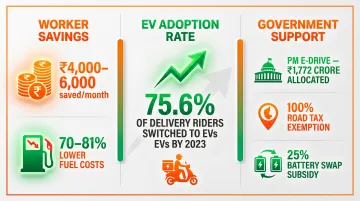
EV rentals eliminate most of these expenses. Prosus and CII research found electric two-wheelers deliver 57.5% lower 10-year total cost of ownership and 70-81% lower fuel costs compared to petrol bikes. Operators like Bounce Daily report riders save ₹4,000-6,000 monthly.
Government policy is compounding these savings:
- PM E-DRIVE allocated ₹1,772 crore for approximately 24.79 lakh e-2Ws through July 2026
- Karnataka offers 100% road tax exemption for electric two-wheelers
- Battery swap subsidies (25% capital subsidy, up to ₹3 lakh for 2W networks) lower infrastructure costs
These incentives are showing up in real adoption numbers. 75.6% of delivery riders surveyed by Borzo had already switched to EVs by 2023, and Zomato has integrated real-time battery swap station locators into their delivery partner app. For gig workers doing the math on monthly expenses, the case for renting electric is hard to argue with.
How Electric Scooter Rentals Work: The 4-Step Process
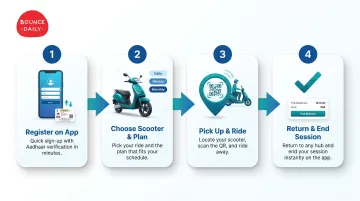
Electric scooter rentals run on a simple four-step loop: register, pick up a scooter, ride your shift, and return it. Everything happens through a mobile app — no paperwork, no waiting.
Step 1: Register on the App and Complete Verification
Download the provider's app (such as Bounce Daily, available on Google Play Store) and create an account with basic personal details.
Verification requirements:
- Aadhaar card for identity verification (standard across providers)
- Driving licence only if you're renting a high-speed model (above 25 km/h)
- In-app KYC — no physical visits, documents verified digitally
Bounce Daily uses instant digital verification — upload your Aadhaar and (if needed) driving licence through the app, and approval typically happens immediately. Once approved, you can browse available scooters and plans right away.
Step 2: Choose a Scooter and Select a Rental Plan
Providers offer multiple scooter variants based on speed and licensing requirements:
Low-speed models:
- 25 km/h top speed, 85 km range (Bounce Daily) (driving licence assistance (available for a nominal ₹200-₹230 fee) at our hub — visit us or check our app to know more)
High-speed models:
- 55 km/h top speed, 70 km range (Bounce Daily)
- Driving licence mandatory
- Chargeable and swappable battery options — better suited for longer routes
Once you've picked your scooter type, choose a plan that fits your work schedule:
- Daily: ₹230–285/day (Bounce Daily Bengaluru rates)
- Weekly: Discounted versus daily rates for regular riders
- Monthly: Lowest per-day cost for full-time delivery work
- Kilometre allowances vary — some plans cap at 200 km/day, others are unlimited
Pay digitally (UPI or card) upfront when you book. Some providers require a refundable security deposit, though policies vary by operator.
Step 3: Pick Up the Scooter and Start Riding
Use the app to locate the nearest hub or designated pickup point. The app shows mapped locations of available scooters.
Before you ride, check:
- Battery level (confirm sufficient charge for your route)
- Brakes (test front and rear function)
- Tyres (inspect for visible damage or low pressure)
- Body condition (document any scratches or damage through the app)
Report any pre-existing damage before you leave — it protects you from liability. Take photos through the app or contact support right away if the app doesn't have that feature.
Unlocking the scooter:
- Complete payment in the app
- Scan the QR code on the scooter or tap the unlock button
- Your rental period starts the moment it unlocks
Step 4: Return the Scooter and End the Rental
At the end of your shift or rental period, return the scooter to the designated drop-off point (typically the same hub where you picked it up, though policies vary by provider).
Return process:
- Park the scooter in the designated bay
- End the session in the app
- The app generates a summary: distance covered, rental duration, and any applicable charges
Watch out for these additional charges:
- Exceeding your kilometre limit (per-km excess fees apply)
- Late returns (hourly penalties kick in after the rental period ends)
- Damage beyond normal wear and tear
Battery handling at return:
- Swappable battery: Exchange the discharged battery at the hub — takes 2–5 minutes and the next rider gets a fully charged scooter
- Chargeable battery: Drop the scooter off and the provider's team handles overnight recharging## What You Need to Know Before Renting in India
Document Requirements
Indian electric scooter regulations depend on speed and motor power. Gazette Notification GSR 1112(E) establishes the Low-Speed Electric Vehicle (LSEV) classification:
Low-speed EVs (motor under 250W, top speed ≤25 km/h):
driving licence assistance (available for a nominal ₹200-₹230 fee) at our hub — visit us or check our app to know more
No vehicle registration needed
Insurance recommended but not mandatory
Only Aadhaar card required for rental
High-speed EVs (above 250W or 25 km/h):
- Valid driving licence required (MCWOG or LMV category)
- Vehicle registration mandatory (handled by rental provider)
- Third-party insurance mandatory (covered by provider)
- Helmet compliance under Section 129 of Motor Vehicles Act (₹1,000 fine + 3-month licence suspension for violations)
Most delivery-grade rental scooters exceed LSEV thresholds—so assume you'll need a driving licence.
Cost Expectations
Rental pricing in Bengaluru (indicative):
| Provider | Daily Rate | Plan Structure |
|---|---|---|
| Bounce Daily | ₹230-285 | 3 days to 1 month |
| Zypp Electric | Varies | Daily/weekly/monthly |
| Bijliride | From ₹399 | Daily rentals via franchise hubs |
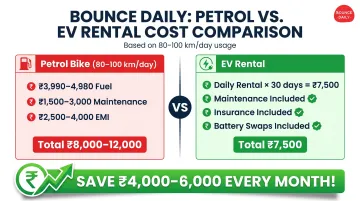
Petrol bike comparison for 80-100 km/day:
- Petrol cost: ₹133-166/day (₹3,990-4,980/month)
- Maintenance: ₹1,500-3,000/month
- EMI (if financed): ₹2,500-4,000/month
- Total: ₹8,000-12,000/month
EV rental cost (₹250/day × 30 days): ₹7,500/month. That figure includes maintenance, insurance, and battery swaps. Against total petrol ownership costs, you save ₹4,000-6,000 every month.
Once you've budgeted for the rental, the rules of the road are equally straightforward.
Riding Rules in India
- Electric scooters must stay on public roads within their speed classification
- Low-speed variants (under 25 km/h) are restricted from highways
- High-speed registered scooters can use highways subject to speed limits
- Helmets mandatory for speeds above 25 km/h (Section 129, MVA 1988)
- Follow all standard traffic rules (signals, lane discipline, parking regulations)
Battery Management Mid-Shift
For swappable battery models:
- Battery swap takes 2-5 minutes at designated stations
- Major swap networks include Battery Smart (1,000 stations across 30 cities) and SUN Mobility (900+ stations nationwide)
- Locate nearest swap station via in-app map
- Zomato and Swiggy have integrated swap locators directly into delivery partner apps
For chargeable models:
- Plan your shift around battery range
- If charge runs low, return early or contact support
- Charging takes 4-6 hours, making mid-shift top-ups impractical
Rider Responsibilities
You're responsible for:
- Complying with traffic laws
- Wearing a helmet (mandatory for high-speed variants)
- Returning the scooter on time to the designated hub
- Reporting damage immediately through the app
- Ensuring no unauthorized riders use the scooter during your rental
Penalties may include:
- Deposit deductions for unreported damage
- Per-kilometre excess charges if you exceed plan limits
- Late return fees (hourly rates)
- Liability for traffic fines incurred during your rental
Common Misconceptions About Electric Scooter Rentals
"It Works Like Booking an Ola or Uber"
Ride-hailing services send a driver to you. Electric scooter rentals work the other way around: you travel to the hub, collect the scooter yourself, handle battery swaps during your shift, and return the vehicle at the end of the day. You're both driver and fleet manager for the duration of your rental.
"All Electric Scooters Have the Same DL Rules"
Only low-speed variants (under 250W motor, capped at 25 km/h) fall outside the standard licence requirement under GSR 1112(E) — driving licence assistance (available for a nominal ₹200-₹230 fee) is available at our hub - visit us or check our app to know more. Most rental scooters built for delivery work exceed those limits. The Bounce Daily high-speed variant, for example, tops out at 55 km/h and requires a valid driving licence. Check the speed classification of any variant before you book.
Per-Minute Apps Don't Work for Full-Shift Delivery
Western micromobility apps like Bird or Lime charge per minute for short city trips, typically under 5 km. That model doesn't translate to gig work, where riders need a vehicle for 8-12 hours straight.
The cost difference makes this clear:
| Model | Cost for a Full Shift |
|---|---|
| Per-minute pricing | ₹500–1,000 |
| Bounce Daily plan | ₹230–285 |
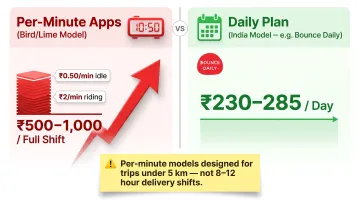
Daily and weekly plans are built around the reality of commercial use — not the occasional short trip.
Frequently Asked Questions
How does e-scooter rental work?
Download the provider's app, register with your Aadhaar (and driving licence if required), select a rental plan, pick up the scooter from a designated hub, and return it at the end of your rental period. Payment is handled digitally through the app.
What do you need to rent a scooter in India?
You need a government-issued photo ID (Aadhaar card), a smartphone to access the rental app, and a valid driving licence if renting a high-speed variant (above 25 km/h). Some providers also require a refundable security deposit.
What are the rules for scooters in India?
Electric scooters above 25 km/h require registration, insurance, and a valid driving licence under Indian motor vehicle law — helmets are mandatory for these variants. Low-speed scooters (under 25 km/h and 250W motor) are exempt from licence and registration requirements.
What does 200 km per rental mean?
Some rental plans include a fixed kilometre allowance — for example, 200 km per day or per rental cycle. If you exceed this limit, you'll be charged per additional kilometre. Estimate your daily route distance before choosing a plan.
Is a driving licence required to rent an electric scooter in India?
It depends on the scooter's speed. Low-speed electric vehicles (under 25 km/h and 250W motor) are exempt from licence requirements in India. Faster models require a valid driving licence. Always check the variant specifications before booking.
Can I use the rental scooter for food delivery or e-commerce work?
Yes. Bounce Daily scooters are specifically designed for gig workers on platforms like Swiggy, Zomato, and e-commerce delivery networks. Both the High Speed and Low Speed variants handle daily delivery routes, with ranges of 55–85 km per charge and swappable batteries to keep you running through long shifts.
Ready to ride? Download the Bounce Daily app, upload your Aadhaar, and pick up a scooter from your nearest hub — same-day onboarding, no upfront ownership costs.